


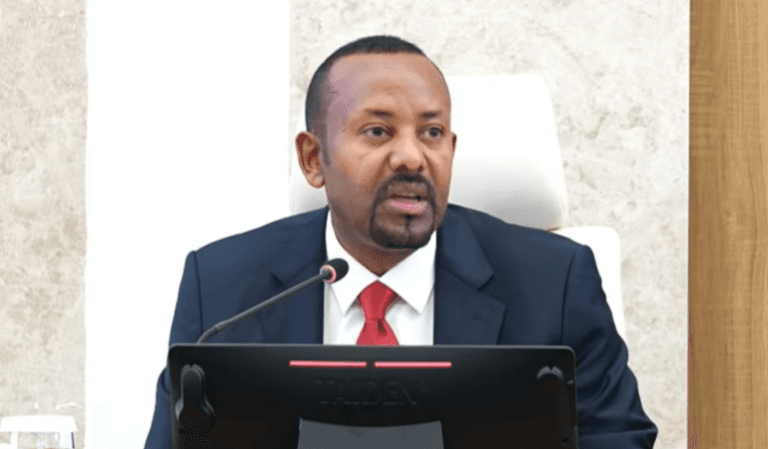
Prime Minister Abiy Ahmed (PhD) told the House of Peoples’ Representatives today that civil works on the Koysha Hydroelectric Dam will be finished within one year, and that all electromechanical work will be completed within the next one and a half to two years.
The Prime Minister made the remarks during his appearance before parliament, where he presented the federal government’s performance for the first quarter of the 2026/27 Ethiopian fiscal year and responded to lawmakers’ questions on key national issues. The session was part of the 4th regular session of the 1st year of the 7th parliamentary term.
Where the project stands
The Prime Minister’s timeline comes shortly after the latest official progress update. Earlier this month, Ethiopian Electric Power (EEP) reported that construction had reached 78.36 percent completion, up from around 77 percent reported in August. Cumulative roller-compacted concrete placement has reached 82.29 percent of the total requirement, and the dam’s left wing has reached 145 metres in height, while other sections average 138 metres against a planned final height of 201.5 metres.
On the electromechanical side, EEP said procurement, manufacturing, transportation, assembly and installation activities for the project’s six turbines and related water conveyance infrastructure are proceeding according to schedule. The equipment is being manufactured at multiple factories to keep construction on schedule.
The PM’s statement broadly aligns with EEP’s own schedule. The utility’s revised implementation timetable envisages completing the main dam construction in 2027, beginning electricity generation in 2028 and reaching full operation in 2029. The first turbine is targeted for October 2028.
A strategic power asset
Located on the Omo River, Koysha is Ethiopia’s second-largest hydropower project after the Grand Ethiopian Renaissance Dam (GERD) and forms part of the Omo-Gibe cascade. Once finished, the dam is designed to generate 1,800 megawatts, and it is expected to produce approximately 6,460 gigawatt-hours of electricity annually, providing additional capacity for domestic consumption and regional exports. The roller-compacted concrete gravity dam will create a reservoir of roughly 9 billion cubic metres covering about 200 square kilometres.


Comments