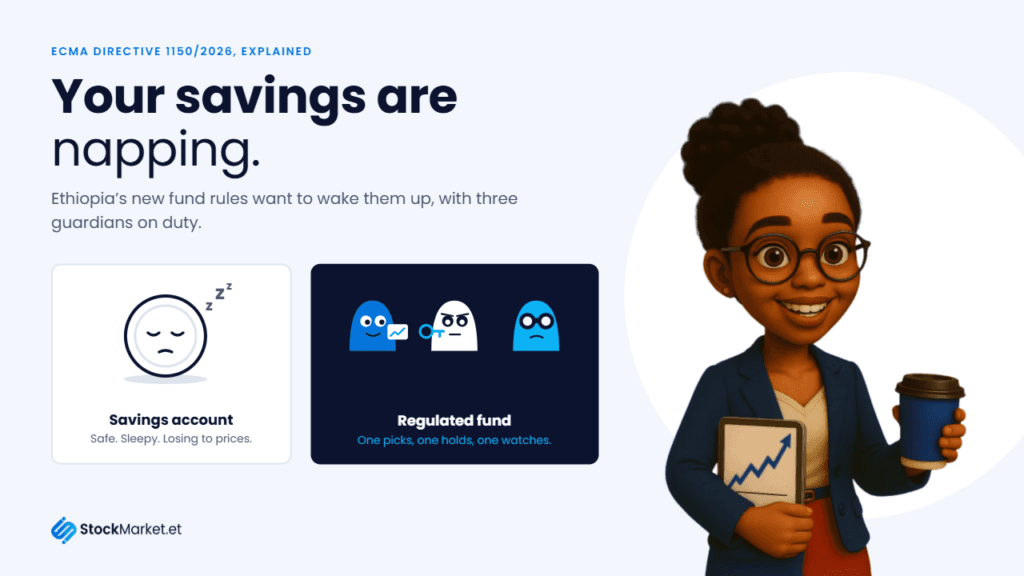
1. Your savings, sitting still You put a little money aside every month. It goes into a savings account, and there it sits. Prices climb faster than your interest does, so each year your savings quietly buy a little less. You have heard about the new stock exchange in Addis Ababa, but which company would
Part one looked at how Ethiopia’s new money system is built. This part looks at time. The system works, but slowly, and almost everyone in the economy wants results now. Imagine you need 10,000 birr today, but you will only have it next year. Someone lends it to you, and a year later you pay
The Ethiopian Securities Exchange (ESX) recorded ETB 510.05 million in equity turnover for the week of September 28 to October 2, 2026, across 525 trades and 215,325 shares in its seven listed securities. The half-billion-birr total is the headline. Underneath it, the week was mostly the story of one stock trading heavily and six trading
Walk into a mini shop in Addis Ababa and look at the sizes on the shelf. Sugar by the quarter kilo. Quarter kilos of onions. One bread roll. Charcoal by the tin. All of those things exist in bigger, cheaper packs a few kilometres away. What the mini shop is really selling is the right
Ethiopia’s interbank money market traded 191.3 billion birr in August, but the number that matters is 13.000, the rate banks accepted for two straight weeks before a $500 million central bank dollar sale changed the price of cash. For the first two weeks of August, the weighted average rate in Ethiopia’s local currency interbank money
Ethiopia’s headline inflation rate for July 2026 was 15.3%, up from 11.7% in April and 9.4% in March, according to the Ethiopian Statistical Service (ESS). Food inflation alone reached 15% year on year. That number is real, and it is already painful. But here is the uncomfortable question: does 15.3% actually capture everything you are
Somewhere along the way, Ethiopia’s stalled job market became a story about laziness. It’s a familiar narrative, usually aimed at the young and the unemployed. And repeated so often it started to sound intuitive, but does Ethiopia’s labour market actually support it? In this article we’re finding out. The theory goes something like this: the
Inside Ethiopia’s internship machine, where a generation works for nothing, learns even less, and the bill lands on everyone. The minibus from Ayat to Bole costs more than 30 birr each way. Hiwot, a composite of the many graduates who tell some version of this story, pays it twice a day, five days a week,
For the past five decades, banks have been a one-stop shop for Ethiopian businesses to get financing. Before this, Ethiopia had a short-lived stock market in the 1960s and early 1970s called the Share Dealing Group, which operated under the imperial regime. Following the Derg regime, the financial system that followed consolidated almost entirely around
Ethiopia has dismantled the last of its emergency controls and handed the economy to a market-based framework held together by interlocking parts. Every piece now depends on every other piece and the National Bank of Ethiopia must keep all of them balanced at once, in high wind. In August 1974, Philippe Petit stepped onto a
Ethio Telecom shares are trading at 900 birr on Monday, up 5.63% on the day and three times the 300 birr price at which the government sold them to the public less than two years ago. For a stock that has traded on the Ethiopian Securities Exchange (ESX) for barely six weeks, TELE has already
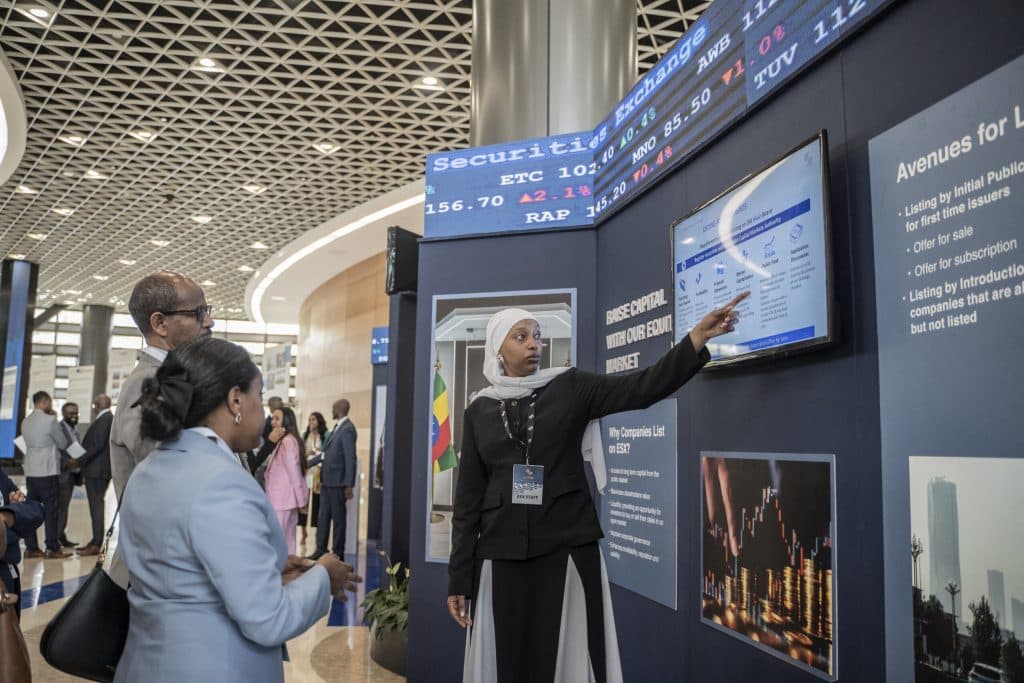
On a Friday morning in January 2025, Prime Minister Abiy Ahmed walked onto a trading floor in Addis Ababa and rang a bell. There were no traders shouting on the floor. There was no opening tick of a long-running ticker. There was, in fact, only one company listed, Wegagen Bank and the screens behind him


 Capital Market