


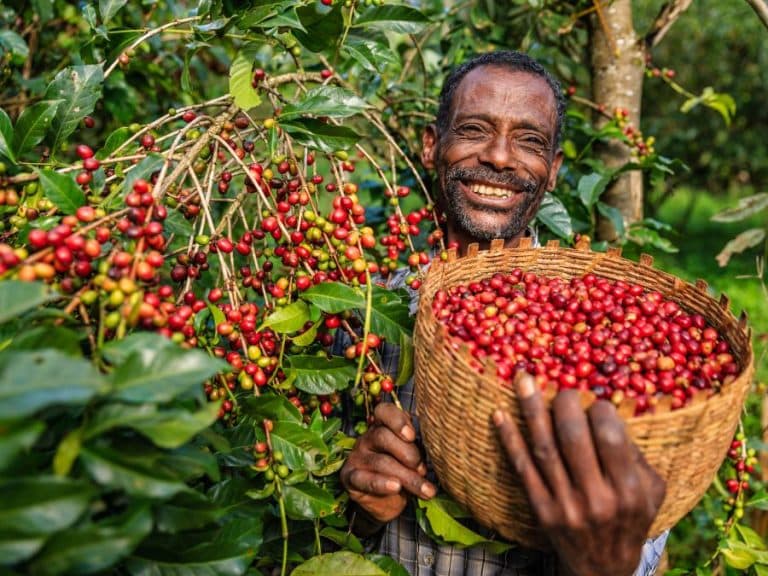
Global coffee prices declined moderately on Wednesday, November 25, 2026, as expectations of improved supply from Vietnam and Brazil weighed on futures markets. But according to a market brief by Sahle-Mariam Gebre-Medhin, the dip should not be read as the start of a long-term surplus cycle. Instead, a growing shortage of Arabica in Central America and Brazil could hand Ethiopian exporters a significant opportunity, if they focus on quality.
| Contract | Price | Change |
| Arabica (ICE New York), Dec 2026 | 268.55 US¢/lb | −5.80¢ |
| Arabica (ICE New York), Mar 2027 | 262.60 US¢/lb | n/a |
| Robusta (ICE London), Jan 2027 | $2,813/t | −$41 |
| Robusta (ICE London), Mar 2027 | $2,788/t | −$40 |
| Robusta (ICE London), May 2027 | $2,770/t | −$46 |
What is moving the market
- Brazil: Arabica production may decline due to the biennial (two-year) production cycle and irregular flowering, while the outlook for Conilon Robusta remains strong. Brazilian shipments are helping fill supply gaps and gradually rebuild ICE inventories, which had been low.
- Vietnam: As the country enters its peak harvest season, rising Robusta supply has put downward pressure on prices.
- Central America: 2026/27 production is projected to fall by 9.9% due to low rainfall, high temperatures and the threat of El Niño. Price differentials for washed Arabica remain high, reflecting limited supply.
- The dollar and speculators: Stronger demand for the US dollar and an expansion of short positions by speculative funds have added further downward pressure.
- El Niño: There is a greater than 79% probability that El Niño will remain strong or very strong between January and March 2027, a risk to supply for the 2026/27 and 2027/28 crop years.
An opening for Ethiopian coffee
With Ethiopia’s new crop harvest underway, the country is well positioned to fill the gap left by Central America, a major supplier of washed Arabica. Demand is likely for both washed and natural coffees, particularly from Yirgacheffe, Guji, Sidama, Harar and Limu.
Even as the New York benchmark has fallen, international roasters are paying a significant premium, or “differential”, above the futures price to secure high-quality Arabica. That gives Ethiopian exporters greater leverage to negotiate better prices.
Lower Arabica output in Brazil is also expected to lift demand for Ethiopian natural (sun-dried) Arabica, while the El Niño risk may prompt buyers to purchase Ethiopia’s new crop early to secure supply and rebuild inventories.
Reasons for caution
The brief warns exporters not to dismiss the recent price fall. Higher Robusta output in Vietnam, a stronger dollar and speculative selling are pushing Arabica prices down in New York. As Robusta becomes cheaper and more plentiful, some international companies may cut costs by blending in more Robusta and less Arabica.
For that reason, the brief advises Ethiopian exporters to shift away from commercial-grade coffee toward specialty and high-grade (Grade 1 and 2) beans, and to maintain quality so that farmers also share in the rewards.
Buyers judge more than price: they rigorously assess quality, origin and consistency across lots. Buyers who turn to Ethiopia in place of Central American origins may be hard to keep as long-term clients if suppliers cannot deliver coffee that consistently meets their standards. Volatile futures markets and a strong dollar may also push buyers toward short-term spot purchases rather than long-term contracts, so exporters are urged to carefully align domestic procurement costs with international selling prices.
The outlook
The brief concludes that the current price decline reflects temporary pressure from financial markets and Robusta supply dynamics, not an oversupply of Arabica. Its message to exporters, farmers, suppliers and the wider coffee community: don’t be unsettled by short-term price drops. By focusing on quality and timely delivery, Ethiopia can turn the Arabica shortages in Central America and Brazil into a golden market opportunity.



Comments