


Wegagen Bank S.C., the first company to list on the Ethiopian Securities Exchange (ESX), reported a 13.6 percent rise in net profit for the 2025/26 financial year. A sharp expansion in its capital base, however, pushed per-share earnings down. For shareholders in one of the market’s reference stocks, that gap now matters most.
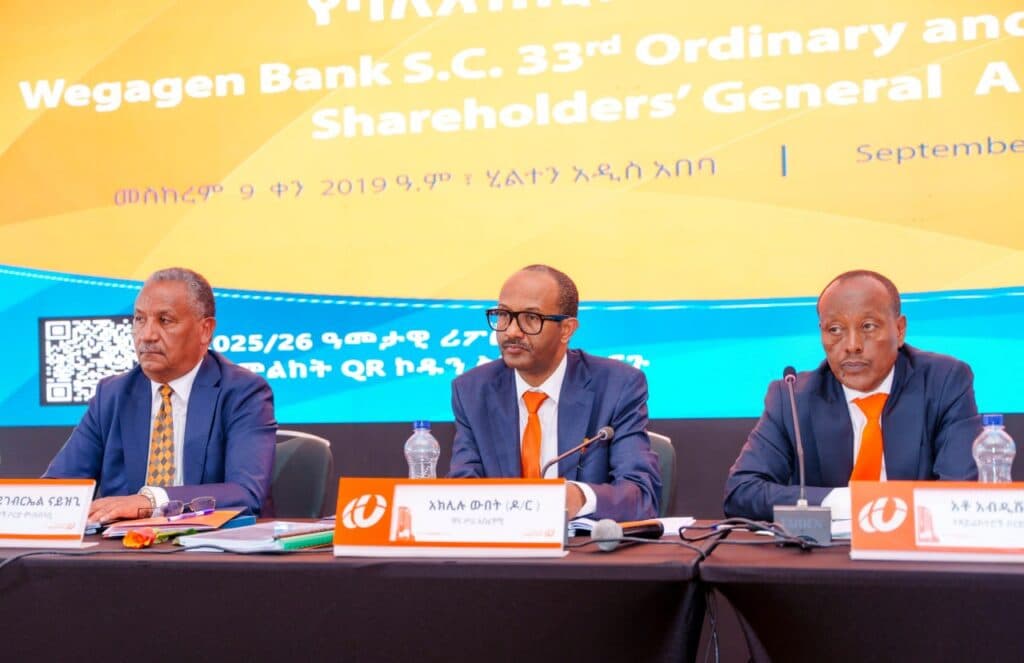
The bank presented its results at its 33rd Ordinary and 16th Extraordinary Shareholders’ General Meeting at the Hilton Hotel in Addis Ababa on Saturday. Net profit reached 3.15 billion birr, up from 2.78 billion birr a year earlier. Profit before tax rose 12 percent to 4.3 billion birr after an income tax expense of 1.15 billion birr, which puts the effective tax rate at about 27 percent.
Total assets rose 32 percent to 111.3 billion birr as of June 30, 2026. That is more than double the pace of profit growth.
Growth spread over a bigger base
The main story for investors is the capital base. Paid-up capital rose 44 percent to 10.09 billion birr, from 7.0 billion birr, and total equity climbed 35 percent to 17.3 billion birr. The number of shareholders grew to 15,598.
Because paid-up capital grew more than three times faster than profit, basic and diluted earnings per share fell to 34.40 percent from 46.10 percent. Ethiopian banks conventionally express EPS as a percentage of par value. The drop is about 25 percent year on year, so each unit of shareholder capital earned noticeably less than it did in 2024/25.
Part of the decline is a timing effect. Capital raised during the year only partly contributed to earnings before the books closed in June. The full-year returns on that capital will not show until 2026/27. Still, the incremental numbers are modest: net profit rose by about 370 million birr against roughly 3.1 billion birr of new paid-up capital.
The bank’s headline return ratios remain solid. Return on average equity was 20.9 percent and return on average assets was 3.2 percent, both strong by regional standards. The open question is whether Wegagen can hold equity returns near that level as its capital base keeps growing.
Profit growth cools after a 73 percent year
The earnings slowdown is clear against Wegagen’s recent track record. Net profit had jumped 73 percent in 2024/25, from 1.60 billion birr the year before. The 13.6 percent gain this year is a marked deceleration.
Costs explain much of it. Total income rose 21 percent to 16.4 billion birr, but total expenses grew 25 percent to 12.1 billion birr. That widened the cost-to-income ratio to roughly 74 percent from about 72 percent a year earlier. Interest expense accounted for 38.3 percent of total costs and staff salaries and benefits for 36.5 percent.
Staff costs are rising with the network. Wegagen now has 458 branches, 398 ATMs, 651 point-of-sale terminals, 7,445 agents and a workforce of 5,555. Interest expense is rising with the deposit base. Deposits grew 23 percent to 81.3 billion birr in a liberalised rate environment where banks compete harder for funds.
Lending stays aggressive
Gross loans and advances grew 26 percent to 67.3 billion birr. Lending outpaced deposit growth and lifted the loan-to-deposit ratio to about 83 percent from roughly 81 percent. This came even though monetary policy focused on tight liquidity management and inflation control through the year.
The loan book is concentrated in trade. Import financing makes up 22.2 percent of loans and export financing 18.2 percent, so trade finance together accounts for about 40 percent. Construction follows at 19 percent, domestic trade and services at 15 percent, manufacturing at 13.4 percent and transport at 8.2 percent. Digital lending makes up the remaining 2 percent.
That trade tilt ties Wegagen’s fortunes closely to external conditions. The Middle East conflict and the disruption to shipping through the Strait of Hormuz fed into fuel supplies and domestic inflation later in the year. The results presentation did not include asset-quality figures such as non-performing loan ratios or provisioning levels. These are the numbers investors will want to see in the full audited statements.
FX becomes a revenue engine
Foreign-currency generation was a clear bright spot. It rose 34 percent to $366 million, from about $273 million, driven by export proceeds, FX market dealings and remittances.
Since Ethiopia moved to a market-based exchange rate in July 2024, FX mobilisation has changed from an allocation exercise into a source of trading and fee income. It also brings in customers, because importers go where the dollars are. For equity investors, Wegagen’s ability to keep growing FX inflows is one of the more important indicators of franchise strength under the new regime.
Digital reach is wide, but still small in the loan book
The Efoyta digital lending platform disbursed more than 9 billion birr to 430,890 borrowers, mainly women, youth and MSMEs. That works out to an average of roughly 21,000 birr per borrower. Mobile banking subscribers rose 21 percent to over 4.08 million. Internet banking users jumped 86 percent to 41,494, and cardholders grew 45 percent to 537,651.
Digital lending still accounts for only 2 percent of the loan portfolio. It is a strategic customer-acquisition channel rather than a meaningful earnings contributor so far. Chief Executive Aklilu Wubet (PhD) said the bank’s new five-year strategy prioritises investment in systems, people, partnerships and risk management. Those investments will add to near-term costs before they reduce them.
What it means for ESX investors
Over five years, Wegagen’s growth has been substantial. Total assets rose from 43.1 billion birr in 2021/22 to 111.3 billion birr, a compound annual rate of about 27 percent. Profit before tax grew more than sevenfold, from 572 million birr to 4.3 billion birr. Paid-up capital nearly tripled.
As the ESX’s first listing, Wegagen is increasingly judged on the metrics public-market investors care about: earnings per share, return on equity and how efficiently new capital is deployed. On those measures, 2025/26 was a year of building rather than harvesting.
The bank now has a larger funding base, a thicker capital cushion under the revised risk-based capital adequacy framework, and a growing FX franchise. The test for 2026/27 is whether profit can grow faster than capital, lifting per-share earnings back toward prior levels. The alternative is that rising funding and staff costs keep eroding returns as competition intensifies across Ethiopia’s liberalising banking sector.


Comments