


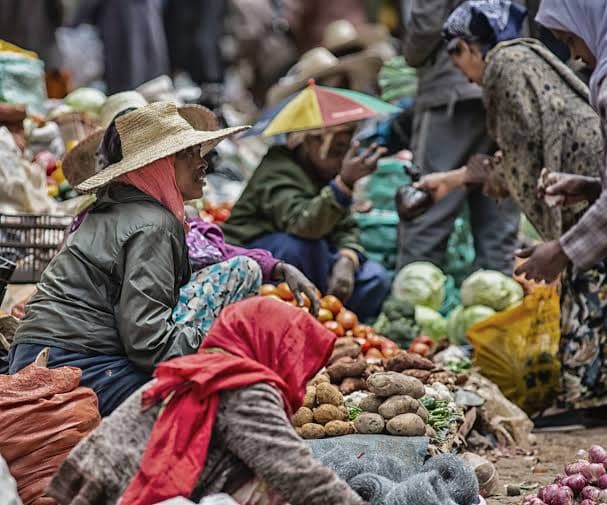
Walk into a mini shop in Addis Ababa and look at the sizes on the shelf. Sugar by the quarter kilo. Quarter kilos of onions. One bread roll. Charcoal by the tin. All of those things exist in bigger, cheaper packs a few kilometres away. What the mini shop is really selling is the right to buy a very small amount, today, and sometimes on a tab.
That right has a price. And it is paid almost entirely by people who have no other way to buy.
Economists have a name for this: the poverty premium. It means a poor household pays more for the same thing a richer household buys. This article is not about how many Ethiopians are poor. It is about something narrower and stranger, the fact that a birr buys less when you have fewer of them.
The setting is hard. Inflation had briefly fallen into single digits in December 2025, then climbed back to 15.1 percent by August 2026, according to the Ethiopian Statistical Service. Over that year, food and non-alcoholic drinks rose 14.9 percent. Sugar, honey and chocolate rose 38.3 percent. Meat rose 22.6 percent. Cooking oil and butter rose 18.8 percent. Food makes up about 54 percent of the official price basket, and far more than that of what a poor family actually spends.
But that 15.1 percent is measured at a standard price for a standard quantity. Poor households almost never buy at that price. They buy at the edge of the market, in tiny amounts, one day at a time. The edge has its own charges.
Buying small costs more
Teff shows this clearly, partly because you cannot buy it in a mini shop at all. It is sold at grain markets, usually by the quintal, 100 kilograms. In February 2026 a quintal cost around 11,750 birr, according to the USDA’s Foreign Agricultural Service. It is still the most expensive staple in the country, more than twice the price of maize.
A family that can put that much cash down at once takes the grain to a mill and comes home with flour that lasts for weeks. To do that, you need two things at the same time: the money, and a mitad with the power to run it.
A family that has neither buys injera instead. One piece at a time, every day, from a neighbour who bakes or a vendor on the street. That price already contains the grain, the milling, the fermenting, the electricity and the baker’s labour. They are paying retail at every single meal.
The household described here is a composite, built from published price and survey data. The prices are real; the person is an illustration.
Cooking fuel works the same way. Ethiopia’s electricity tariff is one of the most heavily subsidised in the world. A market study prepared for the Modern Energy Cooking Services programme found that cooking on grid electricity with efficient appliances costs about six times less than cooking on charcoal — and about five times less even with inefficient appliances. Yet only around 4 percent of households use electricity as their main cooking fuel.
The reason is the appliance, not the fuel. A mitad is a large one-time cost. A tin of charcoal is a small cost today. Charcoal is much more expensive per meal and much cheaper per purchase, and if you have no savings, the second number is the one that decides. A study of Jimma town found that more than 80 percent of households had a grid connection, and more than 85 percent still cooked on firewood and charcoal.
The same meal, two prices
Relative cost of cooking, using efficient appliances
Source: MECS/EnDev, Ethiopia eCooking Market Assessment. Only about 4% of Ethiopian households use electricity as their main cooking fuel.
Not being able to wait costs more
Money goes further if you can choose when to spend it. Poor households cannot choose.
Grain prices in Ethiopia move in a yearly cycle. The USDA’s latest grain report notes that most cereals get cheaper during the main meher harvest from October to December, then rise through the lean season from July to September. A controlled study in a major maize-growing area of western Ethiopia measured the gap: lean-season prices ran up to 36 percent above prices just after harvest. Across sub-Saharan Africa the swing is 25 to 40 percent. In the United States it is about 5 percent.
On paper, that is free money. Store the grain and the calendar pays you. In practice, small farmers do the opposite. They sell at harvest when prices are lowest, then buy the same grain back months later when prices are highest. Debts and school fees fall due at harvest time, and there is nowhere safe to keep a crop for six months. Research on rural Ethiopian households keeps finding the same thing: storage costs and lack of cash push farmers to sell everything straight away.
The poor do not pay more because they choose badly. They pay more because the good choice needs cash they do not have and storage they cannot build.
In the city it is quieter but constant. A salaried household buys when there is a discount, buys the bigger pack, and waits out a price spike. A household earning daily has nothing to wait with. It buys at today’s price, whatever today’s price happens to be, and then does it again tomorrow.
The price of not being able to wait
How much grain prices rise between harvest and the lean season
Sources: randomised trial on grain storage in western Ethiopia (CGIAR); Berkeley research summarised by VoxDev.
Borrowing costs more
Banking has genuinely spread. The World Bank's 2025 Global Findex found 49 percent of Ethiopian adults holding an account in 2024, up from 22 percent ten years earlier. But having an account and using one are different things. Only about 4 percent of adults borrowed from a formal institution. Roughly a fifth used digital payments. Men are 15 percentage points more likely to hold an account than women, a gap that has not closed. And only 58 percent of Ethiopian adults own a mobile phone, against 81 percent across sub-Saharan Africa.
When formal credit does reach small borrowers, it is expensive. The National Bank of Ethiopia raised its policy rate to 16 percent in July 2026, its first change since the rate was introduced at 15 percent in 2024. Commercial Bank of Ethiopia term loans run between roughly 14 and 16.5 percent. Microfinance borrowers face something else entirely: reporting by Birr Metrics found rates near 30 percent, with one microfinance chief executive describing paying 20 percent to attract deposits and lending at about 27 percent.
Collateral is the harder wall. Survey data compiled in an Ethiopian microfinance assessment put the collateral demanded at 296 percent of the loan amount, nearly three birr of security for every birr borrowed, against a sub-Saharan African average closer to 220 percent. If you already own three times what you want to borrow, you rarely need to borrow.
What it costs to borrow, and who can
Ethiopia, 2025–26
Sources: National Bank of Ethiopia; CBE rate revision, March 2025; Birr Metrics; Ethiopian Microfinance Assessment Report; World Bank Global Findex 2025.
Getting to work costs more
Cheap housing is at the edge of the city. Work is in the middle. Somebody has to pay for the distance between them, daily, in cash.
After the fuel price rise that took petrol to around 91 birr a litre, the Addis Ababa Transport Bureau revised the fare table. The shortest minibus trip went from 4.50 birr to 10 birr. The longest reached 65 birr. Two trips a day, six days a week, at the minimum fare, is roughly 500 birr a month — and trips from the edge of the city almost always need a transfer, which means paying twice.
Then there is what the fare table cannot control. Research on the city's minibus sector found that operators routinely split long routes into shorter pieces, so passengers pay two higher-band fares instead of one. Every driver interviewed admitted charging above the official rate, and 84 percent said they did it in the evening, as vehicles were leaving service. The way the fare bands are drawn is what makes splitting routes profitable.
Why buying in bulk is not an option
Three things a household needs at the same time to get the cheaper price
Cash now
Enough in hand for a quintal, a sack or a full tank — not just for today.
Somewhere to keep it
Space and equipment to hold what you bought until you use it.
The ability to wait
Room to skip a bad price and buy later, instead of buying whatever today costs.
Missing any one of the three puts a household back at the retail price, every time.
What would actually change this
If the premium comes mostly from having no cash and no storage, then the fixes are the ones that deal with cash and storage directly, not price rules.
The clearest evidence is about lending at the right moment. Work by economists at Berkeley on post-harvest loans found that farmers offered credit at harvest time stored about 25 percent more grain, sold it gradually through the lean season, and kept the price gain that would otherwise have gone to a trader. The loan did not change the price of anything. It changed who could afford to wait.
The city version is the same idea without the grain. A household that can hold two weeks of food buys at a different price from one holding two days. That capacity depends on cash, on storage, and on whether income arrives in usable lumps rather than daily dribbles. How often wages are paid, how safety-net transfers are designed, and whether digital accounts are actually usable all push on it. Findex shows where the slack is: accounts have more than doubled in a decade, while borrowing, digital payments and phone ownership have not kept up.
Some of it is simply infrastructure with a known cost. An efficient electric cooking appliance removes a large and permanent markup for a household that already has power, though only as far as the supply is reliable, which is exactly why so many connected households in Jimma still cook on charcoal. Enforcing the published transport fares is cheaper still, and would mean redesigning the fare bands that reward splitting routes.
None of this shows up in the inflation rate, and that is the point. Ethiopia pulled the consumer price index into single digits in December 2025 while the gap between what a poor household pays and what the index says it pays stayed roughly where it was. The index measures a price. The premium measures who can reach it.
Which brings us back to the mini shop, and the quarter kilo of sugar. The shopkeeper is not cheating anyone; the margin on a quarter kilo is thin and the hours are long. The customer is not careless. She is buying the smallest amount she can afford, which is the only sensible thing to do with the money she has, and paying a little extra for it, every time. That is not a statistic about poverty. It is an arrangement, and arrangements can be redesigned.

Comments