


In Ethiopia’s rapidly evolving fintech landscape, SantimPay has emerged as one of the standout
innovators reshaping how people transact and businesses operate. Founded with the vision to
simplify payments and drive financial inclusion, the company has grown from a small software
idea into a nationwide payment platform known for its seamless technology and user-friendly
solutions. At the helm of this journey is CEO Tinsaye, a young tech entrepreneur whose
forward-thinking approach and persistence helped SantimPay navigate regulatory uncertainty,
infrastructure gaps, and market skepticism to become a key player in Ethiopia’s digital finance
revolution.
StockMarket.et: Thank you, Tinsaye, for taking the time to speak with us. Let’s start from the
beginning — how did SantimPay come about? What problem were you trying to solve, and what
market gap did you identify?
Tinsaye: Before launching SantimPay, we were running a software development company
called “Zowi Tech”. One of the products we built was an e-commerce platform. However, most
online transactions at the time relied on cash on delivery; customers would order online and pay
only when the product was delivered. This process was cumbersome and inefficient.
While trying to grow our e-commerce business, we realized that the real challenge was the lack
of a reliable digital payment solution. That’s what inspired us to create SantimPay, to solve this
payment bottleneck. Interestingly, when we started developing the platform, there were no
regulations for fintech companies in Ethiopia. We actually began our work a year before the
official fintech directive was introduced. When the regulation was finally released, it validated
our efforts and gave us the momentum to move forward.
StockMarket.et: What makes SantimPay different from other fintech platforms in Ethiopia?
Tinsaye: What truly sets us apart is that SantimPay provides payment services for both
customers and merchants, but we do it with simplicity at the core. Technology should make life
easier, not more complicated.
Our goal is to add real value for users. When we tell a merchant or a customer to use our
product, we ask ourselves: Are we making their life simpler? For instance, look at QR payments.
In many places, you see multiple QR codes for different banks, that’s confusing for both
customers and merchants.
At SantimPay, we created a universal QR code that accepts payments from all banks, including
Telebirr. The funds then go directly into a single bank account of the merchant’s choice, avoiding
fragmentation across different accounts. This innovation simplifies reconciliation and helps
businesses manage their cash flow more efficiently.
StockMarket.et: We see SantimPay’s presence almost everywhere in the country. How did you
manage to achieve such wide market coverage?
Tinsaye: Our growth strategy has always been merchant-focused. Merchants are key drivers of
adoption in the payment ecosystem. If merchants use your product, customers naturally follow.
We go beyond onboarding, we actively train merchants on how to use our platform. This effort
isn’t limited to Addis Ababa; we’ve expanded across regions through multiple branch offices. By
working closely with merchants on the ground, we’ve been able to build strong market depth
and visibility.
StockMarket.et: Over the past three years, you must have faced several challenges. Can you
share some of the major ones?
Tinsaye: Definitely. One of the biggest challenges has been regulatory uncertainty. When we
started, fintech regulations were still evolving, which created a lot of grey areas. Fortunately, the
situation has improved significantly, the government is now giving strong attention to the digital
sector, which helps businesses like ours operate more effectively.
The second challenge is infrastructure. While connectivity in Addis Ababa is fairly reliable, many
areas outside the capital still face serious network issues.
The third challenge is partnerships with financial institutions. Some banks and institutions have
been reluctant to collaborate, often due to a limited understanding of the digital ecosystem and
its long-term potential.
Beyond these, there are broader national challenges: low digital literacy, political instability, and
regional conflicts. For example, we had operations in Mekelle before the war broke out, and
similar instability affected our activities in parts of the Amhara region.
StockMarket.et: You mentioned digital literacy as a challenge. Could you elaborate?
Tinsaye: Yes. We invest heavily in merchant training and continuous follow-up. However,
there’s a broader role that government institutions and major players like Telebirr should take in
promoting digital literacy. To their credit, they have made notable efforts in that regard.
StockMarket.et: How do you see Ethiopia’s fintech landscape now compared to when you
started three years ago?
Tinsaye: The transformation has been remarkable. Technology evolves rapidly, you can’t rely
on the same product for years. What used to take a decade to change can now happen within a
year.
In Ethiopia, the government’s policy shift has been a major catalyst. People are now more
aware of digital platforms and more willing to use them. The growth in digital awareness and
adoption has been tremendous compared to when we started.
StockMarket.et: What is your view on financial inclusion in our country?
Tinsaye: Financial inclusion means bringing everyone, regardless of background or device, into
the digital financial ecosystem. It starts with access to bank or mobile money accounts. For
those without smartphones, we use USSD services to ensure accessibility.
But inclusion goes beyond having an account. It’s also about access to financial services. For
example, many of us deposit our money in banks, but few of us get loans in return. With inflation
rising, depositors should at least have access to fair lending or interest rates that keep up with
inflation.
We’re seeing positive change, new microlending platforms like Milki and Alenta are expanding
access, and even airlines now offer “fly now, pay later” options. These are all signs that financial
inclusion is improving.
StockMarket.et: Let’s talk about FrankRemit. Did Ethiopia’s recent FX reforms inspire it?
Tinsaye: Not exactly. The idea existed long before the reform, the timing was simply a
coincidence. Many people abroad wanted to send money to Ethiopia but faced difficulties finding
reliable channels. FrankRemit was designed to solve that problem, and it’s showing great
progress so far.
StockMarket.et: What are some common misconceptions people have about Ethiopia’s fintech
ecosystem?
Tinsaye: There are quite a few. For example, some people used to avoid getting ATM cards,
believing it would make them spend more. Others think that unless they physically touch cash,
they haven’t really earned it.
When we introduced QR payments to merchants, some were hesitant, they preferred depositing
daily cash at the bank instead of trusting digital systems. Building that trust takes time. Financial
institutions can help by improving timely reconciliations and service reliability. Trust is key to
adoption.
StockMarket.et: Does SantimPay have any plans related to the upcoming Ethiopian Capital
Market?
Tinsaye: Absolutely. The capital market will be a major milestone for Ethiopia’s financial sector,
and we plan to be part of it. We’ve already begun some groundwork to ensure we’re ready to
participate when the time comes.
StockMarket.et: What should we expect next from SantimPay?
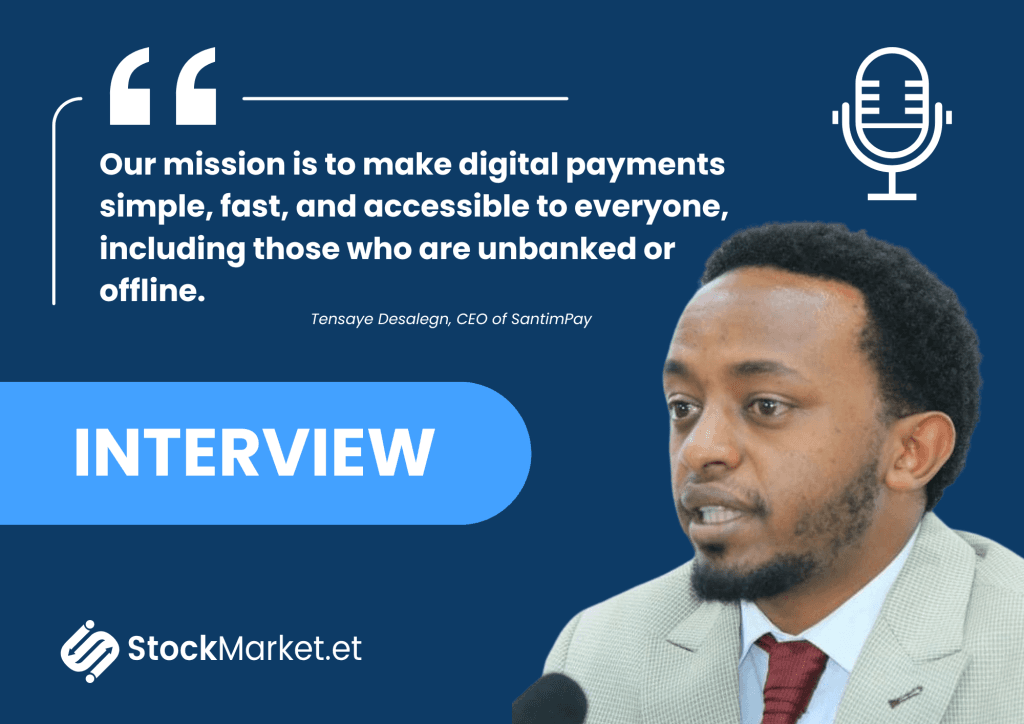
Tinsaye: Our mission is to make digital payments simple, fast, and accessible to everyone,
including those who are unbanked or offline. We’re working on introducing new technologies
and embracing the concept of neo banking, where customers can open and activate bank
accounts digitally, without visiting a branch.
We want to continue innovating and offering solutions that redefine how Ethiopians interact with
financial services. That’s our promise.
StockMarket.et: Finally, how is your expansion into Djibouti going?
Tinsaye: It’s going well! We’ve officially entered the Djibouti market and expect to begin
processing payments within a month. Our goal is to prove that Ethiopian companies have the
capability to operate successfully beyond our borders.
We see ourselves as part of Africa’s fintech story and we believe Africa’s challenges should be
solved by Africans. Djibouti is just the beginning; we plan to expand even further across the
continent.
StockMarket.et: Thank you, Tinsaye.
Tinsaye: Thank you for having me.


Comments