


Ethiopia’s capital market is still young.
The institutions are new. The regulations are evolving. The ecosystem is taking shape almost in real time. Yet amid this period of transformation, another story is unfolding, one that may prove just as important as the market’s infrastructure itself.
It is the emergence of a new generation of professionals determined to build careers in finance, investment, and capital markets.
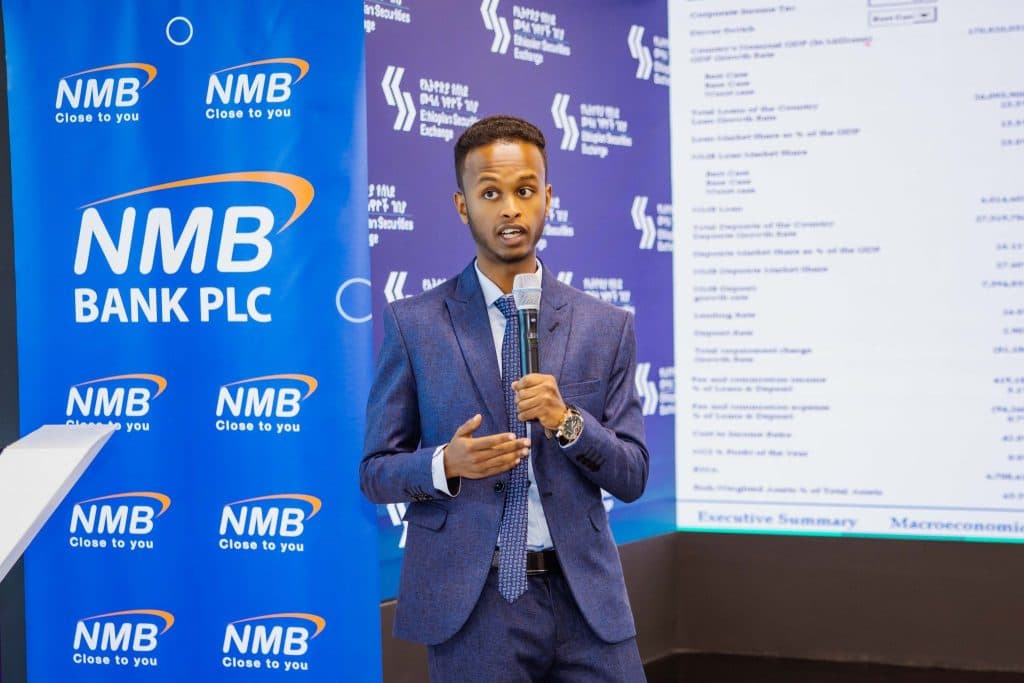
Among them is Kaleb Mekonnen.
Despite being at an early stage of his career, Kaleb’s professional journey has already taken him through some of the most influential institutions shaping Ethiopia’s financial landscape. He has worked with the Ethiopian Capital Market Authority (ECMA), CBE Capital, the Development Bank of Ethiopia, and transaction advisory teams in the private sector. Today, he serves as a Society Administrator for the CFA Institute in East Africa, contributing to efforts aimed at strengthening professional standards in the industry.
His story reflects something larger than individual achievement. It illustrates how Ethiopia’s emerging capital market is creating opportunities for ambitious young professionals willing to learn, adapt, and grow alongside the ecosystem itself.
A Curiosity That Became a Career
For Kaleb, the journey began long before the capital market became a national conversation.
A book he encountered during high school introduced him to finance. Later, discussions with university lecturers helped him understand how that interest could evolve into a career. But it was practical exposure through transaction advisory work that transformed curiosity into conviction.
“What drew me in was the flow of capital itself,” he says. “The way it moves like water, from surplus to deficit, from where there is too much to where it is needed.”
It is a perspective that goes beyond numbers and financial statements. For Kaleb, capital markets are ultimately about connecting resources with opportunities and enabling economic growth.
That fascination has remained at the center of his professional journey.
Learning in a Market That Is Being Built
One of the most striking aspects of Kaleb’s experience is that it has unfolded during the formative years of Ethiopia’s capital market.
Unlike professionals in mature markets who enter well-established systems, Ethiopia’s young finance professionals are developing their careers while the ecosystem itself is taking shape.
Kaleb describes his time in transaction advisory as a defining experience.
Working on large-scale projects exposed him to the mechanics of capital allocation, project feasibility, mergers, acquisitions, and financial decision-making. More importantly, it helped him see how the concepts learned in classrooms translate into real economic activity.
That experience also reinforced an important lesson: careers in capital markets are built through continuous learning.
“The biggest lesson is that this market changes every single day,” he explains. “New regulations, new players, new systems, new ways of thinking, it is constantly morphing.”
For young professionals entering the field, this constant evolution presents both a challenge and an opportunity. Success requires flexibility, curiosity, and a willingness to keep learning.
The Importance of Opportunity
One of the recurring themes in Kaleb’s story is access to opportunity.
Throughout Ethiopia’s capital market ecosystem, organizations are increasingly investing in young talent through internships, graduate recruitment, and entry-level positions. Many capital market service providers actively hire junior professionals, recognizing that today’s trainees will become tomorrow’s market leaders.
This trend is becoming increasingly visible.
Young professionals can be found throughout ECMA, where they are helping shape the regulatory foundations of the market. Similar patterns are visible at the Ethiopian Securities Exchange (ESX), where many early-career professionals are contributing to the country’s first securities exchange.
The same commitment to talent development can be seen in private-sector initiatives.
StockMarket.et, for example, has trained more than 40 interns through its internship program, providing practical exposure to capital markets and creating pathways into the industry for students and recent graduates.
These opportunities matter because they provide something that cannot be learned from textbooks alone: experience.
Kaleb understands this reality well. Asked how he secured opportunities across multiple organizations at a relatively young age, he points to a combination of ambition and technical capability.
“I have made a point of trying to learn something every single day and to keep becoming a better version of myself,” he says.
The message resonates with many aspiring professionals navigating a competitive and rapidly changing industry.
Optimism About Ethiopia’s Future
Perhaps the most striking aspect of Kaleb’s interview is his optimism.
While acknowledging that Ethiopia’s capital market remains in its early stages, he sees enormous potential ahead.
Part of that optimism comes from demographics. Ethiopia is one of Africa’s youngest nations, with millions of young people entering the workforce over the coming years. Another factor is the ongoing reform agenda that has laid the groundwork for market development.
But what excites him most is the human element.
When discussing the future, he repeatedly returns to the energy, ambition, and work ethic of young Ethiopians.
He believes the country possesses the talent needed to build one of Africa’s most significant capital markets.
“The opportunity is almost limitless precisely because the market is so untapped,” he says.
For young professionals considering careers in finance, that statement carries an important implication. Some of the most impactful careers will not necessarily be built in already-developed markets. They may emerge in places where institutions are still being created and where individuals have the opportunity to leave a lasting mark.
Building More Than Careers
Kaleb’s story is ultimately not just about professional success.
It is about participation in nation-building.
The generation now entering Ethiopia’s capital market is doing more than finding jobs. It is helping construct a new financial ecosystem that will influence how businesses raise capital, how investors participate in economic growth, and how resources are allocated across the economy.
That responsibility requires technical competence, adaptability, and vision.
It also requires a willingness to embrace uncertainty.
As Kaleb advises students and young professionals, ambition must be paired with continuous learning, strong communication skills, and openness to new ideas. In a world increasingly shaped by technology and rapid change, standing still is not an option.
The story of Ethiopia’s capital market is still being written.
And if the experiences of professionals like Kaleb Mekonnen are any indication, the next chapter will be shaped by a generation that is not waiting for the future to arrive, it is actively building it.



Comments