


The United States Development Finance Corporation (DFC) is preparing a significant investment in Bishoftu International Airport and the economic zone taking shape around it, the US State Department has announced, in the clearest signal yet that Washington intends to attach itself to Ethiopia’s largest infrastructure undertaking.
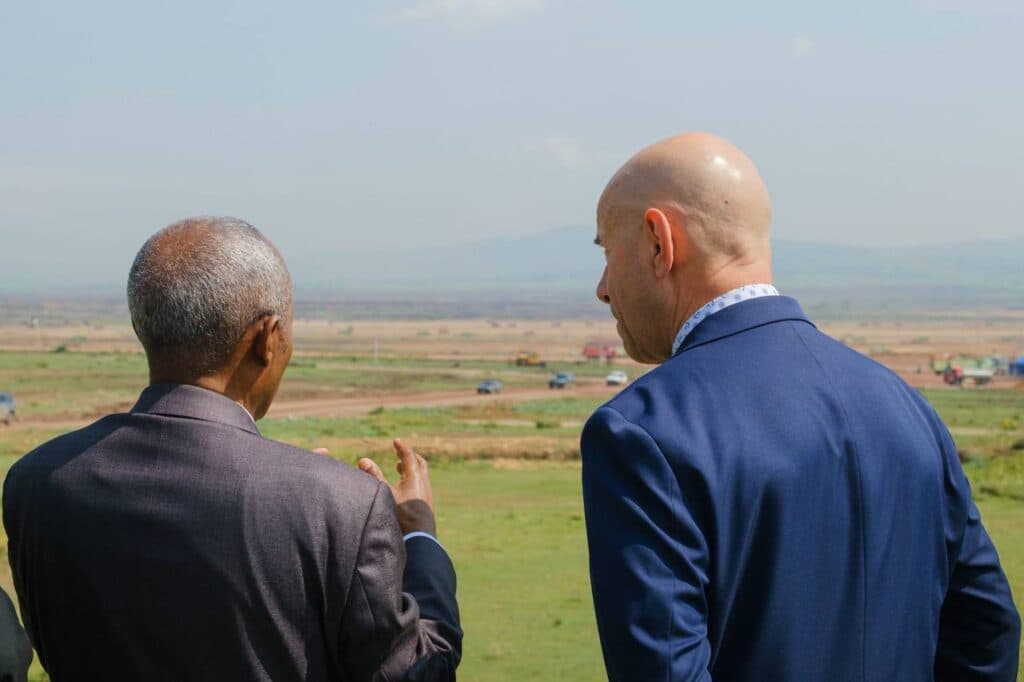
The State Department’s Bureau of African Affairs said the plan is expected to create employment on both sides, for Ethiopians and Americans, support uninterrupted air service between the two countries, and drive growth around the airport corridor. Assistant Secretary of State for African Affairs Frank Garcia raised the plan in a meeting with Ethiopian Airlines Group Chief Executive Mesfin Tasew, and the two visited the project site together, Deutsche Welle reported. Garcia said he is committed to ensuring that American investment and technology form the foundation of the new airport.
The specific instrument being prepared is a financing package aimed at small and medium enterprise (SME) lending in the airport corridor, intended to seed local supply chains and commercial activity around the site rather than to fund runways and terminals directly. No figure has been attached to the package publicly, and no agreement has been signed.
Why the corridor, and not the concrete
The distinction matters. The airport itself, a greenfield hub at Abusera in Bishoftu, roughly 45 kilometres southeast of Addis Ababa, carries a first-phase price tag of about USD 12.5 billion. Ethiopian Airlines Group is the sponsor. Phase one is designed for 60 million passengers a year, with the full master plan providing for four runways, more than 270 aircraft stands and capacity of up to 110 million passengers annually. Groundwork began in January 2026, and the airline has said it will finance early earthworks from its own balance sheet.
The heavy lifting on senior debt has so far been led from elsewhere. The African Development Bank committed USD 500 million and is acting as mandated lead arranger to raise roughly USD 8.7 billion more from institutional investors across the Middle East, Europe, the United States and China. Italy has since entered financing discussions, broadening the lender base further.
American money has been circling the project for close to a year. Ethiopia’s Ministry of Finance opened talks with the DFC in Washington in October 2025 on financing, investment guarantees and partnerships with US firms in airport development, engineering and construction. The DFC has previously indicated potential support of around USD 1 billion in financing alongside USD 1 billion in political risk insurance, with the important caveat that the offer was framed on the assumption of no Chinese involvement. The Export-Import Bank of the United States has signalled no financing cap, but requires at least 51 percent US content.
The complication
That caveat now sits awkwardly against the tender. Ethiopian Airlines prequalified 33 companies and consortia across four works packages, main terminal facilities, support facilities, airfield and infrastructure, and offsite transport links. Chinese state-owned and state-linked contractors took 15 of the 33 positions, representing 10 groups, and are prequalified across all four packages. China Communications Construction Company, China Road and Bridge Corporation, China Civil Engineering Construction Corporation and Beijing Urban Construction Group all appear on the list.
The only US-domiciled bidder is The Lane Construction Corporation, itself owned by Italy’s Webuild. It appears on three packages, each time inside a joint venture led by Webuild and Türkiye’s IC İçtaş, and never on the main facilities package.
Nothing has been awarded. Prequalification determines only who may bid, and Ethiopian Airlines has pushed final contractor selection to early January 2027 after bidders asked for more time to prepare proposals and arrange financing. Mesfin has said the delay is not expected to move the overall completion schedule.
That timeline gives Washington a window, and explains the shape of what the DFC is now offering. SME lending in the surrounding economic zone, aviation technology, aircraft and engines are the lanes where American participation remains open regardless of who pours the concrete.
The aircraft channel
Those lanes are already active. Ethiopian Airlines is reported to be close to an order for eight to 10 long-haul Boeing freighters, likely comprising two current-generation 777Fs and six to eight of the new 777-8F model, which would firm up a memorandum of understanding the carrier signed with Boeing in 2022. Neither party has confirmed the deal. The carrier moved about 897,000 tonnes of cargo in its most recent financial year, up 16 percent, and operates 12 777Fs today.
An order of that size also carries GE Aerospace engines with it, GE90s on the 777F, GE9X on the 777-8F, extending the American industrial footprint well beyond the terminal buildings. US Deputy Assistant Secretary of Commerce Mark Mitchell has previously said American participation in the project could generate additional business for both Boeing and GE Aerospace.
Bilateral backdrop
Garcia’s stop in Addis Ababa is part of a regional trip that also takes in Zambia and Kenya. During the visit he met Foreign Minister Gedion Timothewos for talks on trade, investment and commercial ties, and separately called on the African Union Commission Chairperson. The Bureau of African Affairs said Garcia linked durable peace to economic development and urged progress on regional stability and de-escalation in the Horn of Africa. The meetings follow a structured bilateral dialogue held between the two governments in Washington in May.
Washington has framed the commercial push as a response to Ethiopia’s ongoing market liberalisation and fiscal reform programme.
For Ethiopian Airlines, the calculation is simpler. A diversified lender base across African, American, European, Gulf and Chinese sources gives Addis Ababa leverage on pricing and reduces dependence on any single creditor. The airport is also the physical precondition for the airline’s Vision 2035 ambitions, including, at Bishoftu’s lower elevation, the payload economics that would make genuinely non-stop services to the United States workable.


Comments