


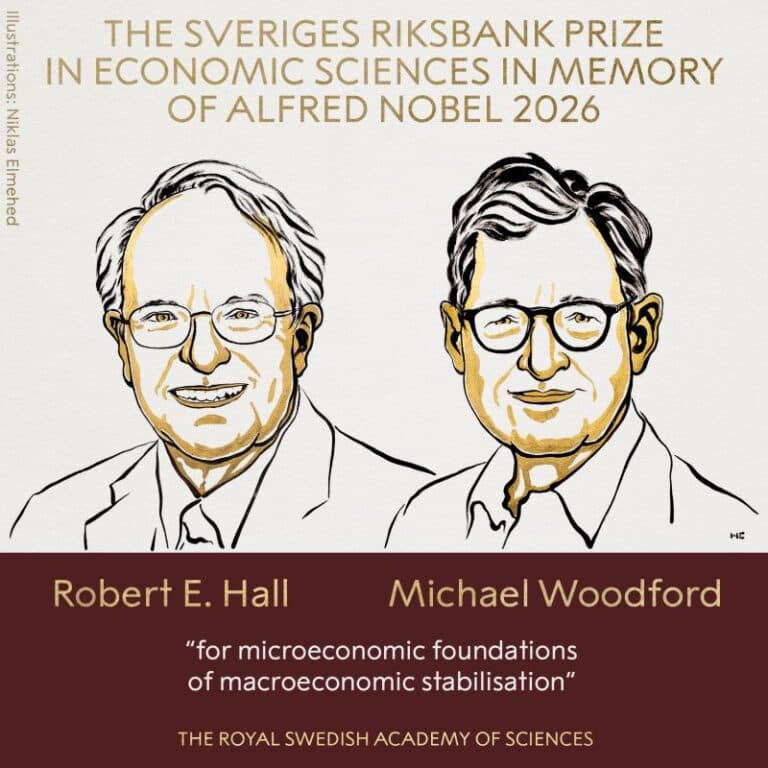
Robert E. Hall of Stanford University and Michael Woodford of Columbia University have won this year’s Nobel-memorial prize in economics. The Royal Swedish Academy of Sciences honoured them “for microeconomic foundations of macroeconomic stabilisation.”
In plain words: they showed governments and central banks how to calm an economy that is overheating or sliding into recession. Their tools now sit at the heart of the models that policymakers use around the world.
To understand why that matters, you have to go back to a time when those tools seemed broken.
When the old map stopped working
Every economy moves in waves. Good years bring jobs and rising spending. Bad years bring layoffs and closed shops.
For most of the 20th century, policymakers followed a recipe from the economist John Maynard Keynes. In a slump, cut interest rates and let the government spend more than it collects. In a boom, do the opposite and cool things down.
Then came the oil crises of the 1970s, and the recipe failed. The old models promised that a bit more inflation would buy lower unemployment. Instead, Western countries got both at once: prices rose out of control while jobs vanished and growth stalled.
A whole decade went by like this. Many people concluded that trying to steer the economy did more harm than good, and that governments should simply stop trying.
Rebuilding the engine from the inside
Hall and Woodford took a different path. They argued the old models broke because they were built on the wrong thing.
Those models leaned on statistical patterns between big numbers like inflation, output and consumption. When the world changed, the patterns changed too, and the models had nothing deeper to fall back on.
So the laureates started from the bottom: real households and real businesses. How does a family decide how much to spend or save? How does a company decide what price to charge? Add up millions of those choices and you get the whole economy.
Think of it like traffic. You can study rush-hour charts, but they won’t tell you what happens when a new bridge opens. To predict that, you need to understand why each driver picks a route. These are the “microeconomic foundations” in the prize citation.
People look ahead, and that changes everything
The heart of their models is a simple truth: people plan for the future. A family saving for next year, or a firm setting prices for the coming months, acts on what it expects to happen.
That opens a powerful door for policymakers. If a central bank clearly explains what it plans to do with interest rates, people adjust their choices today. Words become a policy tool in their own right.
Picture a captain who announces the course well in advance. The crew starts adjusting before the ship even turns, and the voyage runs smoother. Clear, credible plans can move the economy in the right direction before a single rate is changed.
Two scientists, two pieces of the puzzle
Robert Hall: how households spend. In a famous 1978 paper, Hall showed that if people plan their spending sensibly, future changes in their consumption can’t be predicted from the past. Families already use everything they know; only real surprises shift their plans. This idea changed how economists model households, and Hall went on to study how jobs, wages and unemployment respond to shocks.
Michael Woodford: how prices and central banks interact. Woodford built the full framework for modern monetary policy, laid out in his influential 2003 book Interest and Prices. He showed how firms that set prices with an eye on the future respond to a central bank’s plans. His work explains why clear communication, often called “forward guidance” can be as important as the interest rate itself.
Together, their work gave the so-called New Keynesian models a solid footing. Keynes’s goal of smoothing booms and busts survived, but now it rested on how real people actually behave.
Today, central banks and finance ministries around the world use models built on these ideas. When an energy crisis hits, or households suddenly cut back on spending, these models help decide how hard and how fast to respond.
“The laureates’ work has provided us with a stable theoretical foundation for the models that are now used by central banks and governments around the world,” said John Hassler, Chair of the Committee for the Prize in Economic Sciences.
The result is an economy with gentler peaks and shallower troughs. For ordinary people, that can mean fewer lost jobs in hard times and steadier prices in good ones. Half a century after stabilisation policy nearly died, Hall and Woodford helped bring it back to life.


Comments