


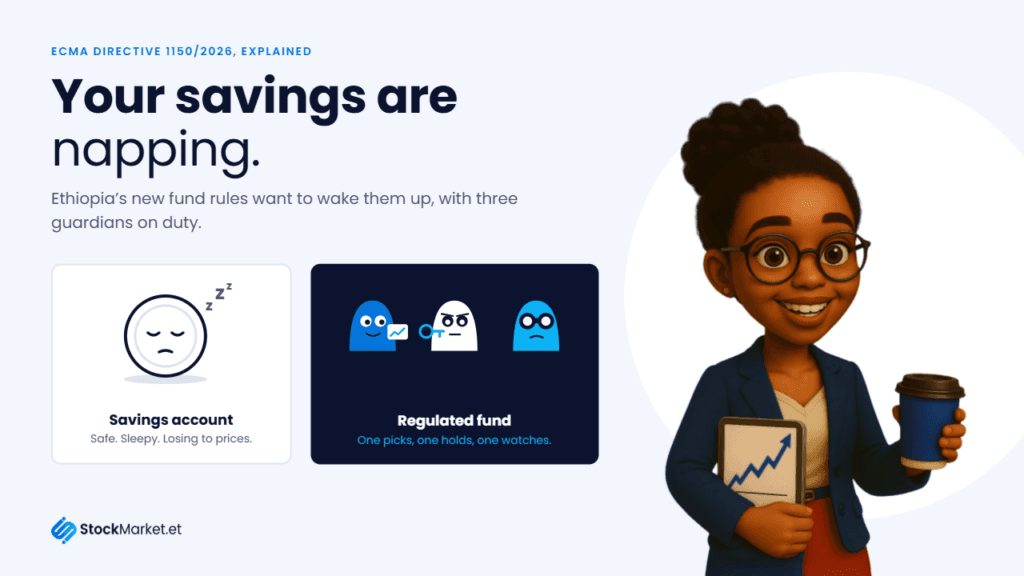
1. Your savings, sitting still
You put a little money aside every month. It goes into a savings account, and there it sits. Prices climb faster than your interest does, so each year your savings quietly buy a little less. You have heard about the new stock exchange in Addis Ababa, but which company would you even pick? And you certainly cannot afford shares in ten different firms to spread your risk.
Now picture ten thousand people in exactly your position. Each of you puts in a small amount. Together you have a large pot. You hire a professional to invest it across many companies, government bills or buildings, and each of you owns a slice of everything. That is a collective investment scheme, better known as an investment fund. It is how ordinary savers around the world reach markets they could never reach alone.
But a pot of other people’s money is also a temptation. Who stops the manager from taking a cut they have not earned? Who actually holds the cash? And what happens on the day you want your money back?
In September 2026 the Ethiopian Capital Market Authority (ECMA) answered those questions in one document: Directive No. 1150/2026 on the Operation of Collective Investment Schemes, 137 pages and 176 articles. Follow your money through it, from the day a fund is born to the day you cash out, and judge for yourself whether the rules are good enough.
2. Five words that unlock the whole rulebook
Legal texts scare people off with vocabulary. This one only needs five words to make sense.
- Scheme: The fund itself. The directive covers every fund operating in Ethiopia, big or small (Art. 3).
- Operator: The professional fund manager, licensed by ECMA, who decides what to buy and sell.
- Custodian: The independent institution, often a bank, that actually holds the fund’s money and assets. The Operator gives instructions; the Custodian keeps the keys.
- Public scheme vs. AIF: A public scheme is sold to everyone, including you. An Alternative Investment Fund (AIF) is sold privately, mostly to wealthy or professional “qualified investors” (Art. 2). Public schemes get the strictest rules, because their investors are the most vulnerable.
- NAV (net asset value): Everything the fund owns minus everything it owes, divided by the number of slices. It is the price of one slice on a given day.
One more thing helps. This directive does not stand alone. It sits on top of the Capital Market Proclamation No. 1248/2021, Ethiopia’s parent capital-markets law, and borrows terms from two earlier ECMA rulebooks: one on public offerings (No. 1030/2024) and one on licensing market professionals (No. 980/2024). Think of it as the fund chapter in a growing library.
3. Six kinds of fund, and the gate every one must pass
Walk into a future Ethiopian fund shop and you will find six products on the shelf (Art. 5). Each one is defined by what it holds.
| Fund | In plain words | The rule that defines it |
|---|---|---|
| Money Market Fund | A safe parking spot for cash, close to a savings account | At least 80% in short-term instruments like Treasury bills, average maturity one year or less |
| Mutual Fund | A basket of shares and bonds | Mostly listed securities, with risk spread out |
| Real Estate Investment Fund (REIF) | A slice of rent-paying buildings | At least 80% in income-generating property, and at least 90% of profit paid out every year |
| Exchange Traded Fund (ETF) | A fund you buy and sell on the stock exchange like a share | At least 80% in the assets of the index it copies |
| Alternative Investment Fund (AIF) | Private funds for sophisticated investors | Sold privately, not by public offer |
| Special Designation Fund | The “none of the above” box | Approved case by case for new ideas |
Two choices here quietly protect you. First, a property fund can never be the kind of fund that promises to pay you back any day you ask (Art. 4). Buildings take months to sell, so a fund full of buildings that promised instant cash would be a crisis waiting to happen. Second, risky strategies such as borrowing heavily, betting on prices falling, or concentrating on a few bets are only allowed in private funds for qualified investors (Art. 25). They are kept away from the public.
Even a fund’s name is policed. It must honestly reflect what the fund does and cannot mislead (Art. 5).
Getting through the gate
No fund can take a single birr from the public until ECMA registers it (Arts. 6, 74). Getting registered is a deliberate, document-heavy journey (Arts. 28–34):
- The fund is first set up as a company, with commercial registration.
- The would-be Operator files an application, in Amharic or English, and swears it is true.
- The file must show who runs the fund, who sits on its board, who owns how much, a business plan that tests what happens if assumptions go wrong, and written policies on money laundering, conflicts of interest and risk.
- ECMA has 30 business days to respond. Each round of questions restarts the clock, with 20 business days for every later round.
- If ECMA says no, it must first hear the applicant out, then explain in writing. The applicant can appeal.
- Approval brings a registration certificate that must be renewed every year.
That yearly renewal is unusual. In many countries a fund is approved once. In Ethiopia, every fund has to re-earn its place annually.
The pressure does not stop at approval. A fund must put at least 30% of its capital to work within six months (Art. 10). Investors’ money is not meant to sit idle in a fund that is still deciding what to do.
4. Three guardians, watching each other
Here is the smartest idea in the whole directive. It never trusts any single party with your money. Instead it splits power three ways, so each guardian keeps an eye on the others.
The manager decides. The custodian holds. The board supervises. None of them can be swapped out without ECMA’s approval.
Guardian one: the Operator (the manager)
The Operator picks the investments, manages risk, runs stress tests and writes the reports (Arts. 44–47). It must act honestly, carefully and in investors’ best interest. The rules that keep it honest are concrete:
- It can invest alongside you, but not take over: An Operator may put up to 10% of the fund’s capital in, and must then leave it there for two years (Art. 43). Enough to have skin in the game, not enough to control.
- No sweetheart deals: Any deal with a related company must be at fair market price, approved and disclosed. Giving the best opportunities to friends, or better terms to favoured investors, is banned (Art. 45).
- Bad news travels fast: If the Operator breaks the fund’s rules or finds false information, it must tell ECMA in writing within 24 hours (Art. 50).
- It pays for its own helpers: If it outsources work, the fee comes out of its pocket, not the fund’s (Art. 51).
- It cannot walk off overnight: Resigning takes six months’ notice. If no replacement is found, the fund is wound up in an orderly way rather than left orphaned (Art. 53).
Guardian two: the Custodian (the vault and the whistle)
The Custodian holds the cash, the shares and, for property funds, the title deeds (Arts. 59–61). It keeps the fund’s assets completely separate from its own, the Operator’s and other funds’ (Art. 60). If the Custodian ever went bust, the fund’s assets would still belong to the fund.
But the Custodian is more than a safe. It follows the Operator’s instructions only when they are within the rules (Art. 59). If the Operator steps out of line, the Custodian must report it to ECMA within 24 hours (Art. 63). Banks can take this role, but they need a separate ECMA licence and must prove they are genuinely independent from the Operator (Art. 57).
Guardian three: the Board (the referee)
Every fund needs a board of at least five voting members, with a majority, including the chair, independent of the Operator and its partners (Art. 35). The Operator may attend but cannot vote. The board hires and fires the Operator, Custodian, auditor and valuer, approves fees and dividends, and runs an audit, risk and compliance committee the Operator cannot sit on (Arts. 37–38). A property fund’s board must include someone with five years in Ethiopian real estate (Art. 36).
And you have a vote too
Any big change, such as new types of investment, higher borrowing or higher maximum fees, needs approval from investors holding two-thirds of the fund (Art. 40). The Operator cannot chair that meeting, and cannot vote on matters where it has a personal stake (Art. 41).
Around all this stand an independent external auditor, a licensed valuer, and where relevant a property manager or Shariah advisor (Arts. 66–72). Fees must be written down in advance, with a ceiling (Art. 73). If a professional makes a careless mistake, the cost is theirs, not the fund’s.
5. Don’t put all the eggs in one basket
The whole point of a fund is spreading risk. So the directive’s investment rules boil down to one promise and a few hard numbers.
The promise: every fund must publish an investment policy that says, in plain terms, what it will buy, how much of any one thing, how much it may borrow and how fast it will invest. Then it must stick to that policy “at all times” (Art. 8). Changing it in any big way needs that two-thirds investor vote.
The numbers that matter most to an ordinary investor:
| The rule | The limit | Article |
|---|---|---|
| How much a fund may borrow | 20% of its value (property funds 40%; no cap for private funds for qualified investors) | 12 |
| How much in any single company | 20% for money market, mutual and exchange-traded funds | 17, 19, 24 |
| How much rent from one property source | 20% of a property fund’s assets | 22 |
| How much profit a property fund must pay out | At least 90% every year | 20 |
| When property rules kick in | Any fund with more than 20% in real estate must follow property-fund standards | 21 |
Why 20% per company, when Europe’s best-known fund rules are stricter? Because Ethiopia’s stock exchange is young and lists only a handful of companies. Tighter limits would make funds impossible to build. Government bonds and bills are exempt from the single-company cap, though funds must still “ensure adequate diversification” (Art. 17). Expect the first funds to hold a lot of Treasury bills.
A few quieter rules close loopholes. A fund cannot promise to sell assets it does not own (Art. 14). It cannot use investors’ money to cover guarantees the manager gave to someone else (Art. 15). Lending out the fund’s shares is allowed only through ECMA-approved repurchase agreements with collateral (Art. 13). Each one shuts a door through which, in other markets, investors have lost money.
6. The day you want your money back
Fast forward two years. School fees are due, or a business opportunity appears, and you need your money. What happens next is the real test of any fund, and the directive spends a whole chapter on it (Chapter Nine).
The fund built for coming and going
The funds that let you join or leave on any working day are called Unit Investment Companies. Their size simply grows when people buy and shrinks when people sell (Art. 121). Each one runs under a Rulebook approved by ECMA, which binds the fund, the manager, the custodian and every investor like a three-way contract (Art. 122).
Inside that Rulebook is a quietly powerful sentence. Both the Operator and the Custodian must sign a promise that they owe investors trustee-level duties: put investors first, avoid conflicts, and never profit from the fund’s assets except as allowed. If they break that promise, you have a clear legal basis to hold them to account.
Step by step, how you cash out
- You fill in a redemption form, approved in advance by ECMA (Art. 128).
- You get the next price, not the last one. Your slice is priced at the next NAV calculated after your request, so nobody can trade on yesterday’s stale price (Art. 127).
- The Custodian cancels your units on the Operator’s instruction, and can refuse if the instruction breaks the rules (Arts. 129–130).
- Your cash arrives within five business days, minus any exit charge that was disclosed upfront (Art. 128).
If the fund is late, it pays: fines start at 100,000 birr plus 10,000 birr for every extra day (Art. 167).
Is the price honest?
A fair exit needs a fair price. Every fund’s assets must be valued at fair, realistic value under international standards, and the annual valuation must come from a licensed independent appraisal firm (Arts. 116–117). Property must be revalued by an independent valuer at least once a year (Art. 118). Private funds may value themselves, but under the same rules.
When the door closes
Sometimes markets freeze. If a fund cannot sell assets at a fair price, the Operator may pause redemptions, but only with board and ECMA approval, and it must announce the pause in English and Amharic within 24 hours (Art. 132). A pause can last at most 28 business days unless ECMA or a court extends it. ECMA can also allow gentler options, such as paying out part of each request.
And fees cannot be used as a trap. Exit charges must be disclosed in advance, a new one only applies to units bought afterward, and no charge may be set so high that it effectively blocks you from leaving (Art. 135).
7. No surprises: what they must tell you
Rewind to the day you first think about investing. Before you hand over a single birr, the directive makes sure you can see exactly what you are buying.
Before you invest
The short version. Every public fund must give retail investors a Key Investor Information Document: a short, plain-language summary of what the fund does, its risks and rewards, and its fees (Arts. 93–94). It must make sense on its own, without needing the thick prospectus beside it.
The full story. The prospectus, approved by ECMA, spells out everything: the investment policy, every fee to every party, who the managers are, how assets are valued, and a section headed “risk factors” (Arts. 81–91). It must even say what share of the money will be invested at 6, 12 and 18 months, and what happens if the fund misses that plan (Art. 82).
Someone answers for every word. If the prospectus is wrong or misleading and you lose money, the fund, the manager, the directors and anyone who signed off are jointly liable to compensate you. Any small print trying to escape that responsibility is void (Art. 80).
Honest adverts. Advertising is only allowed after registration, must reach ECMA three business days before it runs, and must warn plainly that prices can go down as well as up and that ECMA does not vouch for the fund (Art. 98).
After you invest
The information keeps flowing:
- Immediately, when something big happens, such as a lawsuit, a major liability or a change in how the fund is valued or held (Art. 102).
- Every six months, a report within 45 days with the manager’s commentary, performance and financial statements (Art. 106).
- Every year, a full report within 90 days, with audited accounts, a valuation report and, crucially, a statement from the Custodian saying whether the manager followed the rules, and if not, what the Custodian did about it (Arts. 107, 111).
Performance without the spin
Fund marketing around the world has a habit of flattering returns. The directive closes the usual tricks (Arts. 113–115). Returns must be shown after all costs. A great three months cannot be dressed up as an annual figure. Real results cannot be mixed with hypothetical ones. Every report shows the total cost of running the fund as a percentage, next to last period’s figure for comparison. If the fund ever misstates its value by 10% or more, it must disclose the error and how it will stop it happening again (Art. 114).
Private funds for qualified investors face lighter rules: no public advertising at all, but identical documents for every investor, filed with ECMA before any money is raised (Art. 95).
8. When someone breaks the rules
Rules without teeth are just suggestions. Chapter Eleven gives ECMA a toolbox that runs from a private warning to shutting a firm down.
How ECMA keeps watch
Every fund sends ECMA a compliance report at least every six months, written by its compliance officer and confirmed by the board’s audit committee (Art. 156). It covers whether money was raised as planned, whether it has been invested, anti-money-laundering checks and, for property funds, how much rent was paid out. The manager is forbidden from punishing the compliance officer for doing the job honestly. Anyone connected to a fund must hand over documents when ECMA asks (Art. 172).
What breaking the rules costs
| If someone… | They can face… | Article |
|---|---|---|
| Advertises or sells without ECMA approval | A fine of 10–25% of the money raised, offer cancelled | 157 |
| Runs an unregistered fund, commits fraud or ignores the investment policy | Up to 2 million birr each for manager, custodian and fund; licence and registration pulled | 158 |
| Pauses redemptions without permission | Up to 3 million birr, ordered to reopen | 168 |
| Refuses a valid redemption | Up to 2 million birr, ordered to pay at once | 166 |
| Pays redemptions late | Up to 1 million birr plus 10,000 birr a day | 167 |
| Files reports late | 10,000 birr plus 1,000 birr a day | 160 |
| Breaks any other rule | 50,000–300,000 birr | 170 |
Repeat offenders can be blacklisted, and board members who allow violations can be suspended or removed (Art. 158). In deciding the penalty, ECMA weighs how serious and deliberate the breach was and how much investors were hurt (Art. 171).
Three more pieces of the puzzle
Exchange-traded funds need at least one approved market maker on the exchange, quoting buy and sell prices all day so the fund’s market price stays close to its true value (Arts. 140–142).
Umbrella funds can house several sub-funds under one roof. Each sub-fund’s money is sealed off: if one sub-fund gets into debt, creditors cannot touch the others (Art. 146).
When a fund closes, the manager must pay off every debt it knows of or should have found, keep reporting until the end, and publish a final audited account to every investor (Arts. 153–155).
Finally, ECMA keeps a safety valve. It can waive specific rules or allow temporary arrangements where compliance is impossible or a new idea works just as well, and can test new products in its regulatory sandbox (Art. 174).
9. The verdict: can you trust it?
Mostly, yes. On paper, this is a careful, investor-first rulebook. Its biggest risk is not that it is too weak, but that it may be too heavy for a young market to carry.
What it gets right
- No single point of failure. The manager, the custodian and the compliance officer each have a 24-hour duty to raise the alarm. For money to go missing, several independent parties would all have to fail at once.
- Real accountability. Directors who sign a misleading prospectus can be personally liable, and no small print can change that.
- Honest performance numbers. Returns after all costs, no inflated annual figures, visible running costs.
- Property kept in the right box. Property funds cannot promise instant withdrawals, which avoids the kind of mismatch that has trapped property-fund investors elsewhere.
- Penalties aimed at the exit door. Late payments and unauthorised pauses carry daily fines and multi-million-birr penalties, exactly where investors are most exposed.
What is missing or unclear
- No transition plan. The directive takes effect once registered and published, but says nothing about how existing pooled vehicles should adjust. They will need ECMA guidance or waivers.
- A drafting slip on independence. The test for an “independent” director lists its conditions joined by “or” (Art. 35). Read literally, a director meeting just one condition would count as independent. The intent is surely that all must apply, and ECMA should say so.
- Expensive for small funds. Every fund, even a small private one, needs a five-person board, a compliance officer, an auditor, a valuer and an annual renewal. That could keep small or specialist funds off the market.
- Hard to get started. Managers can put in no more than 10% of a fund’s capital and must lock it up for two years, limiting how they can seed a new fund.
- A cap on fraud fines. Selling without approval can cost 10–25% of money raised, but fraud is capped at 2 million birr per party. For a large fund, licence revocation will need to do the deterring.
- Few tools for stressed markets. Beyond pauses, exit levies and partial payouts, the toolbox for handling a rush of withdrawals is thin.
- Tax not addressed. Whether funds pay tax or pass income straight through to investors depends on tax law, not this directive.
- Will the professionals be there? The rules assume enough licensed valuers, custodians, market makers and Shariah advisors. That ecosystem is still being built.
What it means for you
If you are a saver thinking of investing, read three documents: the short Key Investor Information Document before you buy, the Custodian’s statement in the annual report, and the performance report. Remember that private funds offer far fewer protections.
If you plan to launch a fund, start early. You will need a board, a custodian, an auditor, a valuer, a tested business plan and dealing systems that can pay out within five business days, before ECMA’s 30-business-day review even begins.
If you run a bank, custody is a new licensed business line, and with it comes the role of watchdog.
The first funds will most likely be money market and government-bond funds, with property funds to follow. Whether your savings ever leave that bank account will depend less on the text of Directive 1150/2026 than on how quickly and sensibly ECMA puts it to work. The rulebook is written. The story of Ethiopia’s fund industry is only beginning.
This article explains the directive’s text and is not legal advice. Check the official text and consult qualified Ethiopian counsel before acting.


Comments