


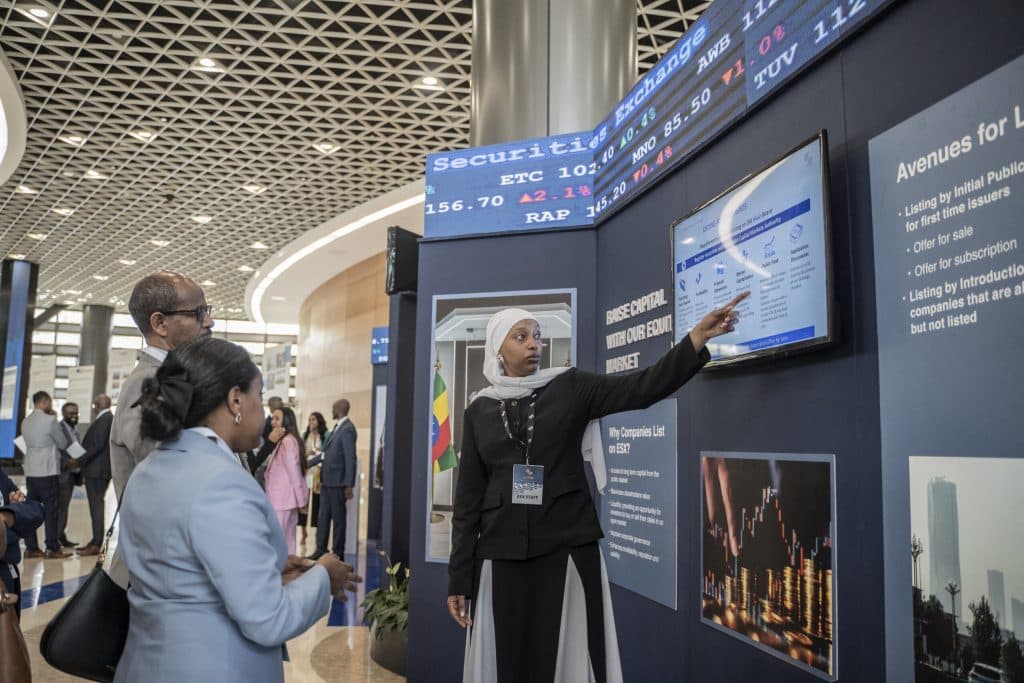
On a Friday morning in January 2025, Prime Minister Abiy Ahmed walked onto a trading floor in Addis Ababa and rang a bell. There were no traders shouting on the floor. There was no opening tick of a long-running ticker. There was, in fact, only one company listed, Wegagen Bank and the screens behind him were waiting for an economy to catch up to its own ambition.
It was the quietest revolution Ethiopia had staged in a decade.
For more than fifty years, since the Derg regime nationalised the country’s modest share-trading activity in the 1970s, Ethiopia has been the largest African economy without a stock market. Companies raised money one way: they walked into a bank. Households saved one way: they walked into the same bank. The system worked. Ethiopia grew, often impressively. But it grew on a single engine and engines, when they’re the only ones you have, eventually start to whine under the load.
That bell-ringing on January 10 was the sound of someone, finally, switching on a second engine.
This is the story of why that matters and why it almost didn’t.
Walk into any boardroom in Addis a year ago and ask a CFO how they were planning to fund expansion. The answer was almost always the same: a term loan from one of the big commercial banks, secured against property, repaid on a schedule that rarely matched how the underlying business actually generated cash.
This isn’t a quirk. It’s mathematics.
Banks operate on a structural mismatch, depositors who can withdraw tomorrow, borrowers who need money for fifteen years. To survive that mismatch, banks rationally do three things: they prefer collateral, they prefer borrowers with track records, and they prefer sectors they already understand. Startups, long-gestation infrastructure, and intangible-heavy businesses (the kind that build software, not warehouses) get squeezed out. Not because anyone is hostile because the model wasn’t built for them.
In Ethiopia, the squeeze was visible in the numbers. Credit to the private sector sat at around 16% of GDP — below the sub-Saharan African average, while domestic savings mobilisation came in at roughly 10.9% of GDP, far short of the regional benchmark of about 20%. Public debt, meanwhile, had marched from 39.6% of GDP in 2011 to 60% by 2018.
Translated into plain English: not enough money was reaching the private sector, not enough Ethiopians had a way to put their savings to productive work, and the government was doing more of the heavy lifting than was healthy.
When you only have banks, this is what the equilibrium looks like.
Bank dominance has a second, subtler problem: it concentrates risk.
When a handful of large lenders are responsible for almost all the credit flowing through the economy, two things happen at once. Lending clusters around a few large, familiar borrowers, typically state-linked projects and a small number of well-known private groups. And the entire financial system’s stability becomes hostage to those same borrowers’ fortunes. If two or three of them sneeze, the banking sector catches a cold. If they fall over, the cold becomes pneumonia.
This is the fragile equilibrium Ethiopia inherited. It’s also why innovation tends to suffocate quietly under bank-led systems. Bank lending is, by design, backward-looking, it asks what you’ve done, what you own, and who will guarantee you. Innovation, by definition, is forward-looking, it asks investors to bet on what doesn’t yet exist. The two don’t speak the same language.
For a young economy, the mismatch is tolerable. For a country of more than 130 million people trying to industrialise, build a tech sector, and absorb a youth bulge into productive work, it becomes a ceiling.
Weynshet Zeberga, who runs the Monetary and Financial Analysis Directorate at the National Bank of Ethiopia, put it more simply. “We needed a way for the government and the private sector to raise long-term capital outside the banking system.”
That’s the sentence the Ethiopian Securities Exchange was built to answer.
Capital markets don’t replace banks. The framing of “banks versus markets” is one of those tidy debates that never survives contact with a real economy. What capital markets do is add gears the banking system doesn’t have.
The first new gear is risk distribution. When a company issues equity or bonds, the risk of that business doesn’t sit on a single bank’s balance sheet, it sits with thousands of investors, each absorbing a sliver. If the company fails, the loss is spread, not concentrated. The system absorbs the shock instead of trembling under it.
The second is patient capital. Equity investors don’t demand fixed monthly repayments. Bond investors will lend for ten or fifteen years if the structure is right. Suddenly, projects with long gestation periods, power plants, ports, manufacturing complexes have a financing channel that matches their economics.
The third is the one that gets economists most excited: collateral-free finance. A startup with no land and no factory, only a team and an idea, can in principle raise equity from people willing to bet on its future. That is, quite literally, how every globally significant tech company has been built. It is not how almost any Ethiopian company has been built.
The fourth is price discovery. When shares trade publicly, the market produces a continuous valuation of the company. That sounds technical, but it has cultural consequences: companies start being judged on performance, governance tightens, audited disclosures become non-negotiable, and capital starts flowing toward whoever is using it best.
The fifth is exit liquidity, the unglamorous plumbing without which venture capital and private equity simply don’t show up. If early investors can’t sell their stake, they don’t make the first investment. A functioning exchange is the back door that lets the front door open.
Put those five gears together and you get something the banking system, on its own, cannot deliver: an ownership culture, sitting alongside the existing debt culture. Businesses stop thinking only about how much they can borrow and start thinking about how much they can scale.
The temptation, in stories like this, is to mistake a launch for a finish line. Ethiopia hasn’t, and the early data shows why.
Wegagen Bank’s listing on launch day was a quiet success. The offer was oversubscribed, raising $26 million against an $11 million target, helped by a $1 million anchor investment from FSD Africa that gave other investors the confidence to follow.
In June 2025, Gadaa Bank became the second listing. By mid-year, the ESX had executed its first inter-broker stock trade, while its interbank trading platform, operational since late 2024, had facilitated over 2.7 trillion ETB in transactions. Government Treasury Bills were formally listed for trading on July 11, 2025, opening the bond side of the market.
Then came the moment that mattered most for ordinary Ethiopians.
Ethio Telecom, the 130-year-old state telecom giant that handles roughly 94% of the country’s telecom traffic, offered 10% of its shares to the public. The IPO ran from October 2024 to February 2025, conducted entirely through the Telebirr SuperApp, a detail that quietly tells you something about where Ethiopia is going. A total of 47,377 citizens bought 10.7 million shares, raising 3.2 billion birr.
The numbers cut both ways. Only 10.7% of the targeted shares were sold, raising roughly $24 million against a 30 billion birr target. The shortfall had specific causes, public awareness of IPOs remained low, and a maximum purchase cap of 3,333 shares per person discouraged high-net-worth participation.
But read it the other way: 47,000 Ethiopians who had never owned a share in anything became part-owners of a national institution. For the first time in history, ordinary Ethiopian citizens are recognised as shareholders in one of the country’s largest and most profitable enterprises. When the allotment confirmation messages finally went out on September 1, 2025, after months of administrative delay, something cultural had shifted that no balance sheet captures.
That’s the part you can’t measure in basis points.
ESX CEO Tilahun Kassahun has been blunt about ambition. The target: 50 listed companies within five years, 90 within ten. As of early 2026, the Ethiopian Capital Market Authority was reviewing 66 prospectuses, with more than 45 from the financial services sector, banks and insurers being the most profitable, best-capitalised institutions in the country.
On April 23, 2026, Awash Bank, one of Ethiopia’s largest private lenders, formally listed, ringing the bell for what regulators hope is the start of a heavier wave. Dashen and Bank of Abyssinia are reportedly close behind.
The strategy is deliberate: anchor the market in financial sector liquidity first, build investor confidence, then expand outward into industrials, telecoms, and eventually SMEs through an over-the-counter platform Dr. Tilahun has floated as a “kickstart” mechanism.
But the friction is real, and the regulator isn’t pretending otherwise. The free-float requirement, the rule that companies must sell a specified percentage of shares to the public, has triggered pushback in Ethiopia, where many businesses are tightly held family firms reluctant to cede control. A small manufacturer may hesitate to sell even 10% of ownership to dozens of outsiders, while lesser-known firms struggle to attract the minimum 50–300 shareholders.
Behind that sentence sits a cultural negotiation that will take years. Capital markets work because owners are willing to dilute. In an economy where ownership has historically meant family control and tight circles of trust, dilution feels less like fundraising and more like surrender.
There’s a macro overhang, too. Reform agendas are fragile things, and the ESX is, in the end, a child of the broader liberalisation project, the floating of the birr, the opening of banking to foreign institutions, the privatisation programme. If the political will behind any of those falters, the exchange’s pipeline thins with it.
Step back, and what’s happening in Addis is recognisably the same pattern other emerging markets have walked. Nairobi, Lagos, Karachi, Ho Chi Minh City, each, at some point, hit the limits of bank-led financing and chose to build a parallel system. None of those exchanges started liquid. None of them looked like much in year one. The question was always whether the institutional scaffolding, the regulator, the depository, the brokers, the disclosure regime, the savings habit, would be patient enough to compound.
Ethiopia has the scaffolding now. It has an independent regulator in the ECMA, a public-private exchange structure with strategic foreign shareholders including the Nigerian Exchange Group, FSD Africa, and the Trade and Development Bank, a mobile trading app called Neway, and a central securities depository for settlement.
What it doesn’t yet have is depth. Liquidity is thin. Three equity listings is not a market, it’s a beginning. Investor literacy is uneven. The diaspora, with its hard currency and appetite for home-country exposure, has been mostly walled off from the early offers.
These are solvable problems. They are also, every one of them, problems of time.
The frame Ethiopia’s policymakers are using is the right one. The argument was never “banks versus capital markets.” Banks aren’t bad. They financed the roads, the dams, the airline, and most of the country’s industrial base. They will keep doing that. What they cannot do, on their own, is finance the next phase, the one where productivity matters more than sheer mobilisation, where ideas matter more than collateral, where a 25-year-old founder in Bole has to be able to raise money against a future she can describe but not yet pledge.
That economy needs a second engine.
Whether the ESX becomes that engine or remains a polite institutional gesture depends on choices made over the next five years, by regulators, by family-owned businesses willing to dilute, by a diaspora that may yet be invited in, and by a political class that has to keep faith with a reform agenda even when the easy headlines run out.
For now, the bell has rung. The screens are on. And for the first time in fifty years, Ethiopia has somewhere to put a question that banks alone could never quite answer:
What’s this company actually worth?
The market will tell us. Slowly. One listing at a time.
Comments