


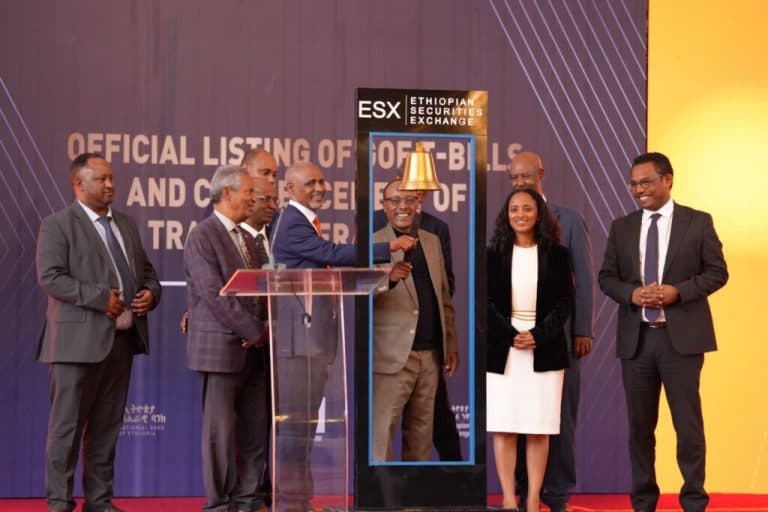
On the morning of July 11, 2025, a country of roughly 135 million people, the second-most populous in Africa, officially opened its first organized securities exchange.
It was a surprisingly understated moment for something this significant. The Ethiopian Securities Exchange (ESX) had, in essence, taken 51 years to arrive.
Ethiopia once had a small share-trading group operating through the State Bank of Ethiopia in 1965, briefly placing the country ahead of much of the continent in financial experimentation. Then came the 1974 revolution. The Derg nationalized industries, dismantled private ownership structures, and buried the idea of a capital market for decades.
While Lagos built the NGX, Nairobi developed the NSE, and Johannesburg evolved into one of the most sophisticated exchanges outside the developed world, Ethiopia continued allocating capital through state banks, government directives, and bureaucracy.
Now, only one company, Wegagen Bank, was listed on day one. ESX CEO Tilahun Esmael Kassahun projected that 90 companies could join the exchange within ten years. International headlines framed the launch as another milestone in Prime Minister Abiy Ahmed’s liberalization agenda.
Most global investors barely noticed.
They probably should have.
Because the reality of African capital markets is that liquidity, not prestige, size, or even returns, is what ultimately determines whether an exchange matters. And Ethiopia, almost accidentally, has assembled a set of structural advantages that could allow it to leap directly into the top tier of African exchanges by liquidity.
Not the biggest.
But potentially the most liquid.
The distinction matters.
Market capitalization is the headline figure most people focus on. South Africa’s JSE dominates the continent with roughly $1.22 trillion in market value as of late 2025. Egypt’s EGX hosts one of Africa’s largest pools of listed firms. Nigeria’s NGX benefits from the scale of its economy.
But professional investors care about something else entirely: can they enter and exit positions without dramatically moving prices?
That is liquidity.
The most common measure is turnover velocity, calculated as annual trading value divided by total market capitalization. According to research from the Nairobi Securities Exchange, most African exchanges sit below 1% turnover velocity. Only two major African exchanges have historically crossed 10%: Egypt at roughly 48% and Johannesburg at around 45%. Nigeria, despite its size, has hovered near 5%, while Morocco and Mauritius generally range between 6% and 8%.
Across much of Africa, exchanges exist, but actual trading activity remains thin. Stocks often sit untouched in pension funds or family portfolios for years. Bid-ask spreads remain wide, price discovery is slow, and foreign investors frequently struggle to exit positions efficiently.
This is why MSCI requires relatively high turnover standards for emerging-market classification.
Kenya itself, one of East Africa’s most respected exchanges, recorded equity turnover of just KSh 105.97 billion in 2024, roughly $820 million, against a market capitalization of KSh 1.9 trillion, or around $14.7 billion. That translates into turnover velocity of approximately 5.6%.
Liquidity has surprisingly little to do with how rich a country is. It depends on how many people trade, how often they trade, how cheaply transactions happen, and how efficient the financial infrastructure becomes.
This is where Ethiopia starts looking unusually interesting.
Ethiopia is Africa’s second-most populous country with approximately 135.9 million people, according to the World Bank, and annual population growth close to 2.5%. The IMF projects economic growth of 9.2% in 2026, among the fastest on the continent.
Per capita income remains low, around $979 according to the World Bank and roughly $1,081 by IMF estimates for 2026. Historically, those figures discouraged investors. But averages hide the more important question: how many people are crossing the threshold where they begin saving and investing?
That number is rising rapidly.
Commercial Bank of Ethiopia alone now holds deposits exceeding ETB 2 trillion, equivalent to around $15 billion, more than doubling within less than three years. In fiscal year 2024/25 alone, CBE collected ETB 515 billion in new deposits, one of the largest annual increases ever recorded by an Ethiopian financial institution. Total financial-sector assets, including social-security funds, reached ETB 5.6 trillion by June 2025, up 40% year-on-year.
Then comes the diaspora factor.
Ethiopia received approximately $7.17 billion in remittances during the 2024/25 fiscal year, up from $4.4 billion the previous year. The government is targeting $8 billion for 2025/26.
For comparison, Kenya, often considered Africa’s benchmark for diaspora inflows, receives around $4.9 billion annually. Nigeria receives roughly $20 billion, despite having nearly three times Ethiopia’s population.
Diaspora capital behaves differently from foreign institutional money. It is patient, emotionally tied to the home country, and actively seeks investment opportunities back home.
Historically, much of that money flowed into real estate, deposits, or informal savings. A functioning exchange changes that equation.
At the same time, Ethiopia’s digital financial infrastructure is expanding rapidly. CBE launched CBE Connect with fintech partner StarPay to channel remittances directly into domestic accounts and wallets. Platforms like Telebirr and M-Pesa Ethiopia have already created millions of active users, allowing retail investment participation to move digitally rather than through paper systems and branch queues.
One of the least appreciated aspects of Ethiopia’s economy is that the country already possesses a deeply rooted shareholding culture despite never having a formal exchange.
Under Ethiopia’s 1960 Commercial Code, companies could organize as share companies and raise money from the public. After the fall of the Derg, many private banks emerged through this exact model.
Thousands of Ethiopians pooled savings to establish institutions like Awash Bank, Dashen Bank, Bank of Abyssinia, Hibret Bank, and Nib International Bank.
Awash Bank itself was established in 1995 by 486 shareholders with ETB 24 million in paid-up capital. By December 2025, the bank had 12,143 shareholders and ETB 38 billion in paid-up capital.
This happened without brokers, electronic trading systems, or a stock exchange.
Over decades, Ethiopia quietly produced tens of thousands, potentially hundreds of thousands, of retail shareholders familiar with ownership culture long before the ESX existed.
The problem was liquidity.
Shares traded informally, valuations lacked transparency, and price discovery barely existed. Investors often waited years for opportunities to sell holdings. Reports suggested that Awash Bank shares traded unofficially at around ETB 2,500 before listing, later rising above ETB 3,000 after entering the exchange in 2026.
The exchange does not create demand.
It releases it.
This gives Ethiopia a fundamentally different starting position from markets like the BRVM, which spent years building retail-investor awareness from scratch.
The listings pipeline further strengthens the story.
Most new exchanges struggle to attract enough quality companies. Ethiopia may face the opposite problem.
At the center stands Ethio Telecom, valued at roughly $1.05 billion. The company carried out one of Africa’s largest IPOs of 2024, offering shares through its Telebirr mobile-money platform.
The IPO ran from October 2024 to February 2025, attracting 47,377 investors and raising ETB 3.2 billion, equivalent to roughly $232 million at the time.
International observers focused heavily on the offering selling only 10.7 million shares out of the planned 100 million.
But context matters.
This was a first-time public offering in a country with no exchange history, minimal brokerage infrastructure, and almost no retail investment ecosystem.
Despite that, nearly 50,000 investors participated within just 121 days.
That is not failure.
That is market formation.
Behind Ethio Telecom lies an even larger pipeline. Ethiopian Investment Holdings oversees 27 state-owned enterprises with an estimated portfolio value of around $45 billion.
Potential future listings include insurance companies, logistics firms, and eventually Ethiopian Airlines, arguably Africa’s most successful airline.
At the same time, multiple major private banks are already preparing for listings. By February 2026, six banks, Awash, Dashen, Abay, Anbesa, Amhara, and Bank of Abyssinia, had received listing approval in principle.
Awash Bank listed first in March 2026, bringing ETB 442.5 billion in assets, equivalent to around $2.84 billion, and more than 12,000 shareholders onto the exchange immediately.
Bank of Abyssinia also carried out a ETB 5 billion rights issue to prepare for listing. Meanwhile, the Ethiopian Capital Market Authority licensed 11 Capital Market Service Providers, including First Addis Investment Bank.
The ESX itself is targeting 9 IPOs by July 2026, 50 listed companies by 2029, and 90 by 2035.
Those targets may actually be conservative.
When Safaricom listed in Kenya in 2008, it transformed the NSE’s trading activity almost overnight. Nigeria experienced similar effects through listings such as MTN Nigeria, Dangote Cement, and Airtel Africa.
Ethiopia may compress that process into only a few years.
Institutional capital adds another critical layer.
Every liquid market ultimately depends on institutions. Retail investors create activity, but institutions create depth and stability.
Ethiopia’s pension and insurance sectors already control approximately ETB 530 billion, roughly $4 billion, in assets. More than 80% of those assets remain concentrated in treasury bills and government bonds.
As regulations evolve, pension funds are expected to diversify into equities and corporate debt markets. Even modest reallocations into listed shares could significantly reshape liquidity dynamics in a relatively small market.
The arithmetic is straightforward.
Billions of birr flowing into a market with limited free float can rapidly increase turnover and deepen trading activity.
Meanwhile, Ethiopia’s broader economic reforms are creating the macroeconomic backdrop necessary for capital-market development.
In July 2024, Ethiopia shifted toward a market-determined exchange-rate system, eased selected current-account restrictions, and adopted a more market-oriented monetary framework. The birr depreciated sharply, while the parallel-market spread narrowed from above 100% to around 15%.
The IMF and World Bank supported the reforms with financing packages, while the G20 provided debt-relief support.
The reforms remain incomplete.
But direction matters.
Historically, capital markets tend to emerge during periods of restructuring rather than perfect stability. Egypt’s market expansion accelerated after the 2016 IMF program. Kenya’s bond market deepened following fiscal reforms after 2015. South Africa’s JSE modernized rapidly during the post-apartheid transition.
Ethiopia is building its exchange during reform, not before it.
That timing may ultimately prove advantageous.
When all the ingredients are combined, Ethiopia’s position becomes unusually compelling.
The country has one of Africa’s youngest and largest populations, rapidly expanding digital financial infrastructure, more than $7 billion in annual remittance inflows, an existing shareholder culture, a deep pipeline of high-profile listings, expanding institutional savings pools, and an active reform agenda.
Few African exchanges began with all these conditions simultaneously.
Still, the risks are serious.
Foreign investors remain largely restricted. Currency convertibility remains limited. Inflation is still elevated. Political tensions could disrupt reform momentum. Regulatory institutions are young and still developing credibility.
Building a long-term investment culture will also take time.
Markets are not built through infrastructure alone.
They are built through trust.
Yet if Ethiopia executes successfully over the next decade, the implications could be enormous.
Additional private bank listings, expanded telecom offerings, corporate bond markets, pension participation, and eventually major strategic listings like Ethiopian Airlines could rapidly deepen the market.
If these developments happen in parallel rather than sequentially, Ethiopia’s liquidity growth could accelerate far faster than many expect.
The country does not need to become Africa’s largest exchange to transform the continent’s financial landscape.
It only needs to become the market where capital moves most efficiently.
Back in the Sheraton ballroom, the bell ringing looked almost ordinary.
But history often hides inside quiet moments.
A liquid capital market is ultimately a machine for converting national savings into economic growth.
Ethiopia already has the savings, in ETB trillions of bank deposits, billions in remittances, pension assets, informal shareholdings, and household wealth sitting outside productive financial systems.
For decades, it lacked the machinery to channel that capital effectively.
Now, for the first time in half a century, that machinery exists.
The exchange is operational.
The pipeline is forming.
The reform process is underway.
And the investor base is waiting.
If Ethiopia fails to capitalize on this opportunity, it may become one of the continent’s great missed economic transformations.
But if it succeeds, the Ethiopian Securities Exchange could emerge as one of the most consequential financial projects Africa has seen in generations.
And remarkably, much of the world is still barely paying attention.

Comments