


Good morning!
A former World Bank president spent this week arguing, in a World Bank working paper, that Ethiopia’s currency float made the poor poorer and handed the winnings to banks and well-connected firms. It is a contested claim, and a minority one inside the institutions that backed the reform. But the rest of the week read like a set of exhibits filed in the same case.
Zemen cleared 10.2 billion birr. Nib International climbed out of a forex hole and back to 4.2 billion. The state shipper posted the biggest profit in its history, partly on foreign exchange gains it did not have to earn. The national carrier grew revenue to USD 9.1 billion and watched costs rise faster. Meanwhile the central bank barred a bank CEO for five years, the competition authority froze a fuel deal for getting too big, and a American visa for an Ethiopian traveler now potentially costs a 3.1 million birr deposit.
Reform generates gains. The question this week keeps asking, from a working paper in Washington to a court docket in Addis, is where they land.
Now grab your buna. There’s a lot on the table.
The Reform Debate
A former World Bank president puts Ethiopia’s float on trial
David Malpass, who led the World Bank from 2019 to 2023, argues in the World Bank’s July Policy Research Working Paper 11428 that Ethiopia’s July 2024 exchange rate liberalization caused a sharp depreciation without adequate stabilization, leaving households to bear the costs while institutions with privileged access to foreign currency benefited.
Citing World Bank data, he notes poverty is projected to reach 43% by 2025, the birr has fallen from about 28 to 161 per dollar since 2019, and inflation has eroded household purchasing power. He argues the reform transferred wealth from wage earners and birr savers to foreign currency holders and borrowers, while proposing stabilization, digital payments, and targeted FX intervention as a better alternative. Although the paper reflects his personal views, it is notable for using the World Bank’s own data to challenge a reform the institution supported. Read more
Manufacturing exports hit USD 607 million, and the target doubles
Industry Minister Melaku Alebel told a performance review in Addis that manufacturing exports reached USD 607 million in 2025/26, up from USD 385 million before the “Made in Ethiopia” push, and set a USD 1 billion target for 2026/27. Sector employment has climbed from roughly 162,000 at the start of the reform programme to more than 433,000.
Hold that figure against the headline. Ethiopia earned a record USD 10.7 billion from exports last fiscal year. Manufacturing accounted for about 5.7 percent of it. The rest is still overwhelmingly gold, coffee, oilseeds, horticulture and livestock, which is to say things pulled out of the ground or grown on it.
This is the number that decides whether the float was worth it. A weaker birr is supposed to make Ethiopian factories competitive abroad. Two years in, manufacturing exports have grown well but remain a rounding error next to commodities. Doubling to a billion would be the first real evidence the reform is changing what Ethiopia sells, not just what it charges for it. Source: Birrmetrics
In Amhara, gold is three-quarters of the mineral export story
Regional President Arega Kebede told the Amhara Regional State Council that gold made up 73.57 percent of the region’s mineral export earnings in 2025/26, with raw opal contributing 18.70 percent and value-added opal products just 7.73 percent. The region exported more than 28,000 kilograms of precious minerals for USD 18.24 million, beating its targets on both volume and foreign currency.
Exploration added to the inventory: 5.148 million tons of estimated iron ore reserves, 2.5 billion tons of granite, 1.625 million tons of basalt. Authorities also identified over 133,500 cubic meters of illegally extracted minerals worth 34.8 million birr, of which 27.1 million birr has been recovered to the treasury.
Look at the opal split. Raw stone earns nearly two and a half times what finished opal products do. It is the coffee problem in miniature, and the same problem the manufacturing target above is trying to solve: Ethiopia is very good at extracting things and much less practiced at finishing them. Source: The Reporter Ethiopia
Corporate Results
Zemen clears 10.2 billion birr as assets pass 116 billion
Zemen Bank reported a preliminary pre-tax profit of 10.2 billion birr for 2025/26, with total assets rising to 116 billion birr from about 88.6 billion a year earlier. Total income reached 17.8 billion birr, equity 26 billion, paid-up capital over 14 billion. Customer deposits jumped 32 percent to 85.4 billion birr, the loan book reached 52.59 billion, and the bank generated USD 698 million in foreign exchange earnings across 142 branches.
A bank founded in 2008 on a deliberately small branch footprint is now compounding at a pace that would have looked absurd five years ago. Note the USD 698 million line in particular: in a system where dollar access is the binding constraint, FX generation is fast becoming the metric that separates Ethiopian banks from one another.
Nib International climbs back out of the forex hole
Nib International Bank returned to profit in 2025/26 with 4.2 billion birr in pre-tax earnings, reversing a 2.9 billion birr pre-tax loss the year before. That loss came almost entirely from 4.4 billion birr in foreign exchange charges on legacy hard-currency obligations opened before the float without sufficient reserves behind them. The bank suspended dividends to rebuild capital. Deposits rose 14 percent to 59 billion birr, total assets reached 75 billion, and transactions on its Nibtera digital platform hit 32 billion birr. CEO Henok Kebede told managers the coming year is about fixing operational weaknesses.
The state shipper posts the largest profit in its history
Ethiopian Shipping and Logistics closed 2025/26 with 157.2 billion birr in revenue against a 144.9 billion target, and a pre-tax profit of 28.2 billion birr, roughly 25.4 billion after tax on unaudited numbers, comfortably ahead of a 17.5 billion plan and about 45 percent above last year. Foreign currency earnings rose to USD 551 million. The enterprise moved more than 7 million metric tons of cargo, 5 million of it bulk, using its own 10 vessels, 47 chartered ships, seven partner lines, 665 company trucks and 3,643 contracted ones. CEO Abdulber Shemsu called it one of the hardest years the maritime industry has faced, citing Red Sea security, Gulf conflict and fuel shortages.
Now the enterprise wants to multiply its capital tenfold, from 20 billion birr to 200 billion, buy six new vessels, and reach 350 billion birr in revenue and USD 2 billion in FX earnings by 2030. Source: Capital Ethiopia
Ethiopian Airlines: USD 9.1 billion in revenue, and costs rising faster
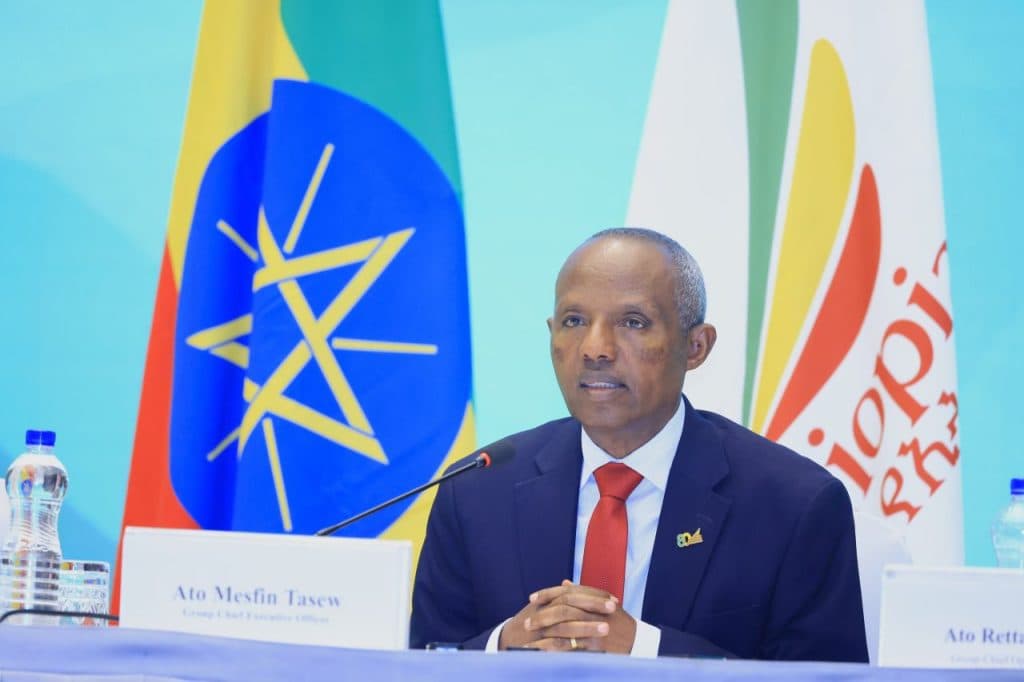
Ethiopian Airlines Group reported USD 9.1 billion in revenue for 2025/26, carrying 20.7 million passengers, up 10 percent, on 8 percent more flights. International destinations rose to 150 with four additions, domestic points went from 22 to 25, nine aircraft joined the fleet, and cargo volumes grew 16 percent. CEO Mesfin Tasew flagged the drag: Gulf crisis disruptions that forced around 10 flight cancellations, aircraft availability constraints, new US travel restrictions and softer Africa–North America demand.
The line that matters most is the one below revenue. Expenses climbed 25 percent, driven largely by fuel costs tied to geopolitical tension.
Regulation & Governance
The NBE bars a bank CEO for five years
The National Bank of Ethiopia removed Tesfaye Boru as chief executive of Global Bank Ethiopia effective July 28 and barred him from senior leadership at any financial institution for five years. A letter dated July 29 explains why: a special inspection of the bank examined corporate governance, lending and credit administration, human resources, foreign exchange operations and overall financial management, and found multiple deficiencies and breaches of both NBE directives and the bank’s own policies. Global Bank submitted a corrective action plan, but the NBE said the severity of the findings, combined with prior written warnings issued in May 2021 and November 2024, justified stronger action. It invoked Article 20 of the Banking Business Proclamation No. 1360/2025 and Article 10 of Directive SBB/89/2024.
The action follows a period in which Global Bank’s board suspended a group of senior executives amid an inquiry into deposit and liquidity practices.
This is the most consequential governance signal the NBE has sent in years. A five-year industry ban on a sitting CEO, documented with a paper trail of earlier warnings, tells every board in the country that the regulator keeps a file and eventually uses it. For a market preparing to put bank shares in front of public investors on the ESX, an enforcement regime with teeth is not a side story. It is the precondition. Source: Capital Ethiopia
The Ola Energy–TotalEnergies deal hits a competition wall
The Ethiopian Trade Competition and Consumer Protection Authority has temporarily halted approval of Ola Energy’s acquisition of TotalEnergies Marketing Ethiopia, on concerns that the combined business could approach half the country’s fuel retail market and would be larger than National Oil Company. The deal, agreed in Paris at the end of June and undisclosed in value, would transfer more than 120 service stations, ten storage facilities, logistics infrastructure, the lubricants business and aviation fuel supply at Bole to a pan-African retailer backed by Libyan state investment institutions, ending TotalEnergies’ 76-year presence in Ethiopia.
Officials’ stated worry is concentration risk: one company controlling that much of the fuel chain could shape prices, and any future operational failure or exit would ripple straight into national fuel availability. Source: Capital Ethiopia
Dashen takes digital loan defaults to court
Dashen Bank has started filing lawsuits against borrowers who failed to repay digital loans taken through Telebirr, after repeated notices and a temporary penalty waiver programme. The bank says many borrowers used the waiver window to settle, but those who did not are now facing proceedings, and some courts have already ordered defaulters to pay legal costs on top of outstanding principal. The products in question are Telebirr Mela micro-credit and Telebirr Endekise overdraft, delivered through a partnership with Ethio Telecom that has put billions of birr of credit down a phone line.
Capital Market
Two more registrations, and Wegagen doubles its registered float
ECMA approved the registration of 2,818,305 Nib Insurance S.C. shares on July 28: 2,618,305 existing shares held by shareholders plus 200,000 new shares earmarked for an offering to existing investors. Separately, on July 24, the authority registered an additional 3,876,031 existing Wegagen Bank shares, taking the bank’s total registered securities to 10,094,666, up from 6,218,635.
Wegagen was the first company to list when the ESX opened for trading in January 2025.
The pipeline keeps widening on two axes at once. Insurers are following banks into the regulated fold, and companies already inside it are bringing more of their share register with them. Wegagen’s total has now grown by 62 percent, which is not a new issuer but is a materially deeper float in the exchange’s founding stock.
Infrastructure & Capital Flows
EEU’s 25-year plan carries a USD 30.65 billion price tag
The Ethiopian Electric Utility unveiled a national power distribution master plan running to 2049, requiring an estimated USD 30.65 billion. CEO Getu Geremew’s roadmap projects peak demand rising from 4,289 MW in 2025 to 39,327 MW by 2049, driven by population growth, urbanisation, industry and electric mobility. The build-out: 16,500 km of new medium-voltage lines, 9,700 km rehabilitated, 21,800 transformer interventions, 6,945 MVA of added transformer capacity, and 128 new substations at roughly USD 16.3 billion. Phase one alone costs USD 1.3 billion, with Addis Ababa taking USD 575 million and Oromia USD 478 million. A separate ten-year smart grid strategy, covering smart meters, SCADA, distribution automation and GIS, runs USD 515 million to 640 million.
The diagnostic behind it, funded by the World Bank at over EUR 4.7 million and carried out by Monenco Iran, surveyed 1,100 feeder lines, 183 substations and 79,000 km of medium-voltage line. It found 271 feeders short of capacity, 182 severely overloaded, and 6,800 distribution transformers needing urgent repair at an initial USD 71 million. Source: Capital Ethiopia
Washington wants a seat at Bishoftu
US Deputy Assistant Secretary of Commerce for the Middle East and Africa Mark Mitchell said on July 29 that the Department of Commerce has been “closely engaged” in pushing for American participation in Ethiopian Airlines’ USD 12.5 billion Bishoftu International Airport. He named no companies or contracts, but said involvement could support additional purchases of Boeing aircraft powered by GE Aerospace engines, following the airline’s April agreement for six more 787-9 Dreamliners on top of 20 already on order.
Construction began in January about 45 km southeast of Addis, targeting four runways and completion in 2030. The African Development Bank has committed USD 500 million and is leading efforts to mobilise a further USD 8.7 billion. Ethiopian Airlines has separately confirmed that several Chinese firms and joint ventures are shortlisted for the main construction packages. All of this is happening while Ethiopia remains suspended from AGOA. Source: StockMarket.et
The Public Purse
Digital procurement nearly doubles to 597 billion birr
The Public Procurement and Property Administration Authority reported more than 597 billion birr in completed transactions through the electronic government procurement system in 2025/26. The comparison is the story: the same system handled 308.75 billion birr the year before. Source: Birrmetrics
Beyond the Border
A US visa may now require a 3.1 million birr deposit
The US State Department is making its visa security deposit programme permanent and raising the maximum from USD 15,000 to USD 20,000 for certain B1 and B2 applicants from 50 countries, 30 of them in Africa. Ethiopia is on the list, alongside Djibouti, Nigeria, Senegal, Uganda and Tanzania. The previous USD 5,000 floor has been removed, leaving consular officers discretion up to the new ceiling. The deposit is refundable on compliant departure and forfeited on overstay. The pilot ran from August 2025.
Afreximbank and Gebeya put USD 50,000 behind African creators
Afreximbank’s Creative Africa Nexus programme has partnered with Ethiopian-founded pan-African technology company Gebeya to launch the CANEX Create-thon 2026, a USD 50,000 competition across music, video and gaming. Participants build on Gebeya’s Dala Studio platform during a four-day sprint from 20 to 24 August, with registration open from 30 July to 19 August. Winners take USD 7,000, USD 3,500 and USD 1,500 per category, with USD 500 for qualifying finalists and a trip to CANEX WKND in Lagos in November. Unlike a pitch competition, entrants must submit working prototypes or finished work. It is open to amateurs and established creators alike, with no studio or production company required.
Afreximbank’s Temwa Gondwe framed the gap plainly: African creators have visibility and digital talent but have lacked the financing and tools to convert either into a business. Gebeya CEO Amadou Daffe said the point is moving creators from ideas to market-ready products.
🎧 On the Podcast
Episode 8 is live!
We break down the interbank money market and what more than 3.5 trillion birr in bank-to-bank trading actually tells you about liquidity, pricing and the plumbing beneath Ethiopia’s financial system.
Every story above is a claim on the same pot. A working paper argues the float moved wealth from households to institutions. Zemen’s 10.2 billion birr, ESL’s record profit and its 2.7 billion birr of foreign exchange gains are institutions doing well. Nib’s two-year climb out of a 4.4 billion birr forex hole is an institution that did not. The airline’s 25 percent cost increase is the geopolitics tax. A five-year ban on a bank CEO and a frozen fuel merger are the state deciding that some gains are not legitimate. And a 3.1 million birr visa deposit is the world outside pricing Ethiopians out of a room entirely.
The reform is producing money. That much is settled. The unsettled question, running from a USD 30.65 billion grid plan to a USD 607 million manufacturing target to a cooperative sector adding 21.7 billion birr of capital from below, is whether the gains keep pooling where they land first, or eventually reach the households paying for them.
Keep your coffee strong. See you next Monday. ☕