


Pour the buna. This week’s number is eight. That is how many companies the Ethiopian Capital Market Authority registered shares for on a single day, Tuesday, September 30: six banks, two insurers and, for the first time in a while, a petroleum company. Together that is roughly 243 million shares brought inside the regulator’s fence in one sitting.
Big numbers were everywhere this week. The stock exchange crossed half a billion birr in weekly trading. Awash Bank crossed half a trillion birr in deposits. The central bank governor said reserves have nearly tripled. Ethiopian Airlines signed for about $5 billion worth of Boeing freighters (catalogue price).
But almost every headline came with fine print. The half-billion birr in trading was 98% one stock. The half-trillion in deposits is partly inflation. The reserves story arrived the same week that most of the country’s economists told a survey they don’t trust the price numbers and aren’t sure the floating birr will last. So this week, we read the small type.
Capital Market
The ESX crosses half a billion birr in a week. One stock did the work.
The Ethiopian Securities Exchange traded ETB 510.05 million in shares between September 28 and October 2, across 525 trades, StockMarket.et’s weekly analysis shows. It is a record-sized week. It is also a one-name week: Awash Bank (AWAB) made up about 93% of shares traded and roughly 98% of the value, around ETB 499 million. The other six listed securities shared about ETB 10 to 11 million.
Most of it happened on one day. On Tuesday, 129,431 Awash shares changed hands as the stock jumped 5.44% to ETB 2,500, and it then sat at that round number for the rest of the week while tens of thousands more shares traded. Awash ended the week up about 5.3%.
Elsewhere, prices moved a lot on very little. Abay Bank (ABAYB) rose 15.06% on Thursday on two shares, enough to make it the week’s best performer. Sidama Bank (SIDAX), the newest listing, debuted Monday at ETB 1,300 on nine shares and did not trade again. Ethio Telecom (TELE) slipped about 5.5% to ETB 430.10, and Bank of Abyssinia (BOAX) was the steadiest active name, up about 1.3% to ETB 1,821.
For scale: the interbank money market on the same exchange platform moved ETB 37.1 billion that week, about 73 times the stock market, with seven-day money at around 13%.
The record is real. So is the concentration. Heavy volume at one unchanged price usually means a big buyer or seller is parked at that level, and the data doesn’t say which. For most of the board, the lesson is simpler: when two shares can move a price 15%, the screen tells you where the last tiny order matched, not what you could actually sell a meaningful stake for. And with near-risk-free bank money paying about 13%, that’s the hurdle every bank share has to clear for institutional money.
Sidama Bank lists: a microfinance lender becomes the ESX’s seventh company
Sidama Bank began trading on the Ethiopian Securities Exchange on Monday, September 28, under the ticker SIDAX, StockMarket.et reports. It opened at Br 1,300 a share in a quiet debut: nine shares changed hands. Wegagen Capital Investment Bank was the transaction advisor and prepared the prospectus.
The bank has a short history as a bank but a long one as a lender. It started in 1994 as the Sidama Microfinance Institution, serving underserved communities in the region, especially coffee-farming households. It was relicensed as a full commercial bank on July 1, 2022. The listing involved no new shares: ECMA registered 1,447,002 existing shares in July. Sidama was one of four companies the ESX approved in principle that month, alongside Ayat, Nib Insurance and ZamZam Bank.
The exchange now has seven companies on its Main Market. Ethio Telecom is the only one that isn’t a bank. More are coming: ESX chief executive Yodit Kassa told Bloomberg in mid-September that 11 new listings have in-principle approval. The exchange’s goal is 50 listed companies by 2030.
Eight companies, one day: ECMA’s biggest registration batch yet
On September 30, ECMA approved registration statements for eight issuers, according to notices dated October 1:
- Cooperative Bank of Oromia: 210 million shares, 128 million existing plus 82 million new shares to be offered to existing shareholders
- Berhan Bank: 9,999,000 shares, 6,328,419 existing plus 3,671,581 new shares open to both existing and new shareholders
- Awash Insurance: 8 million existing shares
- Oromia Bank: 7,824,963 existing shares
- Oromia Insurance: 3 million existing shares
- Goh Betoch Bank: 2,176,368 existing shares
- Rammis Bank: 2,101,106 existing shares
- Yetebaberut Beherawut Petroleum: 160,000 existing shares
All were registered under Article 75 of the Capital Market Proclamation and the Public Offer and Trading of Securities Directive, which require securities offered to the public to be registered. None of this is a listing or an offer to buy.
Two things stand out. First, most of this is housekeeping: companies with thousands of existing shareholders bringing those shares under the regulator’s rules, as the law now requires. Second, two banks are doing more than housekeeping. Cooperative Bank of Oromia and Berhan Bank registered new shares, which means they intend to raise fresh capital, and Berhan is opening the door to investors who aren’t shareholders today. Watch for prospectuses from those two. And keep an eye on Yetebaberut: a non-financial company joining a queue that has been almost all banks and insurers.
Foreign investors: the rulebook is out for comment
ECMA has published a draft Foreign Portfolio Investment (FPI) Regulation, which will govern how foreign portfolio investors can take part in Ethiopia’s capital market. The draft is on ecma.gov.et. Written comments go to fpifeedback@ecma.gov.et until October 25, and a public consultation forum follows on October 26.
Economy and Policy
Governor Eyob: reserves near $5.6 billion, but “not yet complete”
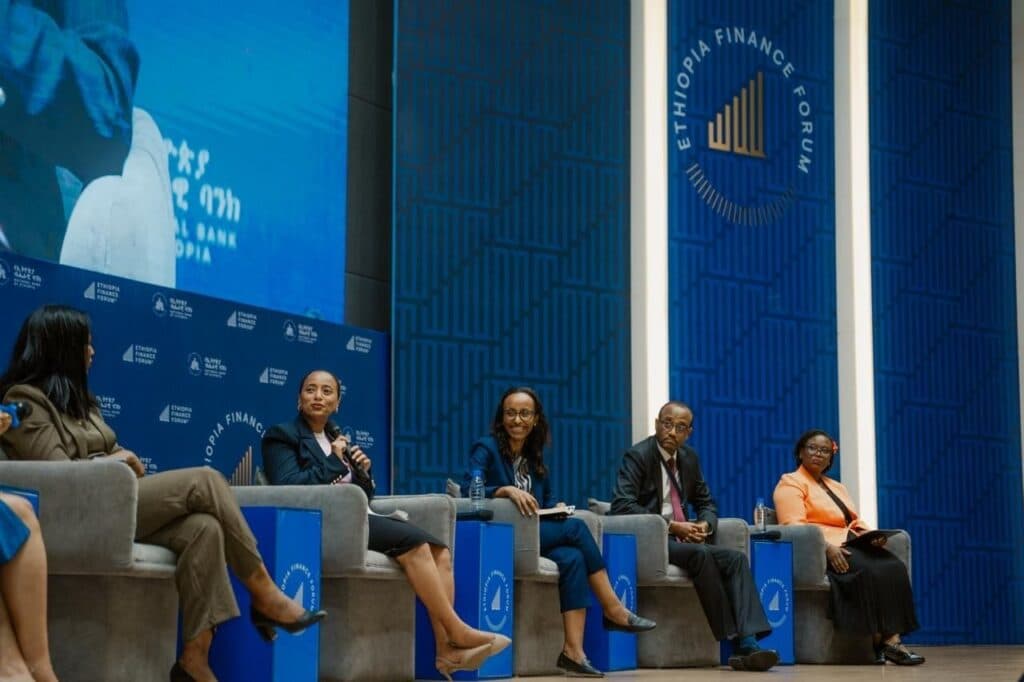
National Bank of Ethiopia Governor Eyob Tekalign (PhD) told the Ethiopia Finance Forum 2026 that foreign reserves have grown from about $2 billion in 2023 to roughly $5.6 billion in 2025, Birrmetrics reports. The current account deficit fell from $6.2 billion to $289.3 million in the year to June 2025, helped by a 119.2% jump in exports and a 13% rise in remittances. He also said headline inflation fell from near 30% in January 2024 to 9.7% in December 2025, before rising to 13.4% in May 2026 on fuel disruptions linked to the Middle East conflict.
He was careful with the victory lap. “The task is not yet complete, and I do not wish to declare victory prematurely,” he said.
At the same forum, Birrmetrics reports, Eyob signalled that the remaining rule forcing goods exporters to sell part of their foreign currency earnings (cut from 50% to 30% in July) will be phased out once the interbank FX market is deep enough. Service exporters already keep all of theirs. He put bank non-performing loans at about 3.3%, below the 5% ceiling, and flagged cybersecurity as the price of fast digital growth: the NBE has set up a dedicated cyber unit and is requiring banks to report on their defences.
Note the dates: the $5.6 billion is a 2025 figure, not today’s. Still, the direction is clear. The surrender rule matters for exporters: every dollar they keep is a dollar they decide how to use. The cyber warning matters for everyone with a mobile banking app. Speed and security, he said, can’t be traded for each other.
The economists aren’t convinced
The Ethiopian Economics Association published a research report this week, The Anatomy of Inflation in Ethiopia by Naser Yenus Nuru (PhD), combining official data, a statistical model and a June 2026 survey of 266 EEA members. The survey results are blunt:
- 56.4% think the market-based exchange rate is uncertain to last or unlikely to survive the next two to three years
- 70.7% say confidence in the birr as a store of value has worsened since the reforms
- 57.2% consider official inflation figures unreliable
- 52.3% see the NBE as lacking real independence from fiscal pressure
- 60.9% give the NBE’s single-digit inflation goal low or very low credibility
A quarter of respondents estimate inflation at 35% or above, far from the official figure. The gap tracks where people work: private-sector respondents were the most likely to put inflation that high, while government respondents put it lowest. Experts ranked birr depreciation as the biggest driver of prices, ahead of domestic supply shocks and global commodity prices. The report’s model, by contrast, finds money supply explains about 18% of inflation’s swings over a year and the exchange rate about 10%.
Read this alongside the Governor’s speech. The hard numbers (reserves, the current account) have clearly improved. What hasn’t caught up is belief. Inflation is partly about what people expect, so a credibility gap is not a side issue. The report’s main recommendations: independent review of how inflation is measured, clearer central bank communication, and supply-side fixes that interest rates can’t deliver. Worth noting too: the survey ran in June, before the July removal of the credit cap.
Cabinet: VAT, income tax, data governance and an energy loan
The Council of Ministers’ 59th regular meeting approved amendments to the Federal Income Tax and VAT regulations, StockMarket.et reports. The VAT changes are meant to ease VAT registration for businesses following the abolition of Turnover Tax, and add exemptions for selected supplies. The Council also sent Parliament a draft data governance proclamation (covering data security, sovereignty, sharing and AI research) and a draft reorganisation of federal executive bodies after the 2018 E.C. elections, and approved ratification of an SDR 145.8 million IDA loan for phase one of an energy sector reform and modernization project.
The tax change is the one small businesses will feel. With Turnover Tax gone, many firms that used to pay it will move into the VAT system, which means invoices, records and filings. Watch for the implementing details before you assume your costs stay the same.
Banking
Awash Bank crosses half a trillion birr in deposits
Awash Bank’s deposits have passed 500 billion birr, a first for an Ethiopian private bank, StockMarket.et reports. That’s about 32 billion birr added in the three months since June 30, when deposits stood at 467.8 billion. Total assets reached 622 billion birr, paid-up capital rose 38% to 38.5 billion, and the bank has asked the NBE for permission to open a branch in Djibouti. Its loan-to-deposit ratio fell to about 58%, a cautious level.
Two pieces of fine print. First, CBE still dwarfs everyone: it added 707.4 billion birr in deposits in one year alone, more than Awash’s entire deposit base.
NCBA eyes Ethiopia, and plans to buy its way in
Kenya’s NCBA Group says Ethiopia and the DRC are its next target markets, Capital reports. Managing Director John Gachora said the bank expects to be in Ethiopia soon and will enter through an acquisition rather than building from scratch. The push follows South Africa’s Nedbank agreeing to buy about 66% of NCBA in a deal worth roughly $850 million.
This is what foreign bank entry is starting to look like in practice: not new banks opening branches, but regional groups shopping for a local bank to buy. With 25 of 31 Ethiopian banks holding under 22% of the market combined, as the NBE’s own stability report notes, there are plenty of candidates. If you hold shares in a small bank, this is the story to watch.
Women get one in five loans, but less of the money
Women receive about 20% of loans in Ethiopia but only 17% of the money lent, Tsedey Bank President Yohannes Ayalew (PhD) said, as reported by Birrmetrics. The gap isn’t whether women can borrow but how much: their loans are smaller, mainly because banks lean on collateral and formal records that women-run businesses are less likely to have. Tsedey’s own numbers show it can be done differently: women hold 56.4% of its accounts and 46.8% of its outstanding credit, helped by group lending and by tying branch managers’ targets to lending to women. The NBE now requires banks to report both the number and the value of loans to women.
“What gets measured gets prioritized,” as Kifiya’s deputy CEO put it. Counting loan value, not just loan numbers, is a small reporting change with real teeth. It will show which banks are actually financing women’s businesses and which are just counting borrowers. Source: Birrmetrics
Business and Industry
Ethiopian Airlines orders 10 Boeing freighters
Ethiopian Airlines signed in Addis Ababa on September 30 to buy eight Boeing 777-8F and two 777F freighters, with an option for eight more 777-8Fs, StockMarket.et reports, citing Reuters. The catalogue value is about $5 billion; the real price is confidential. The airline’s cargo fleet today is 12 777Fs, three 767 freighters and four converted 737s.
Cargo is where Ethiopian has been quietly strongest, and this order doubles down on Addis as Africa’s freight hub. It also ties into the $12.5 billion new airport, whose first phase is due in 2030 and which the airline is helping to finance.
EIH adds a $55m Hilton Garden Inn ahead of COP32
Ethiopian Investment Holdings is building a roughly $55 million, 150-room Hilton Garden Inn and wellness facility inside the existing Hilton Addis Ababa compound, Birrmetrics reports. Elmi Olindo Contractors is the design-and-build contractor, and completion is set for October 2027, a month before Addis Ababa hosts the UN climate conference, COP32.
Akobo Minerals readies its first direct gold export
Akobo Minerals, which runs the Segele gold mine, expects to make its first direct gold export in October or November, a test shipment of 10 to 20 kg worth about $1.5 to $3 million, CEO Jørgen Evjen told Ethiopian Business Review. The company has NBE export approval, an offshore account and permission to keep 70% of export earnings in dollars. Second-quarter output was a record: about 37 kg of doré, $6.1 million in sales and a 71% EBITDA margin. A debt refinancing with Verdant Capital is expected to launch in October. Source: EBR
Region
Ethiopia closes its embassy in Asmara and expels an Egyptian diplomat
The Ministry of Foreign Affairs announced on October 1 that it is closing Ethiopia’s embassy in Eritrea, citing hostile acts against the country. It also declared ten Eritrean diplomats in Addis Ababa persona non grata and gave them 48 hours to leave. The statement said Ethiopia remains committed to peaceful resolution of disputes.
On the same day, the ministry also declared an Egyptian diplomatic staff member, Ahmed Moharam Ahmed Soliman, persona non grata and ordered him to leave the country within 48 hours, the Ethiopian News Agency and Addis Standard report. The diplomatic note cited the Vienna Convention on Diplomatic Relations. It did not give a reason for the designation or say what conduct led to it.
Cairo responded in kind. Egypt declared a counsellor at the Ethiopian Embassy in Cairo persona non grata and also gave him 48 hours to leave. An Egyptian source told Ahram Online that Ethiopia’s action was unfortunate and unjustified, and said Cairo’s decision followed the principle of reciprocity.
💡 Weekly Tip: Who Are the Middlemen?
You can’t buy shares on the ESX yourself. Trading is fully electronic and only licensed firms can place orders, so choosing your middleman is your first real investment decision. A new StockMarket.et guide explains who does what:
- A broker places trades for you and earns a commission. It works for you.
- A dealer trades with its own money. When you trade with a dealer, it’s on the other side of your deal, so compare its price with the market.
- An investment advisor tells you what to buy but can’t execute trades. If an “advisor” asks you to send money so it can buy shares for you, that’s a red flag.
Before you hand over a single birr: check the firm’s licence on ECMA’s website, confirm a broker is an ESX member, never pay into a personal account, and walk away from anyone who guarantees returns. Your shares themselves are recorded at the Central Securities Depository, not just on your broker’s books.
🎧 On our weekly Educational Content
This week we explore securities brokers and their role in Ethiopia’s growing capital market, from placing trades to connecting investors with opportunities. A good companion to the tip above, and to a week when one stock did almost all the trading. Watch on YouTube
Headlines are where the story starts, not where it ends. A record trading week that is really one stock. A record deposit base that is partly inflation. Reserves that have genuinely tripled, and economists who still don’t quite believe it. Eight companies registered in a day, and only two actually raising money. This week the market also opened a draft rulebook for foreign investors, and the fine print in that one is worth reading before October 25.
See you next Monday ☕