


If you want to buy shares on the Ethiopian Securities Exchange, you cannot just walk in and place an order yourself. Trading at the ESX is fully electronic, with no physical trading floor, and it can only be done through licensed intermediaries such as brokers and dealers. Investors are not directly involved in the trade itself.
So the middleman is not optional. It is your gateway to the market. Choosing the right one, and knowing what each type of firm can and cannot do for you, is one of the first decisions a new investor makes. It is also where many costly mistakes begin.
Why the market needs middlemen
The legal foundation is the Capital Market Proclamation No. 1248/2021. It gives the Ethiopian Capital Market Authority (ECMA) the power to license intermediaries such as brokers, dealers, and investment advisors, and to supervise how the exchange operates. Together these licensed firms are called Capital Market Service Providers (CMSPs).
Intermediaries do three things for investors. They connect you to the exchange, they hold you to rules designed to protect your money, and they give the regulator someone accountable if something goes wrong. An unlicensed “agent” offers none of these protections.
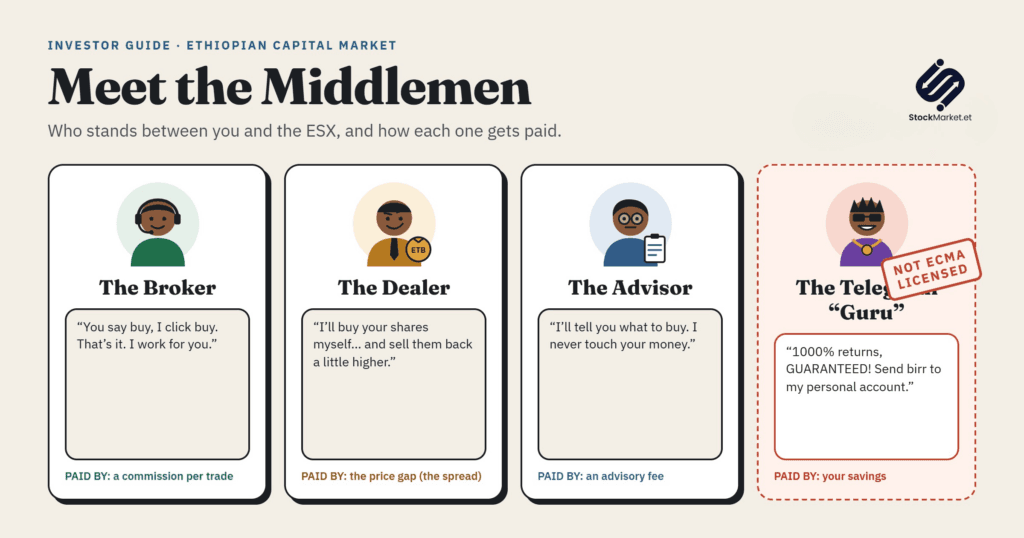
The broker: your agent in the market
A securities broker buys and sells shares on your behalf. When you tell your broker to buy 100 shares of a listed company, the broker sends that order into the ESX trading system and finds a seller at the best available price.
The key point for investors is that a broker works for you. It earns a commission on each trade, not a profit from the price you pay. Its job is to execute your instructions faithfully.
What to ask a broker:
- What commission do you charge per trade, and are there other fees (account opening, custody, withdrawal)?
- How do I place orders: in person, by phone, or through an app?
- How quickly will I receive confirmation and statements after a trade?
The dealer: a trader using its own money
A securities dealer also buys and sells securities, but for its own account. A dealer might buy shares from you directly and hold them, hoping to sell them later at a higher price. Dealers help keep the market liquid by standing ready to trade when other buyers or sellers are scarce.
For investors, the difference matters. When you trade with a dealer, the dealer is on the other side of the deal. It profits from the gap between the price at which it buys and the price at which it sells. That is legitimate, but it means the dealer’s interest is not identical to yours. Always compare the price a dealer offers against current market prices.
Many firms in Ethiopia hold licenses covering several activities. When ECMA issued its first investment bank and dealer licenses in 2025, the holders were authorized to offer investment banking, advisory, securities brokerage and dealing services. So one company may act as your broker on one trade and as a dealer on another. A good firm will tell you which role it is playing.
The investment advisor: guidance, not trading
A securities investment advisor helps you decide what to invest in. Advisors analyze companies, assess your goals and risk tolerance, and recommend a strategy. They do not execute trades on the exchange for you; you still need a broker for that.
Advisors are regulated in how they talk to you. Under ECMA rules, their advertisements must not be untrue or misleading, testimonials and claims about past profitable picks are restricted, and any charts or formulas must carry clear disclosures about their limits. Licensed advisory firms must also appoint a qualified research officer who is licensed by the Authority.
This is a useful test. If someone promising investment advice shows you screenshots of past winners, guarantees returns, or offers “free” signals that later come with strings attached, that is a warning sign.
What to ask an advisor:
- How are you paid: a flat fee, a percentage of assets, or commissions from products you recommend?
- Do you have any business relationship with the companies you are recommending?
- Can I see your ECMA license?
Investment banks: the bigger players
You will also hear about investment banks. These firms mainly help companies raise money, for example by managing an IPO or a bond issue. Some also provide brokerage and advisory services to individual investors. By early 2026, Ethiopia had 16 licensed market intermediaries: 5 investment banks and 11 securities dealers and investment advisors, and ECMA has continued to license new firms since then.
Where your shares actually live
Your broker places the trade, but your shares are recorded somewhere else. The National Bank of Ethiopia launched the Central Securities Depository (CSD) on 22 November 2025, together with the Ts’ega national investor portal. The CSD keeps the official record of who owns what. This separation protects you: even if a broker runs into trouble, the record of your ownership sits with the depository, not only on the broker’s books.
How to check whether a middleman is legitimate
Before you hand over money or personal details, run through these checks.
- Look them up on ECMA’s register: The Authority publishes announcements of every license it grants at ecma.gov.et. If a firm is not listed as licensed for the service it is offering you, stop there.
- Match the license to the service: An advisor’s license does not permit it to trade your money. If an “advisor” asks you to transfer funds so it can buy shares for you, that is a red flag.
- Check ESX membership for brokers and dealers: A trading license from ECMA is one step; the firm must also be a member of the exchange to execute trades there.
- Never pay into a personal account: Legitimate firms operate through company accounts and issue formal receipts and statements.
- Be wary of guaranteed returns: No licensed intermediary can promise that a share price will rise.
- Get everything in writing: Fees, services, and the firm’s role in each transaction should be documented before you commit.
The bottom line
Brokers carry out your orders, dealers trade with their own money, and advisors tell you what they think you should do. Each plays a legitimate role, and each has different incentives. The investor who understands those incentives, and who takes five minutes to verify a license, is far better protected than one who trusts a confident voice on Telegram.
Ethiopia’s capital market is young, and the list of licensed firms is still growing. That makes it more important, not less, to confirm who you are dealing with before your first birr leaves your account.


Comments