


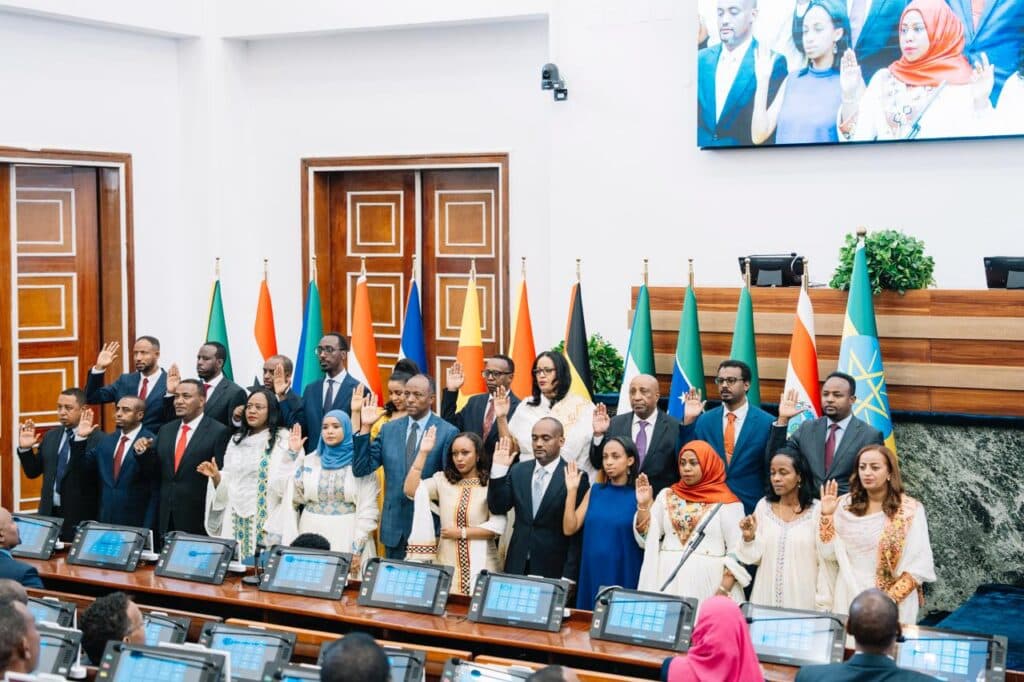
Pour the buna. This week’s number is 22. That is how many federal ministries Ethiopia’s new Council of Ministers will run, after the House of Peoples’ Representatives approved Prime Minister Abiy Ahmed’s cabinet on Wednesday. Nine of the 22 ministers are women, including three of the four who sit at the centre of fiscal and trade policy.
The cabinet was only the start. Over the week, the Prime Minister’s Office named a new head of the capital market regulator, a new chief of the Investment Commission, dozens of state ministers, and new leaders at the shipping line, the roads agency and the Institute of Foreign Affairs. Parliament opened its 7th term with Abiy sworn in for a third time and his finance minister of eight years moving to the Speaker’s chair.
Markets kept moving underneath all of it. The Ethiopian Securities Exchange traded more than 600 million birr in shares. Three banks published annual results. Two of the biggest private lenders launched international payment cards. And the central bank set a larger dollar-auction calendar for the quarter, starting Tuesday.
Here is the week.
Government
A new term opens: Abiy sworn in, Ahmed Shide becomes Speaker
Abiy Ahmed (PhD) was re-elected Prime Minister for another five-year term and sworn in on Monday, October 5, at the opening of the 7th parliamentary term. It is his third term since he first took office in 2018.
On the same day, Finance Minister Ahmed Shide was elected Speaker of the House of Peoples’ Representatives. He had led the Ministry of Finance since 2018, through the birr float, debt restructuring and the IMF-backed reform programme. He replaces Tagesse Chafo, Speaker since 2018.
Parliament approves a 22-ministry cabinet
Temesgen Tiruneh stays on as Deputy Prime Minister, a post he has held since 2024, after parliament approved the new Council of Ministers on Wednesday. Four of the 22 ministries have been rebranded or reorganised under the new executive structure, including a new Ministry of National Strategy.
The economic team:
- Finance: Fitsum Assefa (PhD), previously Minister of Planning and Development, takes over from Ahmed Shide
- Revenues: Aynalem Nigussie stays in post
- Trade and Regional Integration: Yasmin Wohabrebbi, the ministry that handles WTO accession talks and AfCFTA
- National Strategy: Bereket Fesehatsion
- Innovation and Technology: Frehiwot Tamiru, until now CEO of Ethio Telecom
Several senior ministers keep their portfolios, among them Berhanu Nega at Education, Mekdes Daba at Health, Gedion Timotheos at Foreign Affairs, Hana Arayaselassie at Justice and Habtamu Itefa at Water and Energy.
The full Council of Ministers
| Portfolio | Minister |
| Deputy Prime Minister | Temesgen Tiruneh |
| Finance | Fitsum Assefa (PhD) |
| Revenues | Aynalem Nigussie |
| Trade and Regional Integration | Yasmin Wohabrebbi |
| National Strategy | Bereket Fesehatsion |
| Agriculture | Addisu Arega |
| Industry | Feseha Yetagessu (PhD) |
| Mines | Alemtsehay Paulos |
| Logistics | Sadat Nesha |
| Urban Development and Infrastructure | Mohammed Abdurahman |
| Water and Energy | Habtamu Itefa (PhD) |
| Irrigation and Lowland | Sultan Weli (PhD) |
| Innovation and Technology | Frehiwot Tamiru |
| Culture and Tourism | Selamawit Kassa |
| Labor and Skill | Awelu Abdi |
| Education | Prof. Berhanu Nega |
| Health | Dr. Mekdes Daba |
| Women and Social Affairs | Shewit Shanka |
| Youth and Sport | Aklilu Tadesse (PhD) |
| Defense | Mohammed Idris |
| Foreign Affairs | Gedion Timotheos (PhD) |
| Justice | Hana Arayaselassie |
| Peace | Mussa Adem |
The Prime Minister’s Office takes shape
Alongside the cabinet, the Prime Minister announced a set of appointments inside his own office:
- Ambassador Betre Mengistu: Chief of Staff of the Prime Minister’s Office and Minister of Cabinet Affairs
- Adem Farah: Coordinator for Democratic System Building, with the rank of Deputy Prime Minister
- Enat Alem Meles: Minister of Government Communication Services
- Fikadu Tessema: Minister in charge of Government Affairs
- Daniel Kibret: Delivery Follow-up Sector Head, with the rank of Minister
- Ambassador Nasise Chali: ENFI Follow-up Sector Head, with the rank of Minister
- Coordinators for Democratic System Building (rank of Minister): Bikila Hurisa (PhD), Fisseha Dessalegn, Dereje Duguma (PhD), Tesfahun Gobezay and Habtamu Sisay
Getachew Reda was reappointed East Africa Affairs Advisor to the Prime Minister, with the rank of Minister.
State ministers named, and new heads at three agencies
In a list dated Meskerem 30, 2019 E.C. (October 10, 2026), the Prime Minister’s Office named 44 state ministers across the new ministries, including two at Finance, three each at Agriculture, Defense, Peace, Justice, Trade, Industry, Innovation and Technology, Health and Women and Social Affairs, and two at Revenues.
Leadership also changed at three federal institutions:
- Engineer Shimelis Eshetu: Director General, Ethiopian Roads Administration
- Abdulwasa Abdullahi (PhD): Director General, Institute of Foreign Affairs
- Captain Tefera Kassa: CEO, Ethiopian Shipping and Logistics
President Taye: sea access remains a central priority
Addressing a joint session of both houses of parliament on Tuesday, President Taye Atske Selassie said Ethiopia will step up efforts to secure reliable access to the sea, Birrmetrics reports. He said the goal will be pursued through peaceful means, dialogue and arrangements based on mutual benefit, as part of the government’s wider foreign-policy and economic agenda. He added that foreign policy will continue to focus on regional peace, economic integration and engaging countries with differing positions through diplomacy.
Capital Market
Dagmawit Shiferaw takes the helm at ECMA
Dagmawit Shiferaw has been appointed Director General of the Ethiopian Capital Market Authority, replacing Hana Tehelku, who moves to lead the Ethiopian Investment Commission. Yirgalem Assefa (PhD) has been named ECMA’s Deputy Director General.
Dagmawit has more than 15 years of experience across investment management, innovative finance, telecommunications, consulting and the public sector, with roles at UNDP, Renew Capital, STGT Trading, Candor Consultancy and Ethio Telecom. Since 2023 she has been Director of the Innovative Finance Lab at UNDP Ethiopia.
Hana had led ECMA since August 2024, succeeding founding Director General Brook Taye. During her tenure the Ethiopian Securities Exchange launched (January 2025) and the first foreign investment bank was licensed. ECMA now oversees 26 registered companies, seven of them active in the securities market.
The same reshuffle, set out in a Prime Minister’s Office list dated October 10, also reached the investment agencies:
- Ethiopian Investment Commission: Hana Tehelku as Commissioner, with Melekit Sahlu and Baysa Bedada (PhD) as Deputy Commissioners. Hana replaces Zeleke Temesgen.
- Ethiopian Investment Holdings: Zeleke Temesgen (PhD) and Jafar Bedru as Deputy CEOs
- Immigration and Citizenship Service: Ambassador Fitsum Arega as Director General
- Ethiopian Diaspora Service: Ambassador Lencho Bati as Director General
ESX: 614 million birr traded in a week
The Ethiopian Securities Exchange recorded ETB 613.9 million in equity turnover between October 5 and 9, across 415 trades and 251,010 shares in its seven listed securities, according to the exchange’s weekly statistics.
Against the previous week (ETB 510.05 million, 525 trades, 215,325 shares), value traded rose about 20% and volume about 17%, while the number of trades fell about 21%.
The interbank money market, which also runs on the ESX platform, moved ETB 51.1 billion, up from ETB 37.1 billion the week before:
| Maturity | Value traded | Trades | WA interest rate | Change |
| Overnight | ETB 8.1 billion | 7 | 13.00% | 0.21% |
| 7 days | ETB 43.0 billion | 44 | 13.00% | 0.02% |
Kenya opens the Dangote refinery IPO to more local investors
Kenya’s Capital Markets Authority has approved seven licensed intermediaries to help Kenyan investors take part in the IPO of Dangote Petroleum Refinery & Petrochemicals in Nigeria. The move follows approval by Nigeria’s SEC for Kenya’s Global Depository Receipt investors to participate.
The approved firms are CPF Capital & Advisory, SBG Securities (with Stanbic Bank Kenya as custodian), Francis Drummond & Company, National Bank of Kenya, Sterling Capital, Kestrel Capital (East Africa) and AXYS Investment Bank. The offer closes on October 13, 2026. The CMA said it remains open to approving more intermediaries.
Africa gets its own credit rating agency
The African Union launched the Africa Credit Rating Agency (AfCRA) on Wednesday in Port Louis, Mauritius, where it will be headquartered. African leaders endorsed its creation in 2018.
AfCRA will rate sovereigns, financial institutions and private companies. It will operate independently and be funded through shareholder capital and its own operations; the AU has not disclosed who the shareholders are. Afreximbank is one of its backers.
According to the AU, African economies carry average ratings of around B to B-minus, against BB for other emerging regions; 23 African economies have no rating from S&P, Moody’s or Fitch; and annual external debt service on the continent rose to $163 billion in 2024 from $61 billion in 2010. The three major agencies have rejected claims of systematic bias, saying they apply the same methodologies globally. Former Nigerian Vice President Yemi Osinbajo said the new agency must meet international standards.
Banking and FX
NBE raises Q2 auction supply to $840 million
The National Bank of Ethiopia will sell $840 million to commercial banks through foreign exchange auctions in the second quarter of the 2026/27 fiscal year, StockMarket.et reports. That is 68% more than its regular first-quarter allocation of $500 million.
There will be six bi-weekly auctions of $140 million each, up from four auctions of $125 million in Q1:
- October 13
- October 27
- November 10
- November 24
- December 8
- December 22
In Q1, the August 12 auction cleared at a record 161.7994 birr per dollar, with banks bidding $470.17 million for $125 million on offer; the NBE then held a special sale matching the entire quarterly allocation in one day. At the September 9 auction, bids totalled $120 million against $125 million offered, the first time since results began to be published that the supply was not fully taken up.
Ethiopia is projected to import $25.8 billion worth of goods in 2026/27, with fuel accounting for about $6 billion. The IMF board approved the programme’s fifth review on July 1, 2026, releasing about $464 million and bringing total disbursements to roughly $2.65 billion.
Three banks report: Abay, Oromia, Zemen
Annual results for the year to June 30, 2026 came in from three lenders this week.
Abay Bank (ESX: ABAYB) reported profit before tax of Birr 6.22 billion, up 47.6% from Birr 4.22 billion, according to audited statements reported by Ethiopian Business Review. Net profit after tax was Birr 4.55 billion.
- Total operating income: Birr 13.12 billion (up 25%)
- Net interest income: Birr 8.61 billion (from 6.26 billion)
- Net FX valuation gains: Birr 1.51 billion (down from 1.87 billion)
- Total assets: Birr 119.69 billion (from 91.35 billion)
- Deposits: Birr 92.74 billion (from 71.91 billion)
- Loans and advances: Birr 61.15 billion (from 48.65 billion)
- Paid-up capital: Birr 9.66 billion; capital adequacy ratio 17.04% (from 15.11%)
- Raised Birr 2.64 billion in new shares and paid Birr 2.04 billion in dividends
Abay listed on the ESX main market on June 25, 2026.
Oromia Bank reported pre-tax profit of 3.82 billion birr, up 49%, at its shareholder meetings on October 10, Birrmetrics reports. Net profit after tax rose 44% to 2.84 billion birr, and earnings per share rose to 386 birr from 297.
- Total income: 15.24 billion birr (up 23%); total expenses 11.42 billion birr (up 17%)
- Fee and commission income: 2.45 billion birr (down 19%)
- Other local income: 1.89 billion birr (up 213%, from about 604 million)
- Foreign-currency mobilisation: $262.65 million (down nearly 20% from $328.25 million); inward transfers down 69.09%, export proceeds down 31.9%
- Total assets: 105.7 billion birr; deposits 88.1 billion birr (both up 24%)
- Loans and interest-free financing: 56.2 billion birr (up 28%)
- Paid-up capital: 7.8 billion birr; total capital 14 billion birr
- Non-performing loans: 2.43%; return on equity 37.5% (from 38.46%)
Zemen Bank reported profit after tax of ETB 6.75 billion, up 15%, according to a statement from Board Chairman Ermias Eshetu, StockMarket.et reports. Profit before tax rose 13% to ETB 9.3 billion and total operating income 17% to ETB 14.2 billion. Foreign exchange gains fell 39%. Earnings per share were ETB 539, down from ETB 683, which the bank attributed to its enlarged capital base ahead of new regulatory capital requirements.
Cards go international: Oromia Bank with Visa, Awash Bank with Mastercard
Two banks launched international payment cards on the same day.
Oromia Bank unveiled three Visa tiers at Skylight Hotel: Oro Visa Classic, Gold and Platinum, in partnership with Visa and Premier Switch Solutions (PSS), Ethiopia’s first Visa-certified third-party processor, StockMarket.et reports. CEO Teferi Mekonnen said the cards extend customers’ international payment options and can be used anywhere the Visa network is accepted, for travel, education, business and online shopping.
Awash Bank launched five card services with Mastercard at Elilly International Hotel, StockMarket.et reports. Four are international: the World Elite International Debit Card and the Platinum, Gold and Corporate International Prepaid Cards. The fifth is the domestic Awash Plus Contactless Debit Card. CEO Tsehay Shiferaw said the products were developed in response to the government’s foreign currency reforms.
Commodities and Industry
Ethiopia’s first gold refinery targets 600 tonnes a year
Ethiopia’s first gold refinery is targeting annual processing capacity of more than 600 tonnes in its first phase. The facility is also intended to serve as a regional refining hub.
The project estimates the value of gold processed each year at about $80 billion at full capacity. Birrmetrics notes that this is the value of the gold handled, not revenue to the refinery or the economy. Investment cost, construction timetable, ownership and employment figures have not been published.
ICO launches a free coffee market data platform
The International Coffee Organization has launched the Coffee Market Intelligence Platform, a free interactive tool that brings global coffee prices, trade flows, production and consumption data into one place, StockMarket.et reports. It was unveiled at the 142nd Session of the International Coffee Council in Geneva and covers more than 200 countries.
Its 2025 trade-flow view maps 246 export corridors totalling 141.8 million 60-kg bags. The largest routes are Brazil to Germany (5.42 million bags), Brazil to the US (5.40 million) and Colombia to the US (5.30 million). Uganda to Italy (2.89 million bags) is the only African corridor in the top ten. The latest full year of data is free; historical series and data extraction are reserved for ICO members and subscribers. The platform is at data.ico.org.
📖 Deep Dive: The Impatient Economy
In 1930, Irving Fisher called interest “the price of impatience.” The second part of our series on Ethiopia’s new monetary framework, by Yesuf Hadji, asks whether anyone will give the new system enough time to work.
The piece traces what changed in July, when the NBE removed the credit cap and raised the National Bank Rate from 15% to 16%: the central bank stopped rationing money and started pricing it. It then sets out how slowly a rate change travels, from the interbank market within days to prices after a year or more, noting that the system’s tools are younger than that delay.
Meanwhile, inflation has risen four months in a row, to 15.3% in July, while most savings accounts still pay around 7%. The article walks through four sources of pressure for quick results (households, banks, the government and the central bank itself) and closes with six things it argues patience would look like in practice, from acting early to building a proper market for government securities.
A new term, a new cabinet and new names at the desks that matter most to markets: Finance, Revenues, Trade, the capital market regulator and the Investment Commission. On the screen, the ESX passed 600 million birr in weekly trading, banks reported their year, and the central bank’s bigger dollar calendar begins tomorrow.
See you next Monday ☕