


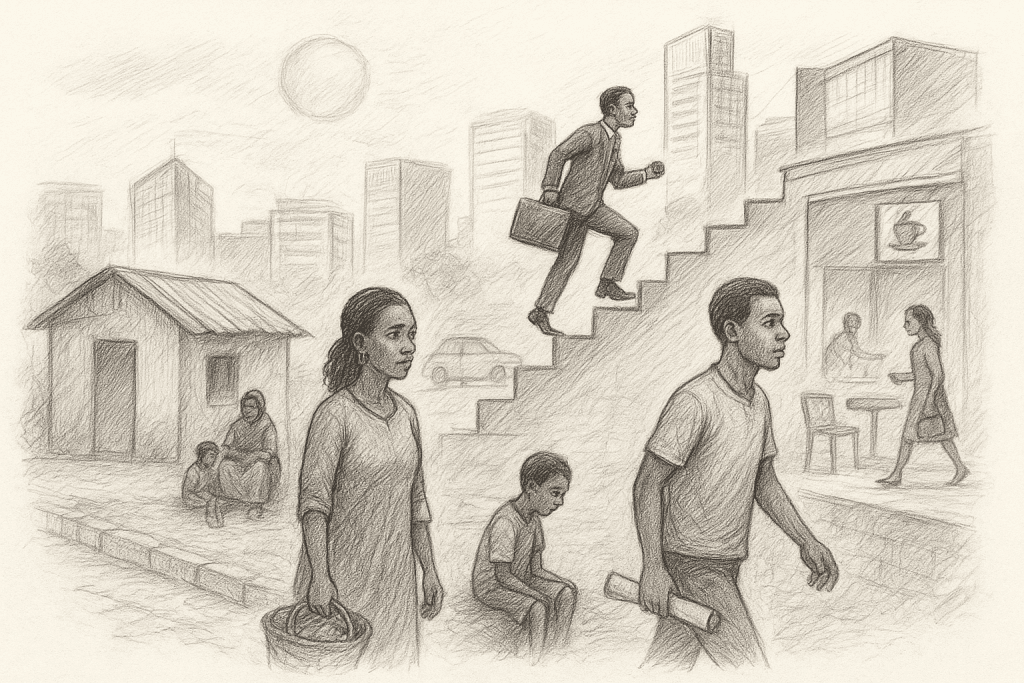
“Why do some Ethiopians earn 20 times more than others in the same city?”
That question feels like an accusation and a confession all at once. Walk down any main street in Addis Ababa and you’ll see it: shiny cafés and new office towers standing beside neighborhoods where a day’s wages pays for a single meal. Ethiopia’s economy is changing fast, moving away from a state-led development model toward a more market-driven one and with that change has come a new pattern of winners and losers. The economy is growing on aggregate, but growth alone hasn’t flattened the ladder; instead, it’s made the top rungs steeper and further apart.
As Ethiopia undergoes capitalist reforms, from partial privatization to a loosening of price controls and the beginnings of a formal capital market, income mobility is becoming increasingly unequal. That’s the uncomfortable thesis of this article: policy shifts, currency dynamics, and access to foreign exchange are now as important as hard work and talent in determining who ends up in the high-income bracket.
The Depth of Poorness and the Shrinking Middle Class
On paper, Ethiopia’s economy appears to be climbing. GDP per capita has risen from $857 in 2022 to $926 in 2024, a steady upward trend that signals progress by most development standards. Yet, for many Ethiopians, life feels like it’s moving in the opposite direction.
Prices rise faster than paychecks, and even as the economy grows, people’s ability to live decently, to afford rent, food, transport, and education, is eroding. The contradiction between macro growth and micro struggle defines Ethiopia’s “new economy of inequality.”
Inflation tells part of this story. After peaking at over 30% in 2023, it has now eased to around 13.2%, but the damage from years of price shocks lingers. Inflation in Ethiopia isn’t a temporary flare-up, it’s a chronic condition that has eaten away at real purchasing power for nearly a decade. Food, fuel, and housing costs continue to rise in absolute terms, meaning that a lower inflation rate doesn’t necessarily translate to relief; it only means the pain is spreading more slowly.
Then there’s the birr, whose dramatic fall has quietly rewritten the country’s income hierarchy. In just a few years, the exchange rate has slid from 58 ETB/USD to around 147 ETB/USD on the market, a devaluation of nearly 150%.
For exporters, dollar earners, and diaspora-linked families, this depreciation has inflated local income. For salary-based workers, especially in the public sector, it has been devastating. Their wages are denominated in birr but their expenses, many imported goods and even locally priced rents, behave as if pegged to the dollar.
Research already hinted at this shift years ago. According to Wieser et al. (2021), real wages in 2020 were on average 3% lower in April and 17% lower in December compared to the same months in 2019. That was before the full impact of currency liberalization and post-conflict inflationary pressures.
If that trend had continued, adjusting for the inflation spikes of 2022–2024 and the steep birr depreciation, real wages today could easily be much lower than their 2019 purchasing power in high stakes. In short, an employee earning 10,000 birr in 2019 would need more than 25,000 birr just to stand still, but many still earn the same or less.
The result is a silent crisis in the urban middle class, which once formed the backbone of Ethiopia’s consumer economy. Teachers, civil servants, and low-level professionals now find themselves slipping into near-poverty, while traders, exporters, and dollar earners surge ahead.
Addis Ababa, the country’s commercial capital, illustrates this divide: a city where one person’s rent equals another’s entire monthly salary, and where “middle-income” no longer guarantees stability.
What’s emerging is not just poverty, but a stratified economy, one where your access to foreign currency, assets, and market-linked income determines your real standard of living. This isn’t simply a matter of who works hardest, it’s about who’s positioned on the right side of Ethiopia’s reform-era economy.
The Weakness of the Birr: Who Gains and Who Loses
The birr has become one of Ethiopia’s most talked-about currencies, not for its strength, but for its fragility. Its steady decline over the past few years has reshaped nearly every corner of the economy. On the surface, the depreciation looks like a technical adjustment, a move toward a market-determined exchange rate that aligns with Ethiopia’s economic reform agenda. But behind the numbers lies a quiet redistribution of wealth: a shift that rewards some and punishes others.
Exporters are among the biggest winners of this shift. They receive their revenues in foreign currency but pay wages and local expenses in birr. When the birr weakens, their profit margins expand automatically. Similarly, remittance earners, families with relatives abroad, are benefiting from the roughly $5–6 billion sent home annually. Each dollar or euro remitted translates into a much larger local sum than it did a few years ago, cushioning them against domestic price surges.
Then there’s the quiet rise of digital and globally connected work. In cities like Addis Ababa, a new class of freelancers, consultants, and remote employees are tapping into foreign income streams. A software developer earning $500 a month from Upwork or Fiverr now makes close to 60,000 birr, while a government employee earning 15,000 birr struggles to pay for rent, transport, and groceries. The difference isn’t necessarily effort, it’s currency exposure.
Meanwhile, import-dependent businesses face the opposite fate. The same depreciation that rewards exporters makes imported goods, from fuel to raw materials, dramatically more expensive. Local manufacturers that rely on foreign inputs are forced to raise prices or cut production, which feeds back into inflation.
Salary earners, particularly those in the public sector, are squeezed hardest. Their nominal wages remain largely unchanged while the cost of living rises month after month, effectively taxing them through inflation.
The result is what economists call a “dual economy.”
One side operates in or around foreign exchange, exporters, remittance earners, digital workers, and investors. The other, much larger side, survives entirely within the birr-based economy, absorbing the full brunt of depreciation and price instability. The gap between these two economies isn’t just about income; it’s about opportunity, stability, and access.
Those who can find a way to link even a small portion of their income to hard currency are quietly escaping the inflation trap, while those who can’t are left running faster just to stand still.
The weakening of the birr has therefore become more than a monetary issue; it’s a mirror reflecting the structure of Ethiopia’s transition. A market-driven system without inclusive access to capital and forex creates new elites faster than it creates new opportunities. The challenge, then, is not only to stabilize the currency but to ensure that the pathways to earn and invest in foreign-linked sectors are open to more Ethiopians, not just the privileged few.
Capitalist Reform and Income Divergence
Ethiopia’s economic story today is one of bold reform and quiet divergence. The government’s Homegrown Economic Reform Agenda (HGER), launched to open markets, attract investment, and modernize finance, is reshaping how wealth is created and distributed.
In theory, these changes aim to build efficiency and unleash private enterprise. In practice, they are redrawing the income map, creating new winners and leaving many behind.
The reform’s foundation lies in a major philosophical shift: moving from state-led growth to market-determined outcomes. For decades, Ethiopia’s economy was guided by public investment, fixed prices, and controlled sectors. That model built infrastructure and lifted millions from poverty, but it also constrained competition.
Today’s reforms flip that logic, liberalizing trade, attracting private capital, and allowing prices to reflect supply and demand. Yet as the state steps back, not everyone is equally equipped to step forward.
Investors now prefer sectors that promise quick returns, like logistics, tech, and manufacturing, over traditional agriculture or state-heavy industries. The result is an uneven geography of opportunity: booming enclaves in Addis Ababa and industrial parks, and stagnation elsewhere.
Privatization has been another key pillar. The partial sale of Ethio Telecom, the licensing of Safaricom Ethiopia, and plans to liberalize banking and logistics mark the country’s clearest steps toward a private-sector economy.
These changes have opened doors for entrepreneurs and professionals who understand finance, regulation, and technology. But for workers in public service or small-scale business, the benefits are less tangible. Wages in the private sector can be double or triple those in government, but they also come with higher volatility and limited job security. It’s a shift from predictable poverty to unpredictable prosperity and not everyone can afford that gamble.
In short, the shift toward capitalism is creating a new hierarchy of income and access. The dividing line is not just who works hardest, but who understands the system. Those with the literacy to navigate finance, the capital to invest, and the networks to seize reform-era opportunities are emerging as Ethiopia’s new high-income class.
For them, reform is liberation. For others, it’s dislocation, a new economy where knowledge gaps, not just income gaps, determine destiny.
As Ethiopia continues this transformation, the challenge will be to ensure that the market’s invisible hand doesn’t become a closed fist, rewarding only those already inside the circle of opportunity.
Ethiopia stands at a crossroads, where rapid reform and growth promise unprecedented opportunities, but also expose deep structural inequalities. The widening gap between dollar-linked earners and birr-dependent workers is not just a short-term imbalance; it is a reflection of how policy, access, and information shape who thrives and who struggles. Addressing this divide will require more than macroeconomic stability; it calls for inclusive policies, broader financial literacy, and pathways for ordinary Ethiopians to participate in the new economy.
Without deliberate interventions, the country risks entrenching a dual economy, where prosperity is concentrated in the hands of a few, and the majority are left sprinting just to stay in place. Ethiopia’s future, therefore, will be measured not only by GDP growth but by whether its rising tide lifts all boats—or only the yachts.


Comments