


Good morning!
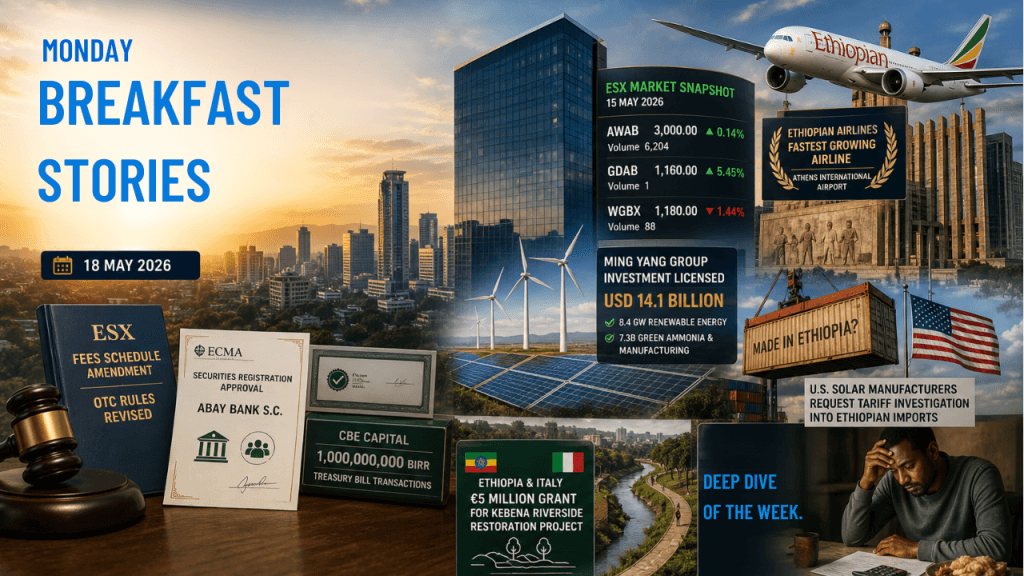
The ESX spent the week upgrading its own architecture. Fee caps on new listings, lower block trade costs, revised OTC rules that finally let banks and pension funds into the debt market, and Abay Bank joining the registration queue: this exchange is not waiting for the market to mature on its own, it is actively lowering the barriers to get there faster. CBE Capital crossed 1 billion birr in Treasury Bill transactions, a quiet first that shows the fixed-income side is finding real traction. Ming Yang Group, the Chinese renewables giant that signed a USD 10 billion agreement at the last Invest in Ethiopia Forum, got its investment license this week and the number has since grown to USD 14.1 billion. Italy signed a €5 million grant to restore Addis Ababa’s Kebena river tributaries. Ethiopian Airlines added a Fastest Growing Airline prize in Athens to its APEX Best in Africa award from two weeks ago. U.S. solar manufacturers put Ethiopia in an unwelcome trade spotlight. And the week’s sharpest piece of writing laid out what inflation and the birr depreciation have quietly done to Ethiopia’s urban salaried class. Not a slow week.
Grab your buna. There is a lot on the plate this morning.
Capital Market Spotlight
ESX cuts fees, revises OTC rules, and opens the debt market to banks and pension funds
The Ethiopian Securities Exchange announced the first amendment to its Fees Schedule this week, introducing a set of changes designed to make the market more accessible for issuers, brokers, and large-volume traders alike.
The headline moves: listing fees are now capped at 500,000 birr for equity issuers, removing the open-ended exposure that had been a quiet concern for companies sizing up their listing costs. Block trade fees were lowered, directly targeting institutional activity where ticket sizes are large enough for basis-point differences to matter. The exchange also introduced formal admission charges for the OTC market, signalling that what was once an informal channel is being brought fully under the regulatory and commercial framework of the exchange.
The OTC rule revision that accompanied the fee changes is the more structurally significant move. Under the revised rules, commercial banks and pension funds are now permitted to participate directly in debt securities trading on the OTC market. That is a meaningful expansion of the institutional buyer base for government and corporate bonds. Until now, the OTC market’s participation pool was narrower, limiting the depth that bond issuers could count on. Bringing in banks, which hold substantial liquidity and naturally match the duration profile of debt instruments, and pension funds, whose liability structures make fixed-income a natural fit, gives the OTC market the institutional foundation it has been missing.
Tighter disclosure and enforcement requirements for issuers were also part of the package, a reminder that the expansion of participation rights comes with higher standards of transparency expected in return.
Abay Bank clears ECMA registration, joins the listing pipeline
The Ethiopian Capital Market Authority approved the securities registration of Abay Bank S.C. this week, adding another name to the growing queue of banks preparing for eventual listing on the ESX. Abay Bank joins Wegagen, Gadaa, and Awash, which are already on the main board, and a pipeline that now includes Zemen, Bank of Abyssinia, Dashen, and others at various stages of the process.
The registration approval is not a listing date, but it is a formal gate that banks must clear before they can proceed. Each approval that comes through narrows the gap between the current three-name main board and the broader capital market that Ethiopia’s economy warrants.
CBE Capital crosses 1 billion birr in Treasury Bill transactions
CBE Capital announced this week that it has become the first investment bank in Ethiopia to surpass 1 billion birr in total Treasury Bill transactions. The milestone matters less as a headline number and more as a signal: the fixed-income side of Ethiopia’s capital market is generating real throughput, not just symbolic activity. Treasury Bills are the entry point for institutional fixed-income investment, and CBE Capital’s volume shows that both supply and demand exist in meaningful quantities. As more investment banks come online through the ESX membership expansion, and as the OTC rule changes bring pension funds and commercial banks into the mix directly, that 1 billion birr baseline will look modest quickly.
Market Snapshot: ESX, 15 May 2026
Ethiopia’s three listed equities all traded on May 15. The session’s story was written almost entirely by Awash Bank.
AWAB closed at ETB 3,000.00, up 0.14 percent (+4.08), on volume of 6,204 shares, accounting for the overwhelming majority of the day’s activity. At ETB 3,000, Awash sits more than 2.5x above its peers on unit price and is currently functioning as the exchange’s liquidity anchor, the name investors reach for when they want to move size. It is the newest issuer and carries the largest free float on the board, with 37.90 million listed shares out of 54.07 million registered.
GDAB closed at ETB 1,160.00, up 5.45 percent (+60.00), on a single share traded. The price move looks dramatic in percentage terms but the volume tells the real story: one transaction does not make a trend. Gadaa Bank has approximately 31,000 shareholders and 1.23 million listed shares, and the absence of volume on most sessions reflects a market still building the retail participation it needs.
WGBX closed at ETB 1,180.00, down 1.44 percent (-17.23), on 88 shares. The ESX pioneer, listed 10 January 2025, saw light-volume consolidation. A -1.44 percent move on 88 shares is not a fundamental signal; it is the natural drift of a thin book. With 14,549 shareholders and 6.22 million listed shares, Wegagen has the broadest shareholder base on the exchange and remains the reference point for how the pioneer issuer performs through market cycles.
Source: ESX Neway, 15 May 2026
Investment & International Partnerships
Ming Yang Group gets its license: a USD 14.1 billion renewable energy bet moves from paper to reality
At the 4th “Invest in Ethiopia” Forum, seven investment agreements worth a combined USD 13.1 billion were signed. The biggest of them just got its investment license. Ming Yang Group, the Chinese renewables conglomerate that signed for USD 10 billion at the forum, has now been formally licensed by the Ethiopian Investment Commission, and the number has grown: the total commitment is now USD 14.1 billion.
The first phase alone is USD 7.47 billion, covering an 8.4 gigawatt renewable energy project across the South Omo, Afar, and Somali regions: 5.4 gigawatts from wind and 2.8 gigawatts from solar. The second phase adds USD 7.3 billion in green ammonia production, electric transmission equipment manufacturing, and wind turbine production, the kind of downstream industrial activity that turns an energy project into a manufacturing anchor.
The EIC framed the licensing as confirmation that investor confidence in Ethiopia’s reform programme is translating into real commitments, not just forum handshakes. Five companies from the 3rd “Invest in Ethiopia” Forum have already commenced operations and are exporting. That track record is what gives the Ming Yang license its weight: the pipeline is moving. Source: EIC
Ethiopia and Italy sign a €5 million grant for Kebena riverside restoration
Ethiopia and Italy signed a €5 million grant agreement this week to fund the Kebena Tributaries Riverside Development Project in Addis Ababa’s Yeka sub-city. The 24-month programme, implemented by the Addis Ababa Urban Beautification and Greenery Development Bureau, will rehabilitate two heavily polluted tributaries of the Kebena River through sewer construction, stormwater drainage works, riverbank protection, and the creation of riparian buffer zones with native vegetation and public recreational spaces.
Finance Minister Ahmed Shide described the initiative as consistent with the government’s push toward sustainable urban development. The project sits within the broader Beautifying Sheger framework, the same programme behind Friendship Park and the riverside corridor upgrades that have reshaped parts of the capital in recent years. Italy’s continued financial commitment to Ethiopian urban infrastructure is one more thread in the bilateral economic relationship that has been deepening across investment, debt restructuring, and development cooperation. Source: Ministry of Finance
Trade & International
U.S. solar manufacturers request tariff investigation into Ethiopian imports
A coalition of U.S. solar panel manufacturers filed a request with the U.S. Department of Commerce this week, asking for a formal investigation into solar panel imports from Ethiopia. The allegation: Chinese-linked firms are using Ethiopia as a transshipment point to route solar products into the United States while bypassing existing anti-dumping and countervailing duties on Chinese solar goods.
The claim is not about Ethiopian manufacturing capacity. It is about the global trade-deflection strategies that Chinese solar producers have deployed across multiple low-tariff jurisdictions since U.S. duties on Chinese panels tightened. Cambodia, Vietnam, and Malaysia have faced similar investigations. Ethiopia is the newest name on that list.
If the investigation proceeds and finds evidence of circumvention, tariffs on Ethiopian solar exports to the U.S. could follow. The immediate economic impact on Ethiopia is limited, the domestic solar manufacturing base is not a major export driver, but the reputational signal matters. Ethiopia is in the middle of a sustained push to attract foreign direct investment and position itself as a manufacturing hub under the Africa Growth and Opportunity Act framework. Any association with trade rule arbitrage, even one it did not initiate, creates a compliance question mark for investors watching from Washington.
Africa & Business
Aliko Dangote and the weight of actually building things
At the Africa CEO Forum in Nairobi this week, Emmanuel Macron unveiled a 27 billion dollar French investment package for the continent and made an unusual pitch: Africa’s wealthy should invest at home rather than park capital abroad. The cameras swept the room and landed on Aliko Dangote, the man who has been doing exactly that for three decades.
A piece published on Stockmarket.et this week traced Dangote’s trajectory from a trading business in Kano in the early 1980s to a continental industrial empire spanning cement, petrochemicals, and infrastructure in over 20 African countries. The Dangote Refinery in Lagos, Africa’s largest, represents roughly 20 billion dollars of capital deployed over more than a decade: a project that survived cost overruns, construction delays, regulatory friction, and a global pandemic before beginning operations.
The lessons for Ethiopia’s own capital market moment are not about scale. They are about patience, about building industry rather than trading assets, and about the difference between an economy that produces things and one that only intermediates them. As the ESX pipeline fills with bank listings and the OTC market begins channeling institutional capital into debt instruments, the question for Ethiopia’s reform economy is whether the market infrastructure being built will eventually finance a Dangote-scale manufacturing bet. That is still a long way off. But the infrastructure for it is, slowly, being put in place. Read more
Aviation
Ethiopian Airlines wins Fastest Growing Airline award at Athens International Airport
Ethiopian Airlines was recognised as the Fastest Growing Airline at Athens International Airport this week, adding another accolade to a trophy cabinet that already includes Best Airline in Africa from the APEX Passenger Choice Awards earlier this month. The Athens award reflects the airline’s aggressive route expansion into European markets, a key pillar of its Vision 2035 strategy to become a top-20 global aviation group. Load factors on European routes have been a priority as the airline expands its long-haul fleet, and recognition from a major European hub carries commercial value beyond the ceremony: it reinforces the airline’s premium positioning with the travel agents and corporate bookers that route decisions depend on. Source: EBC
Deep Dive of the Week
The Funeral of Ethiopia’s Middle Class
Addis Ababa has started to feel like two cities stacked on top of each other. One runs on dollars, generators, imported marble, and apartments quietly priced in foreign currency even though everyone pretends otherwise. A 150-square-metre unit in Bole or Old Airport now sells for between $180,000 and $270,000. Luxury villas in the same areas regularly cross 40 million birr.
A few kilometres away, a civil servant earning under 5,000 birr a month is making impossible calculations with perfect precision. Rent or food. Fuel or school fees. Cooking oil or internet. Incomes are fixed in birr. Life is not.
A new analysis by Yesuf Hadji published this week on Stockmarket.et maps the structural forces behind that split. Between 2004 and 2019, Ethiopia’s economy averaged close to 10 percent annual GDP growth. A young urban professional class formed around government employment, banking, telecom, education, and small business activity. It was never wealthy, but it was stable enough to plan.
Then the sequence hit: the COVID shock, the Tigray conflict, the July 2024 macroeconomic reform that floated the birr, and two waves of fuel price increases. Individually any one of those events would have compressed middle-class purchasing power. Together they compounded. The birr lost roughly half its value against the dollar in 2024 alone. Inflation, which returned to double digits in April 2026, has continued eroding real wages. The people most exposed are exactly the salaried, urban, educated Ethiopians who were supposed to be the base of a growing consumer economy and, eventually, the retail investor class that Ethiopia’s capital market needs.
The piece is uncomfortable reading and worth your time. The reforms that are building the ESX, liberalising insurance, and bringing foreign banks into the system are real and necessary. But the population that would most benefit from those structures as retail investors, the urban middle class, is under more financial pressure today than at almost any point in the recent past. That tension is not a reason to slow the reform. It is a reason to accelerate the parts of it that reduce cost of living, stabilise the birr, and create employment at scale. Read the full piece
That is your Monday Breakfast Stories for this week. The ESX rewrote its own fee schedule and opened the OTC market to institutional buyers, CBE Capital cleared 1 billion birr in T-Bill transactions, Abay Bank joined the registration queue, Ming Yang got its license and its investment commitment grew to USD 14.1 billion, Italy signed a €5 million Kebena riverside grant, Ethiopian Airlines picked up another award in Athens, U.S. solar manufacturers put Ethiopia in an unwelcome trade spotlight, and the week’s sharpest piece of analysis asked a question that the headline growth numbers tend to skip: who is actually getting ahead? The market infrastructure is being built. The people it is meant to serve are under real pressure. Both things are true at the same time.
Keep your coffee strong and See you next Monday. ☕