


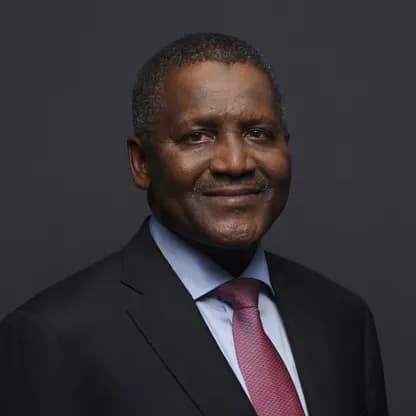
On a Tuesday in May 2026, inside Nairobi’s Kenyatta International Convention Centre, Emmanuel Macron stood before African presidents, ministers, bankers, and billionaires to unveil a $27 billion investment package. Then he made an unusual pitch: Africa’s wealthy should invest in France.
Thirty heads of state listened carefully. So did one private citizen seated quietly among them, a 69-year-old Nigerian industrialist in a white kaftan who, by that point in the year, had added nearly $6 billion to his fortune.
That man was Aliko Dangote.
For nearly two decades, he has been the richest man in Africa. But wealth alone does not explain why presidents court him, why governments redesign policy around him, or why global investors study his next move like a geopolitical signal.
To understand that, you have to go back to Kano.
Aliko Dangote was born on April 10, 1957, in Kano, one of West Africa’s oldest trading cities, where caravan routes once ended and fortunes were built long before oil was discovered in Nigeria.
His great-grandfather, Alhassan Dantata, was once considered the richest man in West Africa. Wealth in the Dangote family was never abstract. It was inherited through trade, logistics, and volume.
As a child, Dangote reportedly bought cartons of sweets with his pocket money and resold them to classmates at a profit. The story gets repeated so often because it explains almost everything about the man he would become.
The instinct was never simply about money.
It was about movement.
Find demand. Secure supply. Scale distribution. Repeat.
Half a century later, the cement kilns in Mugher, the refinery towers in Lekki, and the ports he wants to build across Africa still operate on that exact logic.
After studying business in Cairo, Dangote returned to Nigeria in the late 1970s and started a small trading company with a loan of roughly $3,000 from an uncle. He repaid it within months.
At first, he traded what Africa imported most: rice, sugar, flour, cement.
But then he noticed something bigger.
Everyone around him was making money importing products into Africa. Almost nobody was building the factories to produce them inside Africa.
That observation changed his life and eventually parts of the continent itself.
During the 1990s, many African business elites thrived on import licenses, currency arbitrage, and political connections.
Dangote moved in the opposite direction.
Instead of becoming a larger trader, he started dismantling his dependence on trade entirely.
He built a sugar refinery. Then a pasta plant. Then salt processing facilities. Then cement factories.
In 2003, he commissioned the massive Obajana cement plant in Nigeria’s Kogi State, a project many thought was too ambitious, too expensive, and too risky.
It worked.
And once it worked, the strategy became clear.
Africa’s biggest opportunity was never importing goods from abroad. It was replacing those imports with local industry.
That became the blueprint for everything that followed.
Today, Dangote Cement operates across multiple African countries and has become one of the largest cement producers on the continent.
The formula rarely changes:
- Enter a market with rising construction demand
- Build local production capacity
- Undercut imports
- Scale aggressively
- Control supply chains
It sounds simple now. It did not sound simple twenty years ago.
And nowhere tested that strategy more severely than Ethiopia.
In 2015, Dangote Cement commissioned its Mugher cement plant roughly 85 kilometres west of Addis Ababa.
The project was ambitious: a 2.5-million-tonne-per-year facility meant to serve one of Africa’s fastest-growing construction markets.
Then came the instability.
In 2018, amid unrest in Oromia, the plant’s country manager and two employees were killed in an attack linked to regional tensions. Equipment was vandalized. Operations became difficult. Imported coal shipments faced disruptions.
For many foreign investors, that would have been the end of the story.
Take the loss. Exit quietly. Move on.
Dangote did the opposite.
In February 2025, after meeting Abiy Ahmed in Addis Ababa, he announced a new $400 million expansion project that would double Mugher’s capacity to 5 million tonnes annually.
The expansion includes a new grinding facility closer to Addis Ababa with additional capacity aimed at supporting Ethiopia’s growing urban demand.
But the most important part of his announcement was not the money.
It was one sentence.
“We have successfully repatriated 100% of our loans and dividends.”
For years, foreign investors viewed Ethiopia’s foreign exchange restrictions as one of the biggest barriers to investment. Companies could generate profits in birr but struggle to access dollars.
Dangote was signaling something significant: Ethiopia’s reforms had become credible enough for him to reinvest hundreds of millions of dollars.
That message mattered.
When Africa’s most closely watched industrial investor doubles down on a difficult market, global capital pays attention.
And he did not stop at cement.
Dangote also opened discussions around Ethiopia’s sugar sector and hinted at future fertilizer investments once the country develops sufficient natural gas infrastructure.
Cement. Sugar. Fertilizer.
The same industrial sequence he used in Nigeria is now appearing in Ethiopia.
Cement made Dangote rich.
The refinery made him historic.
The Dangote Petroleum Refinery in Lekki, near Lagos, cost roughly $20 billion and took nearly a decade to complete.
When it finally reached full operational capacity in early 2026, it became the largest single-train refinery in the world, capable of processing 650,000 barrels of crude oil per day.
For decades, Nigeria produced crude oil while importing refined fuel, one of the great contradictions of the African economy.
Dangote changed that.
Suddenly, Nigeria was exporting refined petroleum products at scale.
Jet fuel exports surged. European buyers began sourcing fuel from Lagos. African countries increasingly looked west instead of toward the Middle East.
Then geopolitics accelerated everything.
When tensions in the Middle East disrupted shipping routes through the Strait of Hormuz in 2026, European markets urgently needed alternative fuel suppliers.
Dangote’s refinery became strategically valuable almost overnight.
A shipment from Lagos could reach Europe faster and with fewer geopolitical risks than shipments traveling from the Gulf.
Margins expanded sharply.
Profits followed.
By May 2026, Dangote’s net worth had climbed close to $36 billion, pushing him higher into global billionaire rankings.
But the refinery did something even more important than increasing his fortune.
It started reshaping African supply chains.
One of the refinery’s clients became Ethiopian Airlines, Africa’s largest and most strategically important airline.
That relationship matters.
For decades, African aviation depended heavily on imported refined fuel from outside the continent. A Lagos-to-Addis fuel corridor may sound technical, but economically it represents something larger:
An African industrial ecosystem supplying itself.
In March 2026, Dangote Group presented a long-term roadmap called Vision 2030.
The headline ambition was enormous:
$100 billion in annual revenue by 2030.
The strategy behind it is even larger.
The Lagos refinery is expected to expand toward 1.4 million barrels per day. New investments are targeting ports, gas infrastructure, mining, data centres, and electricity generation.
The philosophy behind the expansion is straightforward:
Africa cannot industrialize without infrastructure.
Reliable electricity. Efficient ports. Local refining. Domestic manufacturing. Regional supply chains.
These are not separate industries in Dangote’s worldview. They are pieces of the same machine.
The group is also exploring financial structures that would allow African investors to fund African industrial projects directly rather than sending savings abroad into foreign assets.
That idea may become one of his most important legacies.
Because Dangote increasingly argues that Africa’s biggest financial problem is not a shortage of capital, it is capital flight.
African wealth leaves the continent faster than industrial investment enters it.
He wants to reverse that flow.
In April 2026, Dangote appeared alongside William Ruto and Yoweri Museveni in Nairobi and proposed another massive refinery project for East Africa.
The proposed facility would process 650,000 barrels per day and cost as much as $17 billion.
Initially, the project pointed toward Tanzania.
Then politics intervened.
Within days, Dangote publicly shifted interest toward Mombasa, citing its deeper port infrastructure and stronger logistics network.
The episode revealed something essential about how he operates.
Dangote can be diplomatic. He can praise governments publicly. But he moves with brutal pragmatism.
Ports matter. Pipelines matter. Logistics matter.
Sentiment does not.
Strip away the headlines, and Dangote’s worldview reduces to a few core ideas.
First: Africa exports raw materials and imports finished goods, trapping itself in dependency.
Second: industrialization matters more than financial speculation.
Third: African capital should finance African growth.
Fourth: infrastructure and policy consistency determine whether industries survive.
And fifth: scale changes everything.
Dangote does not think small.
The Mugher expansion is massive. The Lekki refinery is massive. The proposed East African refinery is massive. Vision 2030 is massive.
In a continent often told to “start small,” Dangote built his career by doing the exact opposite.
There is a lazy version of this story that treats Aliko Dangote as merely a wealthy businessman who benefited from political access and timing.
That interpretation misses the larger point.
What Dangote is building increasingly resembles a private-sector industrial policy operating across multiple African economies.
He is constructing the factories governments failed to build, the refining systems Africa depended on outsiders for, and now potentially the investment structures that could redirect African savings back into African production.
The Ethiopia expansion captures the logic perfectly.
A country foreign investors once viewed as too risky. A difficult operating environment.
And still he invested another $400 million.
Not because of charity.
Not because of sentiment.
Because he believes the demand is real and because he believes whoever controls production at scale controls the future.
Back in Nairobi, when Emmanuel Macron urged Africa’s wealthy to invest in Europe, Dangote listened politely.
Then he went back to planning refineries, cement plants, ports, pipelines, and power projects across Africa.
Because while others talk about Africa’s potential, Dangote is trying to industrialize it.
Comments