


Good morning, and melkam addis amet.
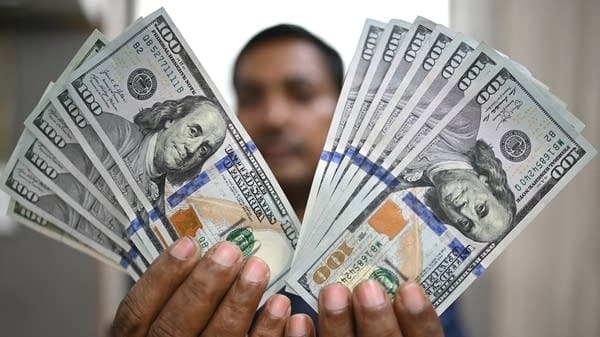
Here is the week in one number. On Wednesday the National Bank of Ethiopia put USD 125 million in front of the commercial banks. The banks asked for 120.
Four weeks earlier, at the 25th auction, those same banks bid USD 470.17 million for USD 125 million and nineteen of them went home with nothing. This week all twenty who showed up got paid, and the central bank was left holding five million dollars nobody wanted.
Now read the rest of the table. Diaspora remittances closed the fiscal year at USD 8.2 billion, up from 7.1 billion. A US-domiciled neobank opened for the Ethiopian diaspora on 7 September. Oromia Bank launched a digital remittance rail the day after. Annual inflation ticked down for the first time in five months. The full-year average for the fiscal year just ended came in at 11.7 percent, the lowest in nearly a decade.
For one week, the thing Ethiopia has been short of since anyone can remember was not short.
Then look at the other column. Brent crude went back above 100 dollars a barrel. Ethiopia imports every litre of fuel it burns. Non-food inflation overtook food inflation for the first time since November, driven almost entirely by the last fuel shock working its way through the economy. The country spent the week in Beijing and Washington trying to raise 8.75 billion dollars for one airport. And at Tulu Kapi, a project that was going to produce gold in 2028 stopped, because people died.
The dollars arrived. The bill for the new year is already in the post.
Now grab your buna. There’s a lot on the table.
Foreign Exchange
The auction that didn’t sell out
The NBE’s 28th foreign exchange auction, held on 9 September, drew bids of USD 120 million against an allocation of USD 125 million, leaving it undersubscribed by five million dollars. Twenty banks participated and all twenty were successful.
The marginal, or cut-off, rate came in at 158.3500 birr per dollar. The weighted average of successful bids was 160.5357. Bids ranged from 158.3500 at the low end to 160.7556 at the high end. The central bank said the next auction runs on the published schedule.
Set that against the last few rounds. The 25th auction on 12 August drew USD 470.17 million for USD 125 million, a bid-to-allocation ratio of 3.8 times, with twenty-eight banks bidding and only nine successful, at a cut-off of 161.0050. On 20 August the NBE sold USD 500 million in a special auction and the birr firmed to 160.21. On 26 August it allocated another USD 125 million at 160.2070.
Three weeks ago this newsletter wrote that the rate was doing the rationing the allocation could not. That was true when demand was nearly four times supply. It is a different market now. A cut-off that falls from 161.0050 to 158.3500 is a birr that has appreciated against the dollar inside a month, at an auction where the central bank could not even clear its own float.
Two readings are available, and both are probably partly right. The optimistic one: a half-billion-dollar special auction, a record remittance year and a functioning formal channel have finally put enough supply into the system that banks can cover their letters of credit without fighting for it. The cautious one: banks that loaded up at 500 million dollars in August simply had nothing left to buy with, and this is a digestion week rather than a turning point.
The 29th auction is the one to watch. If demand stays soft with oil above 100 dollars, something structural has changed. If it snaps back to three times cover, this was a pause. Sources: StockMarket.et
The Diaspora Dollar
8.2 billion dollars, and a five-year run of 32.4
Fitsum Arega, Director General of the Ethiopian Diaspora Service, said remittances reached USD 8.2 billion in 2025/26, up from USD 7.1 billion the year before, citing National Bank of Ethiopia data. He was speaking at the launch of Oromia Bank’s Abba Fardaa digital remittance platform at the Skylight Hotel in Addis Ababa on Tuesday.
Fitsum put the three years preceding those two at an average above USD 5.5 billion annually, which takes the five-year total to roughly USD 32.4 billion. He credited the Homegrown Economic Reform programme and the move to a market-based exchange rate with pulling more of that money through formal banking channels.
For scale: Ethiopia ranked fourth in Africa for remittance inflows in 2024, behind Egypt at 22.7 billion, Nigeria at 19.8 billion and Morocco at 12.05 billion, and ahead of Kenya at 4.94 billion. The 7.1 billion recorded that year was equivalent to 4.8 percent of GDP. Source: EBR
A neobank builds for the corridor
Mela Finance Inc. publicly launched Mela on 7 September, a digital banking platform aimed at the Ethiopian diaspora, starting with the United States–Ethiopia corridor. At launch it offers a US account with no monthly maintenance fee, payroll and direct deposit, account linking, and licensed transfers to bank accounts in Ethiopia, with support in English, Amharic, Oromigna and Tigrinya.
Mela appears on the NBE’s list of licensed money transfer institutions as of 7 August 2026. It is a US-domiciled fintech providing banking services through a sponsorship arrangement, not a chartered bank. Founded in 2024, its stated roadmap includes digital equb tools, merchant payments and products aimed at homeownership and mortgages, none of which are broadly available yet.
Prices
Inflation slows, and changes shape
Annual inflation eased to 15.1 percent in August from 15.3 percent in July, the first slowdown after four straight monthly increases, according to the Ethiopian Statistical Service. Month-on-month prices rose 0.9 percent, well down from July’s 2.6 percent jump.
The composition is the story. Non-food inflation accelerated to 15.4 percent from 14.8, overtaking food for the first time since November, while food and non-alcoholic beverages cooled to 14.9 from 15.7. Non-food has more than doubled from a low of 7.0 percent in March, reflecting the pass-through of higher fuel and imported input costs.
Within non-food, education costs rose 25.3 percent year-on-year, the steepest in the category, ahead of miscellaneous goods and services at 19.3 and alcoholic beverages and tobacco at 18.8. Transport rose 15.6 percent. Housing, water, electricity, gas and other fuels, the heaviest non-food group at 16.8 percent of the basket, rose 13.7.
In the food basket, sugar, jam, honey and chocolate led at 38.3 percent, followed by non-alcoholic beverages and coffee at 29.2 and meat at 22.6. Bread and cereals, the single largest item in the CPI at a 17.1 percent weight, rose a comparatively mild 8.1 percent, which is most of the reason food inflation is where it is rather than higher.
The full-year picture is kinder than the monthly one. The average annual inflation rate for EFY2018 fell to 11.7 percent from 16.0 percent, the lowest annual average since EFY2009, and a long way from peaks above 30 percent in EFY2014 and EFY2015. But the 12-month moving average has now risen for two consecutive months after bottoming at 11.7 between April and June.
The ESS also said it is expanding its price survey from 120 to 200 markets, bringing in Sidama, South Ethiopia, South West Ethiopia and Central Ethiopia. The original 120 were chosen about 25 years ago. A one-year pilot across the 80 new markets showed negligible differences in results. The expansion is a step toward rebasing the CPI on EFY2017 household survey weights.
The Oil Bill
Brent goes back above 100
Brent crude rose above USD 100 a barrel for the first time since July, with West Texas Intermediate around 95, after renewed attacks on energy facilities and shipping in the Middle East. The rally followed US strikes on Iranian oil tankers, continued disruption around the Strait of Hormuz, and Houthi attacks on Saudi cities and energy infrastructure.
Ethiopia imports effectively all the petroleum it consumes. The Ethiopian Petroleum Supply Enterprise imported more than 4.3 billion litres in 2024/25, at a bill of roughly 395.2 billion birr. Higher crude prices feed through to diesel, petrol and jet fuel, with the final impact depending on refined product prices, procurement terms and the birr. Because the bill is paid in hard currency, a sustained rally also absorbs foreign exchange that would otherwise go to machinery, medicines and inputs, and raises freight and maritime insurance costs along the Red Sea and Gulf of Aden.
Financing the Airport
Ethiopia goes to Beijing for 8.75 billion
Ethiopia opened talks with the Asian Infrastructure Investment Bank over financing for Bishoftu International Airport. Finance Minister Ahmed Shide and Ethiopian Airlines Group CEO Mesfin Tasew presented the USD 12.5 billion project to AIIB President Zou Jiayi as a regional transport, trade and logistics hub rather than a replacement for Bole.
The arithmetic behind the pitch: the airline plans to fund 30 percent from its own resources, leaving international lenders and investors to provide the other 70 percent, or roughly USD 8.75 billion. No commitment has been disclosed. Ethiopia’s angle leaned on cross-border significance, which maps onto AIIB’s target of directing 25 to 30 percent of its financing toward connectivity projects by 2030. The African Development Bank is already mandated lead arranger, having announced USD 500 million subject to approval and a mandate to mobilise as much as eight billion more.
And to Washington for the corridor around it
Days earlier, the US Development Finance Corporation signalled it is preparing an investment tied to the airport, according to the State Department’s Bureau of African Affairs. Assistant Secretary Frank Garcia raised it with Mesfin Tasew and visited the site with him. The instrument being prepared is an SME financing package for the airport corridor, intended to seed local supply chains rather than fund runways and terminals. No figure has been published and nothing is signed.
The reason it is the corridor and not the concrete sits in the tender. Ethiopian Airlines prequalified 33 companies and consortia across four works packages. Chinese state-owned and state-linked contractors hold 15 of the 33 slots, representing ten groups, and are prequalified across all four. The only US-domiciled bidder is The Lane Construction Corporation, itself owned by Italy’s Webuild, which appears on three packages, always inside a Webuild-led joint venture, and never on main terminal facilities. The DFC had previously indicated around USD 1 billion in financing plus USD 1 billion in political risk insurance, framed on the assumption of no Chinese involvement. US EXIM has signalled no financing cap but requires at least 51 percent US content.
Contractor selection has slipped to early January 2027 after bidders asked for more time. Separately, Ethiopian Airlines is reported to be close to an order for eight to ten Boeing freighters, likely two 777Fs and six to eight 777-8Fs, which would carry GE engines with it. The carrier moved about 897,000 tonnes of cargo last year, up 16 percent, on a fleet of twelve 777Fs. Source: stockmarket.et, Birrmetrics
Credit
100 billion birr lent against no collateral
Kifiya Financial Technologies said its AI-native financial infrastructure has enabled more than ETB 100 billion in uncollateralized credit through partner banks, reaching over 815,000 MSMEs, smallholder farmers and agri-MSMEs. The platform pairs alternative data with algorithmic risk assessment so that banks can underwrite borrowers who have no collateral and no formal credit file. Its ecosystem includes the Mastercard Foundation and partner banks including Cooperative Bank of Oromia, Bunna, Wegagen, Amhara and Enat.
Mining
Tulu Kapi stops
KEFI Gold and Copper (AIM: KEFI) suspended all development at the Tulu Kapi gold project in western Ethiopia after a serious security incident on Friday 4 September that caused multiple fatalities, including security personnel, members of the surrounding community, and one KEFI employee. The company announced the suspension on 7 September. Its shares fell around 40 percent in London.
KEFI said work will not resume until conditions are in place for a safe and secure environment, and that further drawdown of project financing is deferred while the situation is assessed, though it holds sufficient capital reserves and committed standby facilities. Development began in March 2026 under a 27-month construction programme targeting first gold in mid-2028; before the incident, work covered access road construction, electricity connection, long-lead equipment procurement and phased community resettlement. In a follow-up this week, the company said all affected employees are accounted for with no further fatalities or injuries, and that its management has held consultations with community representatives and federal and
The State of the State
Twenty-eight enterprises, nine days
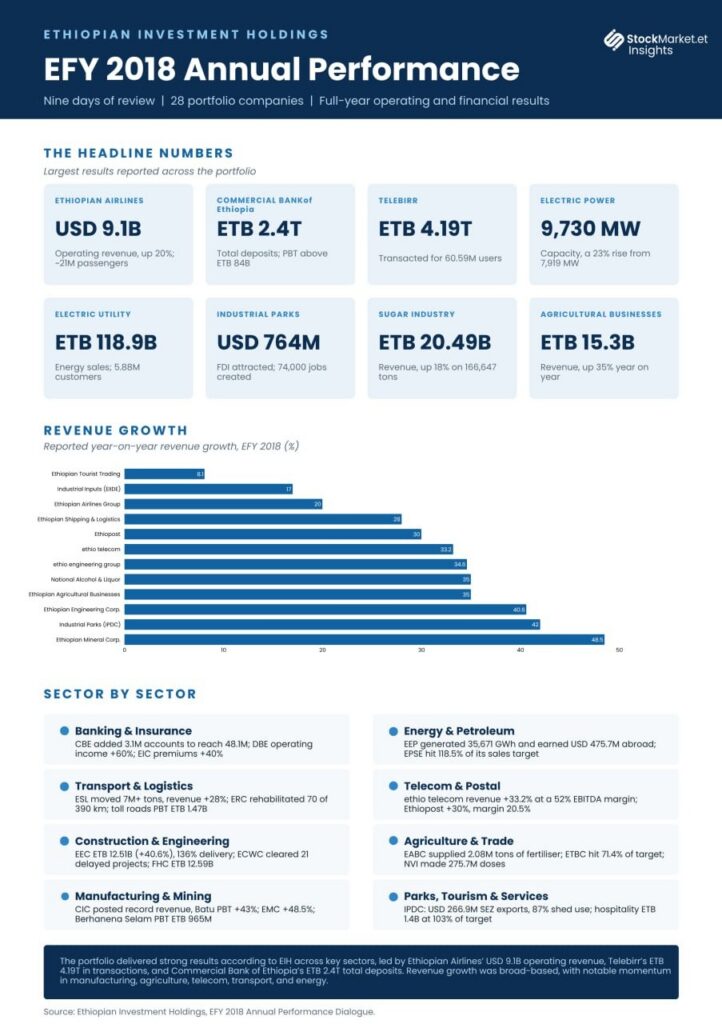
Ethiopian Investment Holdings completed its EFY 2018 performance review, covering 28 state-owned enterprises over nine days. The headline figures: USD 9.1 billion in Ethiopian Airlines revenue, ETB 2.4 trillion in Commercial Bank of Ethiopia deposits, and ETB 4.19 trillion in telebirr transactions. Several entities, including the Tourist Trading Enterprise and Ethiopian Railways, continue to face performance and debt challenges.
Logistics
Mojo gets its first gantry crane
Ethiopia inaugurated the first phase of the expanded Mojo Logistics Center, a 60-hectare hub, and unveiled the country’s first Rail-Mounted Gantry crane. The facility’s terminals and warehouses are designed to process up to one million 20-foot containers a year, with the crane handling transfers directly from the rail line.
The stated economics are import substitution at the logistics layer: packaging dry bulk cargo domestically rather than abroad, preserving foreign currency and creating local employment. The hub connects to the Ethio-Djibouti railway and anchors the DESSU corridor linking Ethiopia, South Sudan and Uganda, positioning it as an AfCFTA node rather than a domestic depot.
Beyond the Border
Africa’s largest IPO opens this week
Dangote Petroleum Refinery disclosed a USD 14.3 billion expansion to double processing capacity from 700,000 to 1.4 million barrels per day by 2029, in the prospectus for an IPO that will be the largest in African history. The offer is 4.1 billion ordinary shares at NGN 525, raising about NGN 2.15 trillion (USD 1.63 billion), largely from retail investors, with a greenshoe option of up to 30 percent more. Subscriptions run from 14 September to 13 October, with trading possible in late November.
The prospectus showed an after-tax profit of USD 1.82 billion in the first half of 2026, against a USD 476 million loss for all of 2025. The refinery, built at a cost of around USD 20 billion and operating since 2024, has benefited from supply disruptions linked to the Middle East conflict, exporting jet fuel across Africa and into Europe. Aliko Dangote said UAE state oil company ADNOC has expressed interest in investing alongside others.
That’s your Monday Breakfast Stories for the first week of the new year.
An FX auction the banks could not fill. A record 8.2 billion dollars from the diaspora and two new rails built to catch more of it. Inflation slowing but changing shape, with non-food prices in the lead. A hundred billion birr lent to 815,000 people who own nothing a bank would take as security. A finance minister in front of the AIIB and an American Assistant Secretary on a construction site, over the same airport, in the same week. A gantry crane at Mojo. Africa’s biggest IPO opening on Monday.
And then the two items that will not sit neatly with the rest. Brent back above 100 dollars, in a country that imports every litre. And a gold project stopped because people died on a Friday afternoon in western Oromia.
EFY 2018 closed with the lowest average inflation in nearly a decade and the largest remittance year on record. That is a genuinely good year, and it should be said as plainly as the rest.
EFY 2019 opens with a fuel shock already running, an 8.75 billion dollar financing gap to close, and the reminder that the binding constraint on an Ethiopian project is not always money.
The dollars showed up this week. What they get spent on is the whole question.
Keep your coffee strong. See you next Monday. ☕