


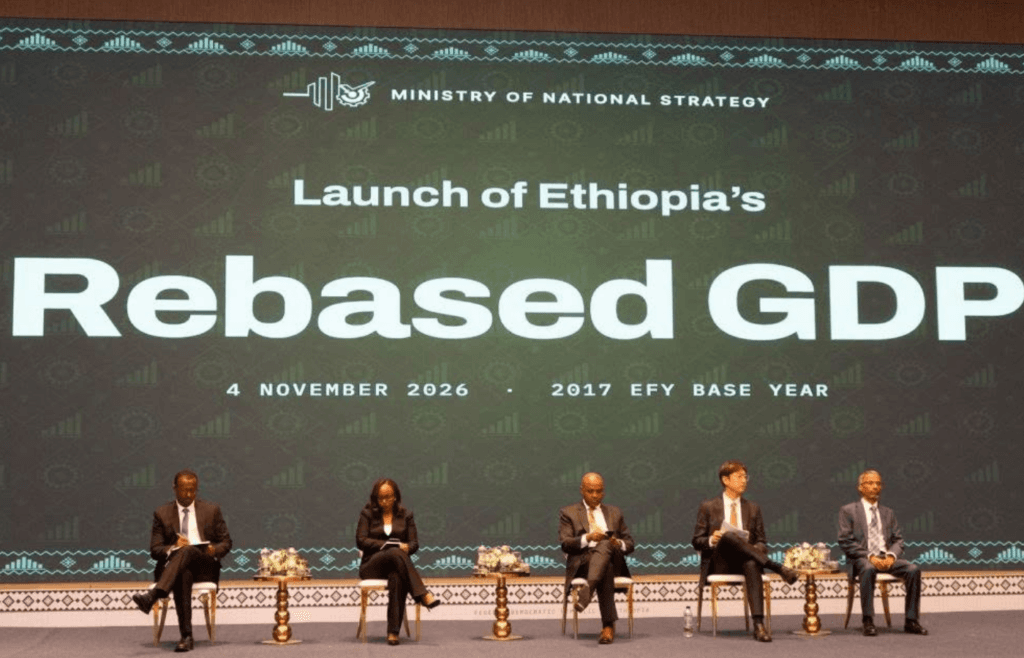
Pour the buna. This week’s number is 31.86 trillion.
That is the size of Ethiopia’s economy in birr for 2025/26 after rebasing, about $210.7 billion, against the IMF’s earlier estimate of about $127 billion. On paper, the economy is far bigger. Civil service pay has not changed since September 2025, while fuel and food cost more.
The rest of the week tested that gap. Inflation eased to 14.6% in October, but the central bank says single digits are at least six months away. Ethiopian Electric Power’s loss reached 122 billion birr as its foreign debt was revalued. Safaricom halved its Ethiopian losses and added debt to its funding, Ahadu Bank doubled its pre-tax profit and is preparing a prospectus, IFC made its first investment in Kifiya, and the IMF wants the central bank out of the gold market.
Here is the week.
Economy & Policy
Inflation eases to 14.6% in October as non-food prices climb
Annual inflation slowed to 14.6% in October from 14.9% in September, according to the Ethiopian Statistics Service. That is 3 percentage points higher than a year earlier, when it stood at 11.6%.
Food inflation fell for a second month, to 14.1%. Non-food inflation kept rising, to 15.4%, and is now above food.
| Annual inflation | June 2026 | September 2026 | October 2026 |
| Headline | — | 14.9% | 14.6% |
| Food & non-alcoholic beverages | 15.1% | 14.8% | 14.1% |
| Non-food | 12.2% | 15.1% | 15.4% |
Sugar, honey and chocolate (36.2%) and meat (23.8%) led food prices. On the non-food side, transport rose to 17.1% from 16.0%, while restaurants and hotels eased to 11.1% from 15.3%. The central bank links the non-food rise to higher electricity tariffs and fuel and firewood costs.
NBE holds the policy rate at 16%; single digits are not coming soon
The National Bank of Ethiopia kept its policy rate at 16% after its eighth Monetary Policy Committee meeting, with the ±3 percentage-point band unchanged. It said inflation will stay in double digits for at least the next six months before easing gradually.
The committee called September’s 14.9% “high relative to the NBE’s single-digit target” and pointed to cost-push pressure from the war in the Middle East. Base money grew 87.2% year on year and broad money 40.2%, faster than nominal GDP. The bank says money growth is now driven mainly by reserve accumulation rather than domestic credit, and it has not lent to the government for more than 27 months.
IMF asks the central bank to leave the gold market
The IMF has called on the National Bank of Ethiopia to withdraw from the gold market, where it is currently the sole authorised buyer and exporter. Governor Eyob Tekalign (PhD) said the matter is under study and an exit is unlikely to happen easily in the near future.
Gold purchases have been a significant source of foreign exchange inflows and reserve accumulation since the currency reforms. No timeline or alternative arrangement has been announced.
Telecom
Safaricom’s Ethiopia losses halve as group profit climbs 36%
Safaricom Ethiopia’s loss before interest and tax fell to KES 11.4 billion (about $88 million) in the six months to September, down from KES 24.3 billion a year earlier. Service revenue in Ethiopia rose 71.6% to KES 10.6 billion, about 13.1 billion birr, and the business now has about 15.4 million active customers, Birrmetrics reports.
The EBITDA loss narrowed 96.5% to KES 434.4 million, and the company still expects Ethiopia to break even on EBITDA by March 2027. That is not the same as profit: depreciation, financing costs and tax still sit below that line.
At group level, net profit rose 36% to KES 58.2 billion and EBIT rose 40% to KES 91.1 billion. Chief Executive Peter Ndegwa presented the results in Nairobi.
Safaricom’s Ethiopian funding reaches $2.84 billion as debt enters the mix
Cumulative funding of Safaricom Ethiopia reached $2.84 billion by the end of September, up about $193 million since March, Birrmetrics reports. About $2.37 billion is equity and $474 million is debt, of which $311 million is in foreign currency and $163 million in birr.
Group CFO Dilip Pal said the company deliberately introduced borrowing to optimise its capital structure. The total includes the $850 million telecom licence and the $150 million mobile money licence. Interest rates, maturities and lenders were not disclosed.
Banking & Finance
Ahadu Bank doubles pre-tax profit to 1.07 billion birr, prepares a prospectus
Ahadu Bank reported a pre-tax profit of 1.07 billion birr for 2025/26, up 113.1%, and net profit of 784.2 million birr, Birrmetrics reports. Revenue rose 48% to 3.2 billion birr. The results were presented at the shareholders’ meeting on November 7.
Total assets reached 14.32 billion birr and deposits 10.47 billion birr. Paid-up capital stands at 1.24 billion birr. The bank says 2% of its loans are non-performing and it obtained $121.3 million in foreign currency, $33 million more than the year before.
Ahadu, which began operating in 2022, says it is preparing a prospectus to raise capital and enter the capital market. The report does not say whether the figures are audited, and no prior-year profit figures were given.
IFC makes its first investment in Kifiya
IFC, the World Bank Group’s private-sector arm, signed its first investment agreement with Kifiya Financial Technology on November 4 at the Africa Financial Summit in Luanda. The money will support Kifiya’s agricultural lending in Ethiopia and its expansion into other African markets, with talks under way in Rwanda, Uganda, Tanzania and Kenya.
Kifiya says its technology has supported more than $1 billion in credit. Founder and CEO Munir Duri said much economic activity “remains unseen by formal finance.” The size of the investment, the instrument and IFC’s stake were not disclosed.
Last week Kifiya launched Michu Mizan, a Sharia-compliant financing product, with Cooperative Bank of Oromia.
Energy & Infrastructure
Ethiopian Electric Power’s loss surges to 122 billion birr
Ethiopian Electric Power reported a net loss of 122.08 billion birr for the year to July 7, 2025, up from 10.15 billion birr, according to audited statements reported by Birrmetrics. Revenue from electricity sales rose to 72.71 billion birr from 27.14 billion.
The driver was 290.51 billion birr in net foreign exchange losses on borrowings and cash, about four times annual revenue, after the birr moved to a market-based rate in July 2024. Borrowings rose to 292.80 billion birr, of which 287.77 billion is owed to foreign lenders and development agencies.
| EEP (birr) | FY to July 2024 | FY to July 2025 |
| Revenue | 27.14 bn | 72.71 bn |
| Net FX losses | 3.95 bn | 290.51 bn |
| Net loss | 10.15 bn | 122.08 bn |
| Borrowings | 104.01 bn | 292.80 bn |
| Accumulated losses | 187.13 bn | 309.21 bn |
FX losses are a revaluation of outstanding debt, not cash paid out in the year. Operating profit was also lifted by 143.28 billion birr in exchange-rate gains booked as other income. The auditor, Audit Service Corporation, gave an unmodified opinion. The report carries no comment from EEP.
Dangote launches a $2.5 billion fuel terminal and pipeline project in Namibia
Dangote Group and Namibia launched a $2.5 billion tank farm and regional pipeline project near Walvis Bay, Birrmetrics reports. The terminal will hold 600 million litres of diesel and petrol, eight times Namibia’s existing national storage, and is expected within 18 to 20 months.
A planned 1,700 km pipeline network would carry fuel to Botswana, Zambia, Zimbabwe, Malawi and parts of the DRC. It still needs engineering studies, route surveys and regulatory approvals. The cost split between terminal and pipeline and the financing were not disclosed.
For Ethiopian readers, the pattern is familiar: Dangote is pairing its Lagos refinery with storage and pipeline links across the continent, including the $660 million Djibouti–Ethiopia fuel link announced in September.
China gives $15 million for Ethio-Djibouti railway supplementary works
Ethiopia and China signed a $15 million grant for supplementary work on the Ethio-Djibouti railway. The package covers locomotive spare parts, track hardware, station-yard accessories and track maintenance machinery, plus training by Chinese technical experts.
State Minister of Finance Tiguist Fisseha signed for Ethiopia. The railway carries more than 90% of Ethiopia’s import and export freight through Djibouti. No delivery timeline was given.
Deep Dive: A Bigger Economy, the Same Empty Pockets
Rebasing has made Ethiopia’s economy 31.86 trillion birr (about $210.7 billion) for 2025/26, far above the IMF’s earlier estimate of about $127 billion. On the new count, public debt falls to 27.4% of GDP from 45.3%. Tax revenue falls to 5.5% of GDP from 9.1%.
The salaries have not moved. The last civil service raise was in September 2025, and a degree holder starts at 11,500 birr a month. Since December, diesel is up 40% and gasoline 30%, and kerosene more than doubled in a single month. A budget room in a condominium can cost more than that entire starting salary.
The new numbers also give households a smaller share of the economy: household spending falls from 80.9% of GDP to 64.4%. The piece argues the rebased GDP is “a better photo of the economy, not a better economy,” and proposes a household income survey, a real-wage index and a rent index to test whether growth reaches pay packets.
New from StockMarket.et: The Legal Architecture of Ethiopia’s Capital Market
One proclamation, seven directives, one rulebook and two drafts, mapped in a single report.
👉 Read it now on StockMarket.et
Weekly Tip: Paper Losses vs. Cash Losses
When a company borrows in dollars and reports in birr, a weaker birr makes the same debt look bigger in birr. That increase is booked as a foreign exchange loss, even if no extra money has left the bank account that year.
- Unrealised (paper) loss: the debt is revalued at the new exchange rate. It hits profit and equity now.
- Realised (cash) loss: paid when the company actually buys dollars to make a repayment at the weaker rate.
Paper losses still matter. They show how much more birr the company will need to repay its foreign debt if the rate stays where it is. That is why EEP’s 122 billion birr loss is worth reading closely, not dismissing.
For information only. Not investment advice.
On the Calendar
- November 10: NBE foreign exchange auction ($140 million)
- November 24: NBE foreign exchange auction ($140 million)
🎧 On our weekly Educational Content
Who is an investment advisor, and what role do they play?
In the capital market, investment advisors help investors make decisions based on better information. In this week’s video, we look at what an investment advisor does, why it matters to investors, and the role advisors play in the capital market.
🎥 Watch the full video on our YouTube channel:
The rebased economy came in at 31.86 trillion birr while pay packets stayed put, and inflation eased to 14.6% with the central bank promising no single digits for at least six months. Ethiopian Electric Power’s loss reached 122 billion birr as its foreign debt was revalued. Safaricom halved its Ethiopian losses and added debt to its funding, Ahadu Bank doubled its pre-tax profit and readied a prospectus, and IFC invested in Kifiya. The IMF asked the central bank to leave the gold market, and Dangote took its storage-and-pipeline model to Namibia.
See you next Monday ☕