


When Ethiopia released its first national digital payments strategy in 2021, few predicted just how quickly the country would sprint into the digital age. Today, cash is disappearing from pockets, mobile money is exploding, and Ethiopia stands as one of Africa’s fastest-moving fintech frontiers.
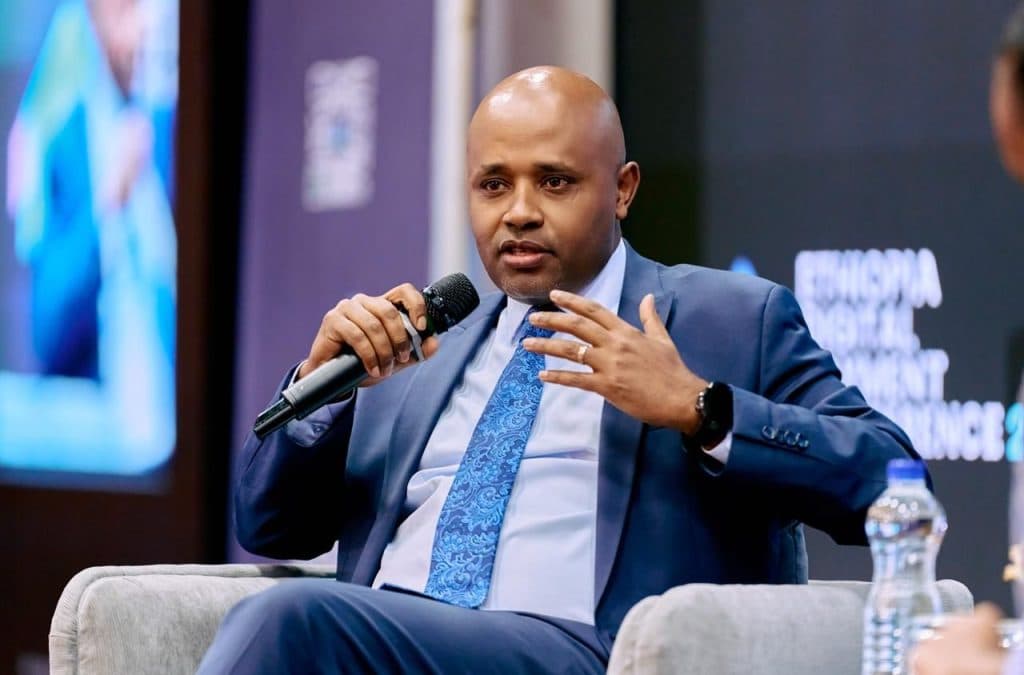
At the center of this transformation is Dr. Eyob Tekalign, Governor of the National Bank of Ethiopia (NBE). Though only three months into the role, he brings decades of policy leadership, from finance to national planning. At the Digital Payments Conference, he joined Senior Advisor Sinit Zoro of the Tony Blair Institute for a wide–ranging conversation—part reflection, part roadmap for Ethiopia’s digital future.
What follows is a dive into that conversation: candid, big-picture, and packed with insight.
From Campus Vision to National Leadership
Asked whether his 21-year-old self ever imagined becoming central bank governor, Dr. Eyob smiles. His answer blends humility with destiny.
He recalls a college life rich in extracurricular leadership—student council, economics clubs, even theater. “Probably more than my curricular activities,” he jokes. The desire to serve was always there; he calls it a calling. His wife calls it a “virus.”
But becoming the steward of Ethiopia’s financial system? That was never a guaranteed outcome.
“I would tell young people: passion, discipline, commitment—these take you far. Serving your country is an honour.”
It’s a grounded beginning to a conversation that soon zooms out to Ethiopia’s fintech revolution.
Digital Payments: Ethiopia’s Biggest Win Yet
If you want proof of Ethiopia’s digital acceleration, look no further than your own wallet. Dr. Eyob points out what many in the room already know instinctively: hardly anyone carries cash anymore.
And the numbers? They’re wild:
- Mobile money accounts: 2 million (2020) → 140 million (2025)
- Mobile banking users: 9.1 million → 54+ million
- Digital transaction value: 18.5 trillion birr,
translating to 50+ billion birr per day, or an astonishing 2.1 billion birr per hour
The pace of adoption has surprised even policymakers.
“Imagine if these transactions were happening in cash,” Eyob says. Impossible. The shift has already changed how Ethiopia moves money.
But it wasn’t an accident. He credits a clear strategy, strong government leadership, and deep public-private collaboration. Ethiopia didn’t just digitize payments—it designed the leap.
His warning, though, is sharp:
“We should not be complacent. We’ve come far, but there is much more to do—trust, security, gender divides, rural divides, innovation beyond payments.”
The message: celebrate the wins, but keep sprinting.
BRIDGE: Ethiopia’s Strategy for 2026–2030
The new strategy—Digital Payments 2.0—introduces a framework called BRIDGE, a set of pillars guiding the next five years.
We walk through each, starting with the foundation.
B — Building Robust, Interoperable Digital Public Infrastructure
Digital Public Infrastructure (DPI) is the invisible backbone of the fintech economy. And for Eyob, it’s a public good, meaning the government must lead.
Ethiopia has already invested billions in:
- national fiber networks
- mobile generations (2G → 4G)
- payments infrastructure
- government digital service platforms
- and most recently, capital market infrastructure like the CSD
Interoperability—once unthinkable—has become reality. Banks and fintechs that once operated in silos are now interconnected.
But Eyob is clear: DPI is never “done.”
Data sovereignty, cloud strategy, cybersecurity, and infrastructure for treasury markets are the next frontier.
“We cannot just write policies. The Central Bank must also put money where its mouth is.”
Balancing Data Sovereignty & Regional Integration
Digital economies are by definition cross-border, and Ethiopia is committed to regional integration. But this raises a global dilemma:
How do you stay interoperable while protecting national data?
Eyob acknowledges the tension.
African leaders are pushing for harmonized rules under the AfCFTA. But financial integration lags behind trade integration. Convertibility, currency issues, and differing regulatory regimes slow progress.
His takeaway:
“Regional integration must be backed by financial integration. Central banks need to sit together, strategize, and prioritize.”
It’s a call for coordination, not isolation.
R — Reaching All Ethiopians: Inclusion as a Design Principle
Digital transformation means little if it leaves people behind. Gender gaps, rural access, youth inclusion, and disability inclusion remain major challenges.
Even as a regulator, the NBE plays an active role.
One standout example: Ts’ega, a digital investment portal that democratizes access to treasury bills. Traditionally available only to institutions, T-bills can now be purchased by ordinary citizens from their phones.
Another: Nafir, a major initiative for agricultural finance—designed with risk guarantees and fintech partnerships to bring farmers into the formal financial system.
But Eyob stresses collaboration above all:
“Inclusivity is not a job for one institution. It requires the entire ecosystem.”
I — Increasing Adoption: The Cashless Mirage
If digital payments are soaring, does Ethiopia become cashless soon?
Eyob’s answer is pragmatic and refreshingly honest:
“A cashless society is a mirage—at least for now.”
He envisions a hybrid economy where:
- digital dominates
- cash survives in niche use cases
- sovereignty keeps national currencies alive
- and central bank digital currencies (CBDCs) may eventually emerge
Stablecoins and private digital currencies add complexity. The next decades will be hybrid, layered, experimental.
But the direction is clear: Ethiopia is digitizing rapidly—but not dogmatically.
D — Developing Digital Human Capacity
Technology is only as strong as the people who use it.
Ethiopia’s strategy recognizes two parallel needs:
- Digital literacy for citizens
- High-level talent for AI, cybersecurity, fintech engineering, and data systems
AI is the wild card. Debates range from dystopian fears to utopian fantasies of effortless abundance.
Eyob positions himself somewhere in the middle.
He acknowledges the potential for productivity and wealth creation—but not the dreamy version of universal basic income where “you take an ice cream and walk away without paying.”
That world requires a new global social contract—and we’re nowhere near it.
His real message:
“AI will reshape Ethiopia. It will create new wealth. But we must prepare—skills, ethics, strategy, governance.”
It’s not fear or hype. It’s responsibility.
Where Ethiopia Goes From Here
If Digital Payments 1.0 sparked Ethiopia’s fintech revolution, 2.0 aims to institutionalize it—scaling infrastructure, deepening inclusion, and preparing the country for a hybrid financial future shaped by AI, CBDCs, and regional integration.
The bridge to 2030 has been laid.
Now it’s time to cross it.


Comments