

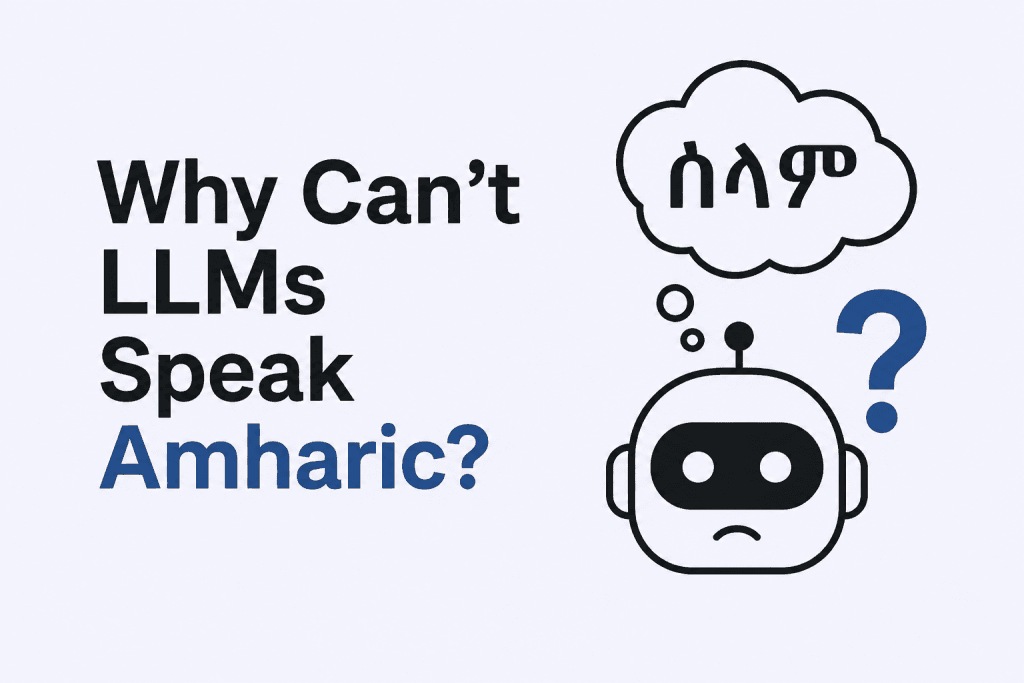
The AI revolution is the most consequential infrastructure shift of our generation. It is also being built, almost entirely, for someone else.
The question behind the question
When people ask why AI can’t speak Amharic well, they usually expect a technical answer. They expect to hear about data scarcity, about the peculiarities of the Ge’ez script, about how complex Amharic grammar is to model.
Those things are real. But they are symptoms, not the disease.
The disease is economic. The frontier AI companies, OpenAI, Anthropic, Google are not ignoring Ethiopian languages because they are too hard. They are ignoring them because there is, as yet, no compelling financial reason to pay attention. The 120 million people who speak Amharic do not, in aggregate, represent the kind of dollar-denominated market that moves a product roadmap in San Francisco. That is the whole story, and everything else is a consequence of it.
Understanding this matters, not because the economics are interesting, but because the economics are changeable. And until Ethiopians are clear-eyed about the actual problem, we will keep waiting for a solution that is not coming.
First: what these systems actually are
A large language model (LLM) is, underneath the hype, a very sophisticated prediction machine. It reads enormous amounts of text, learns statistical patterns from that text, and uses those patterns to predict what should come next in any given sentence. The more text it reads in a language, the better it gets at that language. The less it reads, the worse.
This is not a design flaw. It is the design.
But “prediction machine” is easy to say and hard to picture. Before going further, it is worth understanding what actually happens when these systems are built, and why each stage of that process has a specific, structural consequence for Ethiopian languages.
The training process has three stages: pre-training, instruction tuning, and RLHF. At every single stage, Ethiopian languages are either absent or treated as an afterthought. This is not one problem. It is three compounding problems stacked on top of each other and understanding the stack is what makes the rest of this article make sense.
Which means the first question to ask about any language is simply: how much of it lives on the internet? Because whatever is on the internet is, roughly, what these models learned from in stage one.
For English, the answer is: almost everything. More than 40% of all indexed web content is in English. Chinese, Spanish, and Arabic follow at a considerable distance.
For Amharic, the answer is almost nothing. Amharic's share of the web's indexed text is approximately 0.0036%. One page in every 28,000. Afaan Oromo, Tigrinya, and Somali are smaller still.
Worse, consider what that Amharic actually is. Most of it is religious content, Bible translations, Orthodox liturgical texts, sermon transcriptions. Very little of it is modern, commercially precise, or technically grounded. A model trained on this corpus learns how Amharic sounds in a church. It does not learn how Amharic sounds in a trading room, a courtroom, a bank, or a hospital.
The Amharic Wikipedia has around 15,000 articles. English has over six million. That 400-to-1 ratio is the starting point for understanding everything else.
But there is a twist. And it makes the situation both more interesting and more damaging than the raw numbers suggest.
The language is everywhere. The models just cannot see it.
Open any Ethiopian social media feed TikTok, Telegram, X, Instagram. You will find Amharic everywhere. But not written this way: ሰላም. Written like this: Selam. Or: anch Kongo 😂. አንች ቆንጆ ....
This is romanized Amharic, the language written phonetically in Latin script, the way it actually lives on keyboards that were never designed for Ge'ez input. It is how most young, urban, digitally active Ethiopians write when they are not on a phone with an Ethiopic keyboard installed. It is the dominant written form of Amharic in chat applications, comment sections, X threads, and WhatsApp groups. It is how millions of people write the language every single day.
And to an AI model, it is completely invisible as Amharic.
When someone types "Selam" instead of "ሰላም", the model sees Latin characters. It has no mechanism to recognize this as an Amharic utterance. It cannot flag it as Amharic training data. It gets swept into the general Latin-script corpus and either ignored or, worse, misclassified as broken English. The actual volume of Amharic digital content that exists which is enormous, given Ethiopia's social media penetration is almost entirely invisible to training pipelines because it arrives in a script the model associates with European languages.
So the 0.004% figure for Amharic in training data is already devastatingly small. But that figure only counts Ge'ez-script Amharic. Romanized Amharic, which represents how most urban Ethiopians actually communicate digitally, is not counted at all. It does not contribute to model quality. It does not improve comprehension. It generates no training signal whatsoever.
The consequence is a split that harms both forms simultaneously. Ge'ez Amharic is too rare in training data to build proper understanding. Romanized Amharic is abundant but invisible. A language spoken by millions people as a first language, and written daily by millions more in digital spaces, produces essentially zero usable signal for the models that are supposed to serve those users.
There is something worth pausing on here. Romanized Amharic is not a degraded form of the language. It is not a shortcut or an error. It is the natural, living adaptation of Amharic to digital infrastructure that was not designed with Ethiopians in mind. It is how the language actually moves through the internet. An AI system that only recognizes Ge'ez-script Amharic as "real" Amharic is making a quiet cultural judgment and it is the wrong one.
The data gap, in other words, is even deeper than the numbers show. And it runs through both the script that was excluded from training, and the script that was included but never identified.
The tokenization tax; and why it is an economic weapon
This is the part of the story that almost no mainstream commentary explains and it is arguably more damaging than the data gap, because it operates as a structural economic penalty on every single interaction in our language.
To understand it properly, you need to see what actually happens when you send a message to an AI. Not the marketing version, the mechanical one.
The process is the same for every language in theory. In practice, it breaks at step two for Amharic before the model has even started thinking.
Before an AI model reads any text, it first breaks that text into processing units called tokens. Think of tokens as the model's alphabet except instead of individual letters, tokens are chunks: whole words, word fragments, syllables, or in the worst case, raw bytes of computer data.
The token dictionary was built by analysing what appears most frequently in training data. Since training data was overwhelmingly English, the dictionary is deeply optimized for English. Common English words are single tokens. "Investment" is one token. "Capital market" is two. The model processes them efficiently, quickly, cheaply.
When the model encounters Amharic, it has no efficient chunks to use. The Ge'ez script — ፊደል — was never well represented, so the tokenizer falls back on splitting words into raw bytes. One Amharic word can become ten or fifteen fragments that each carry no meaning on their own.
You can test this directly on OpenAI's public tokenizer the same one governing how their current frontier models read text. The word "ኢትዮጵያ" Ethiopia in Amharic, five characters becomes ten tokens, rendered as question marks because the tokenizer cannot even display the byte-fragments it has created. "Ethiopia" in English: three clean tokens.
Same word. One script: 3 tokens. The other: 10 tokens. A 3.3× penalty for simply being written in our own alphabet. Across full sentences, the gap widens to five or seven times.
This has three consequences that are commercial before they are technical:
Amharic is more expensive to run. AI APIs charge per token. A customer service chatbot handling conversations in Amharic burns five to seven times the budget of the same bot handling English. This single fact explains why almost no Ethiopian company has built a serious Amharic-first AI product. The unit economics punish it structurally before you have written a single line of code.
Amharic is slower to respond. More tokens means more computation. Users waiting for an Amharic AI response wait longer than users waiting for the same response in English. In any market where user experience determines adoption, this is a competitive disadvantage built into the foundation.
Amharic is less intelligent by design. Every AI model has a finite working memory. It can hold a certain number of tokens in focus before earlier parts of a conversation start falling away. Because Amharic fills that memory five to seven times faster than English, the model has far less room to reason. The same model that can work through a sophisticated financial analysis in English loses the thread of a simpler question halfway through in Amharic not because it doesn't know Amharic, but because it has spent its thinking capacity on processing inefficient fragments. It is not just slower. It is structurally less capable of complex thought.
The token tax is not a quirk. It is a compounding penalty that makes Amharic AI more expensive, slower, and less capable at every layer of the stack.
The morphology problem: our languages don't fit the template
English is, by the standards of world languages, structurally simple. It has minimal verb conjugation. It rarely changes word endings based on grammatical relationships. "She went to the market" is five words, five discrete ideas, arranged in a predictable sequence.
Amharic is not like this. A single Amharic verb can carry the subject, the object, the tense, the aspect, the negation, and the social register of the speaker all embedded in one chained form. Afaan Oromo is agglutinative in its own way: words are built by stacking layers of meaning. Tigrinya has a grammatical complexity that linguists study for careers.
The models powering the current generation of AI were designed from the ground up around the assumptions of English grammar. When they encounter an Amharic verb doing the work of an entire English clause, they tend to fragment it break it into pieces that have no individual meaning and try to assemble something coherent from the rubble.
The attention mechanism the part of the model that connects words to each other and builds contextual understanding depends entirely on having meaningful tokens to work with. When the tokens are byte-fragments instead of words, the attention patterns become flat and meaningless. Click through the demonstration below and compare what happens when the model processes a meaningful English sentence versus the same information in Amharic.
This is why AI-generated Amharic so often sounds hollow and slightly alien even when the words are technically present: the model reconstructed the surface of the sentence but missed the weight of it. The attention mechanism is working on rubble.
The five reasons nobody is talking about
Everything above is the standard story, the data is scarce, the script is expensive, the grammar doesn't fit, the attention breaks. These are increasingly known.
There are at least five more reasons Ethiopian-language AI is failing structural, economic, and political that almost never appear in the mainstream conversation.
1. The reasoning layer is English all the way down.
Return to the training diagram above. The third stage RLHF is where the model learns what a "good" answer looks like. Human evaluators rate responses, and the model adjusts. This entire process is conducted almost entirely in English. The people writing the guidelines, rating the responses, deciding what "a good answer" looks like overwhelmingly, they are working in English.
The consequence is that even when a model has seen some Amharic in stage one, its deeper capabilities how to follow complex instructions, how to chain thoughts together, how to reason through ambiguity were shaped entirely by English. A model responding in Amharic is not reasoning in Amharic. It is reasoning in English and dressing the output in Amharic. When the reasoning gets complex financial analysis, legal interpretation, multi-step problem-solving the English-trained reasoning layer breaks down at the Amharic surface. This is not a vocabulary problem. It is an architectural one.
2. The model cannot hold a language.
Ask any frontier AI model to write a long response in Amharic only. Watch what happens. It starts in Amharic. Within a few paragraphs sometimes within a few sentences it begins drifting: English words appear, then English sentence structures, then whole English passages before the model remembers the instruction and corrects itself.
This is not the natural, intentional code-switching that Ethiopians practice in daily life the fluent, meaningful mixing of Amharic and English that is a feature of educated Ethiopian speech. What the model does is different. It is a system that cannot sustain one language in its processing for long, defaulting back toward the language it actually learned to think in.
The downstream consequence is worse than it appears. AI-generated content is increasingly being used to build future AI training datasets. If today's frontier models produce Amharic that is systematically contaminated with English fragments, and those outputs end up in future training corpora, the contamination compounds. Each generation of models learns from the errors of the last. The ceiling on Amharic AI quality falls with each iteration rather than rising.
3. The model's worldview is imported.
A language model does not just learn vocabulary and grammar. It absorbs a worldview. It internalizes assumptions about how families are structured, how commerce works, what a normal workplace looks like, how authority functions, how land is owned, how debts are honored. All of that was learned from text overwhelmingly produced in the United States and Western Europe.
Ask a frontier model to explain an iddir or an equb and it reaches for analogies from a world it actually knows. It calls an iddir a "mutual aid society." It describes an equb as a "rotating savings club." Both technically adjacent to accurate, but both missing the texture, the obligation structure, the social consequences, the cultural architecture that make these things what they actually are to the people who live inside them.
The language surface is Amharic. The mind underneath is not. No amount of additional Amharic vocabulary will fix this if the underlying model was only ever taught to see the world through one set of eyes.
4. The AI pipeline extracts value from the communities it underserves.
The large AI companies employ substantial numbers of human workers to label data, evaluate model outputs, and moderate harmful content. A significant portion of this work is outsourced to lower-wage markets across Africa, Asia, and Latin America, at rates that would be unacceptable in the cities where the finished products are sold.
The structural irony is precise. The same regions whose languages are least supported by frontier AI are often the ones providing the human labor that makes frontier AI possible. Workers rate English responses, label English training data, and moderate English-language harms. That labor makes English models better. It does not flow back into improving the languages of the communities doing the work.
This is not an accident. It is the natural output of a system where language capability and labor cost are both optimized for the same markets. The result is a transfer: human capital and intellectual effort move in one direction, while language quality and AI capability concentrate in another.
5. Our language data is being extracted without reciprocity.
Any Amharic text that exists digitally news articles, government documents, academic papers, court records, social media is, in principle, available to be scraped and used in AI training. Most of it already has been. The frontier models consumed whatever Amharic was findable on the open web.
Ethiopian institutions that created this content the universities, the publishers, the broadcasters, the government agencies received nothing. No licensing fee. No revenue share. No commitment that the resulting models would be made available to Ethiopian users at any particular quality or price. The data flowed outward. The capability stayed abroad.
A Māori media organization in New Zealand faced exactly this dynamic. After spending years building an annotated language archive, they had to fight off AI companies trying to use it without compensation or commitment. They now have explicit data sovereignty agreements: whatever is built using their language data must benefit their community. Ethiopia has nothing equivalent. That conversation has not yet started here.
The economic structure underneath everything
All of the problems above the data gap, the token tax, the romanization invisibility, the morphology mismatch, the English reasoning layer, the code-switching drift, the imported worldview, the labor extraction, the data harvesting have the same economic root.
Frontier AI companies allocate resources to what their paying customers value. Their paying customers are, overwhelmingly, enterprises operating in English in dollar-denominated markets. A product manager at OpenAI is measured on metrics that reflect the experience of American and European enterprise users. Amharic response quality does not appear on that dashboard. When a response in Tigrinya hallucinates something that never happened, no alarm sounds.
This is not malice. It is rational behavior within a given incentive structure. And it means that waiting for frontier labs to solve this for Ethiopia is not a strategy. It is an abdication.
There is no cavalry. The path to good Ethiopian language AI runs through Ethiopian builders deciding to build it and through the institutions, the investment, and the accountability structures that would make that building possible.
What is actually being built
The honest picture: more than most people know, and far less than what is needed.
Lesan AI, built by an Ethiopian team, has produced machine translation technology for Amharic, Tigrinya, Afaan Oromo, Somali, and English that demonstrably outperforms Google Translate and Microsoft Translator on our languages. Crucially, they did not compete with the frontier labs on raw computing power. They went offline digitizing physical books and archival print sources, building a custom OCR system for the Ethiopic script, constructing datasets from content that actually reflects how these languages are used. Their approach is the most important proof of concept available: Ethiopian-led AI development, with limited resources, producing superior results.
EthioNLP, a research community, maintains the most comprehensive catalogue of NLP tools and datasets across Amharic, Afaan Oromo, Tigrinya, and Wolaytta.
EthioLLM has released open-source multilingual models for five Ethiopian languages a genuine foundation that any developer can build on.
Masakhane, the pan-African NLP collective, includes strong Ethiopian participation and has produced benchmarks and datasets that are now cited in international research.
These efforts are real and they matter. They are also fragmented, under-resourced, and proceeding without serious institutional backing from Ethiopian banks, universities, or government. They are being sustained by researchers and builders working largely on the strength of their own commitment.
What should actually happen
Better Ethiopian-language AI is not waiting for a technical breakthrough. The technical knowledge exists. What is missing is investment, institutional coordination, and accountability.
A national language data effort is the single highest-leverage intervention. A coordinated push funded jointly by financial institutions, universities, and the state to clean, digitize, and openly license a large corpus of text across Amharic, Afaan Oromo, Tigrinya, Somali, Sidamo, and other local languages. Not only scraped from the web. Sourced from physical archives: books, newspapers, court records, government documents, broadcast transcripts. At national scale, the output changes the foundation every future model is built on.
Domain-specific models before general-purpose ones. Chasing GPT-class general Amharic capability is a losing race given current resource constraints. But an excellent model for Amharic financial services, Amharic legal drafting, or Amharic medical triage is achievable today with existing techniques and budgets that are realistic for Ethiopian private-sector investment. Domain specificity is not a compromise. It is a strategy.
Public benchmarks that create accountability. A credible, maintained, public benchmark for Amharic financial reasoning, Afaan Oromo customer service quality, and Tigrinya comprehension would change the incentive landscape for every company serving the Ethiopian market. What gets measured gets built. Nothing is being measured right now.
Language data sovereignty in the regulatory framework. The ECMA regulatory sandbox, NBE digital finance policy, and any national AI framework should treat Ethiopian-language data as strategic infrastructure the same logic applied to mineral resources, telecommunications spectrum, or financial data. Extraction without reciprocity should not be the default.
And for every organization producing quality written content in our languages: whether news, analysis, financial research, or legal documents the most important realization is this: that content is building the data commons that future models will be trained on. The quality of what is produced in Amharic today is part of the quality of Ethiopian AI tomorrow.
The closing argument
The reason these models cannot speak Amharic well is not that Amharic is too complex. Mandarin is complex. Arabic is complex. Finnish has grammatical features that defeat non-native speakers for years. All of them work in frontier AI because someone decided they were worth investing in.
Amharic, Afaan Oromo, Tigrinya they sit in a part of the economic map where the incentive has not yet been assembled. The data is thin because no one paid to make it thick. The romanized form of the language is invisible because no one built a system to recognize it. The tokenizer is broken because no one fixed it. The reasoning layer is English because the people who built the reasoning layer were English speakers. The worldview is imported because no one constructed a local one. The benchmarks don't exist because no one commissioned them. The data was extracted because no one said it couldn't be.
Every single one of these is a solvable problem. None of them will solve themselves.
The next decade of Ethiopia's digital economy will be built on language models. The question is not whether AI comes. It is already here. The question is whether it speaks to us or whether we spend the next decade learning to speak to it.
That is a choice. And right now, mostly by default, we are making it in the wrong direction.

Comments