


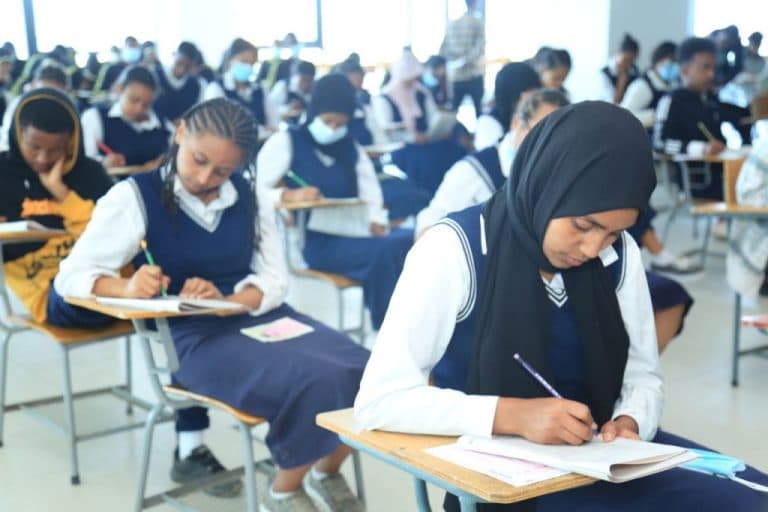
Each year, hundreds of thousands of Ethiopian students sit for the National Secondary School Leaving Examination (SSLE), also known as Matric. For generations, this exam represented a hope of progress and an opportunity for upward economic mobility. But in recent years, for the majority of students, that hope has become an unattainable fantasy. With pass rates dropping to historic lows, the crisis of mass failure has become impossible to ignore. It is not merely a reflection of student performance; it is a mirror of a deeply troubled education system and a nation at a crossroads.
There isn’t only a single factor causing mass failure. Rather, it is a combination of years of declining educational quality, regional inequality, language barriers, and, last but not least, psychological and economic pressures.
Ethiopia’s education system has undergone rapid expansion over the past 20 years. In fact, the gross enrollment ratio for secondary education has doubled in the last decade, from approximately 23% in 2011/12 to 46% in 2021/22. But expansion has not been matched with quality. Overcrowded classrooms and underpaid teachers have been emblems of Ethiopian schools for quite some time. Besides weakening the foundation of learning essential for a student’s academic success, it also fails to provide sufficient support for test takers.
Although the declining quality of education is a nationwide problem, some places have it worse than others. Students in urban areas relatively have better access to good schools, internet access, and supplementary materials. While students in rural and/or conflict-affected areas face unreliable electricity, teacher shortages, and prolonged school closures, with little to no supplementary materials to fall back on. Although these students learn in completely different situations, the exam they take, however, is uniform.
Beyond the quality of education, students also face a language barrier. Ethiopia has over 80 indigenous languages. However, the exam is administered using English, a foreign language. For many, English is a language restricted to the walls of the classroom. Concepts get lost in translation, both for the student and the teacher. Students may understand the concepts in their native language but fail to express them in English. A teacher may find it easier to explain in his/ her native tongue, yet English is the medium of language that must be used.
Lastly, we have exam anxiety. For many, Matric is the most important test they will ever take. It determines which university they will attend and what major they may learn. The weight of expectation from families places a mental strain that few teenagers can handle. Even though the students just hold a pencil during the exam, they bear the weight of the world on their backs.
What does the failure of over 90% students mean for the future of Ethiopia? Is it just an educational issue or a national emergency?
Well, Ethiopia’s development relies heavily on the knowledge economy, yet the foundation of that economy is crumbling. Every failed exam represents a lost opportunity to nurture the next generation of engineers, doctors, teachers, and innovators. For a country striving for industrialization, this loss translates into a weakened workforce and slower national progress.
Students who failed the exam are trapped in a confusing predicament: too educated for low-skilled jobs, yet without the credentials for higher ones. This fuels unemployment and a hopeless future in succeeding in their own country. This may encourage young people to leave the country by any means possible.
Beyond unemployment and lost opportunities for professionals, it may also create a harsh societal divide. The current system favours the privileged. Those who can afford private education or live in urban centers stand a better chance of passing, while rural and low-income students are systematically left behind. Over time, this educational divide risks creating another reason for division among Ethiopians.
Additionally, when tens of thousands of students fail, it raises questions about accountability. Is the exam fair? Is the curriculum aligned with classroom realities? Is the government doing enough to bridge gaps in infrastructure and teacher training? Currently, these questions remain unanswered.
Calling the mass failure of students a national emergency is an understatement. It reveals cracks in the nation’s foundation, where years of neglect, inequality, and outdated systems have silently accumulated. Behind every failed grade lies a silenced dream, a young person who might have shaped the nation’s future but was failed long before they failed an exam. Although the government has invested in expanding education, it is still not enough to provide the needed support. Fixing education is not charity; it is survival. Because no nation can hope to move forward when its future is left behind.


Comments