


On a dusty morning in 2012, Melkam, a schoolteacher from Shashemene, stood in line at a small local bank. She clutched a bundle of worn Ethiopian birr notes, her modest monthly savings. Around her, farmers, students, shopkeepers, and government workers filled the room, each ready to hand over what little they could. They weren’t paying bills or buying land. They were buying into a dream.
For Melkam, contributing 500 birr to the Grand Ethiopian Renaissance Dam wasn’t just about electricity or development. She imagined a future where classrooms glowed with light.
“I knew my small contribution was a drop,” she later said, “but together, we were making a river.”
Like millions of Ethiopians across the country and abroad, Melkam gave not because she was wealthy, but because the GERD represented something larger than herself, a collective act of sovereignty, dignity, and belief that Ethiopia could chart its own future.
For nearly a century, the Nile’s waters were bound by colonial-era treaties that favored Egypt at the expense of upstream nations. The 1929 agreement, signed between Britain and Egypt, granted Cairo sweeping “historical rights” and even a veto over projects in countries like Ethiopia.
Thirty years later, the 1959 treaty between Egypt and Sudan divided the river’s flow entirely between the two downstream states, 55.5 billion cubic meters to Egypt and 18.5 to Sudan, leaving nothing for Ethiopia, the very source of most of the Nile.
Ethiopia never recognized these deals. To Addis Ababa, they were illegitimate relics of colonial dominance. The Grand Ethiopian Renaissance Dam was thus conceived not just as a power project, but as a bold rejection of this old order, a declaration that the Nile must be shared fairly.
An attempt to modernize these rules came in 1999, when the Nile Basin Initiative introduced the Cooperative Framework Agreement. It embraced principles of equity and the duty not to cause harm. Ethiopia and other upstream states signed, but Egypt and Sudan refused, fearing it would dilute their historic claims. That failure left a deep rift unresolved. In many ways, the GERD itself became the concrete expression of this divide, a fait accompli rising on the Blue Nile.

It was the late Prime Minister Meles Zenawi who first laid the cornerstone of Ethiopia’s great ambition. In 2011, he announced to the world that Ethiopia would build the Grand Renaissance Dam on the Blue Nile, a project entirely funded by its own people. For Meles, the dam was more than concrete and turbines; it was a declaration that Ethiopia would no longer be bound by colonial-era restrictions.
“If the dam were judged solely by the benefits it brings to all, then every country, including Sudan and Egypt, should have contributed to its construction. But since that did not happen, our only choice was clear: either build it with our own resources, or never build it at all. And not building it was never an option.” — Meles Zenawi
After his passing, the vision did not fade. His successor, Hailemariam Desalegn, carried the project forward with quieter diplomacy, establishing the International Panel of Experts and signing the 2015 Declaration of Principles with Egypt and Sudan. It was an effort to reassure neighbors that Ethiopia sought cooperation, not conflict.
CNBC journalist: “So you’re going to proceed with construction as planned even though Egypt is concerned that the dam will affect the Nile River?”
Former Prime Minister Hailemariam Desalegn: “I have said time and again that the construction will not be stopped for a second.”
Then came Prime Minister Abiy Ahmed, under whose leadership the dam neared completion. His tone was more assertive, often framing the Nile as a “gift of God” for Ethiopians, a resource to be claimed with pride. Abiy’s government pressed ahead with the filling of the reservoir, even without a binding agreement, while at the same time extending invitations for dialogue.
As Prime Minister Abiy Ahmed reflected on the project, “The GERD symbolizes the spirit of sacrifice and resilience of the Ethiopian people, marking a new era of growth, unity, and prosperity for our nation.”
Across these three administrations, the message has remained remarkably consistent: the GERD is not just an infrastructure project, but a national destiny. This rare continuity in Ethiopian politics shows how deeply the dam is woven into the country’s identity, a principle no leader can easily compromise.
Egypt’s response to the GERD has shifted with its leaders, but Ethiopia’s stance has remained steady. Under President Mohamed Morsi, Egypt reacted with sharp, confrontational rhetoric and even implied threats of military action, a reflection of shock and political anxiety over Ethiopia’s ambitious project.
When Abdel Fattah el-Sisi assumed power, Cairo shifted to a more cautious and diplomatic approach, seeking a legally binding agreement and appealing to international bodies. From Ethiopia’s side, these shifts only reinforced the importance of pursuing a firm yet measured path: completing the dam to secure national development while keeping channels open for dialogue.
Ethiopia’s consistent message has been clear: harnessing the Blue Nile for its people is a sovereign right, and regional disagreements, however intense, will not derail the GERD’s construction.
Sudan, as the second downstream nation, occupies a unique position in the GERD equation. The dam offers Sudan tangible benefits. By regulating the seasonal and often unpredictable flow of the Blue Nile, the GERD can prevent catastrophic floods that have historically damaged agricultural lands, towns, and infrastructure. It promises more reliable electricity, reduces siltation in Sudanese dams like the Roseires, and could, according to economic models, boost the country’s GDP.
At the same time, Sudan’s stance has been shaped as much by domestic politics as by regional diplomacy. The 2019 revolution and the establishment of the Sovereign Council created an opening for a reassessment of foreign policy.
Historically, Sudan attempted a “double game,” balancing ties between Egypt and Ethiopia. Today, the immediate benefits of the GERD make alignment with Ethiopia increasingly pragmatic, offering solutions to pressing domestic challenges rather than adherence to outdated legal claims. In this light, the dam serves as both an opportunity for economic gain and a catalyst for a new political orientation in the region.
The history of the GERD dispute is a long and convoluted diplomatic saga. The following table provides a chronological overview of the key events and repeated attempts at resolution.

The stalled negotiations are not due to a lack of effort on Ethiopia’s part, but rather reflect a fundamental unwillingness by some downstream parties to compromise on positions that Ethiopia sees as non-negotiable for its development.
Ethiopia’s negotiators have been central to shaping the GERD discussions, consistently emphasizing the country’s sovereign right and commitment to equitable resource use. Chief negotiator Sileshi Bekele highlighted the deep national ownership of the project, stating that the motto “It’s My Dam” inspired widespread support for the construction, while also noting that Ethiopia has persistently pursued negotiations in good faith, unlike some downstream countries.

Reta Alemu, Director General of International Law at the Ministry of Foreign Affairs, underscored Ethiopia’s principle of equitable and reasonable utilization of the Nile waters as outlined in the 2015 Declaration of Principles.
Meanwhile, former lead negotiator Fekahmed Negash reflected a pragmatic stance toward third-party mediation, observing that external involvement is unnecessary given the dam’s near completion. Together, these statements reflect Ethiopia’s strategy of balancing firm national interests with measured diplomacy, reinforcing its unwavering commitment to the GERD amid complex regional negotiations.
At the heart of the GERD’s success was Engineer Simegnew Bekele Aynalem, the project’s first Chief Project Manager. From the dam’s inception until his untimely death in 2018, Simegnew was the public face of the project, guiding its construction with his engineering expertise and patriotic dedication.
“The Nile was just a song for Ethiopians but this generation has begun a project to get something from it, to get some power and to use the dam as a service that will attract tourists and we are happy to construct the dam for this purpose.” He also strongly asserted that the dam would not negatively affect downstream countries like Egypt, aiming to dispel misconceptions about its impact.
Engineering Feat and Powerhouse
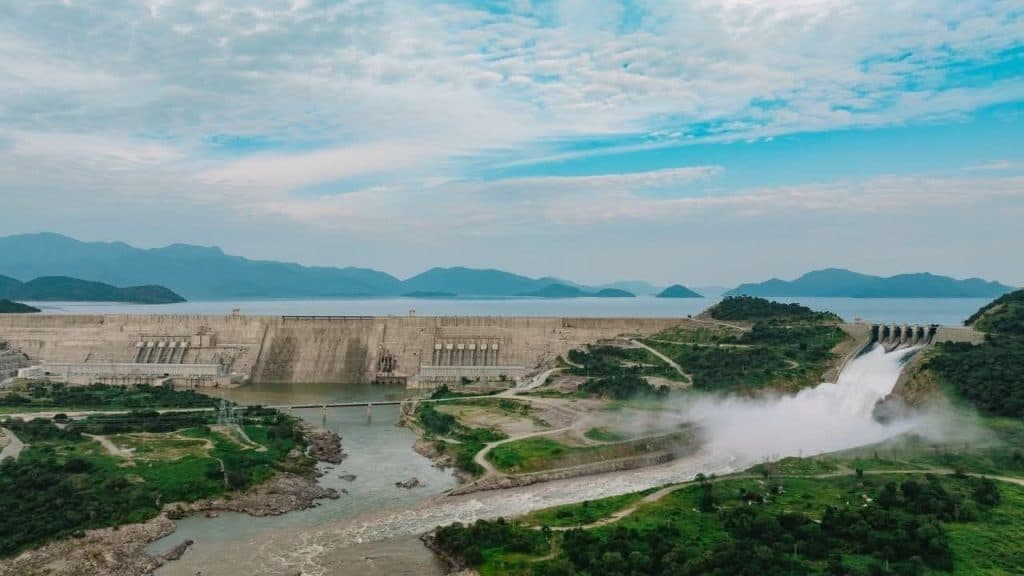
The Grand Ethiopian Renaissance Dam (GERD) stands as a monumental achievement in engineering and a cornerstone of Ethiopia’s energy future. The main dam stretches 1.8 kilometers in length and rises 145 meters high, with a lower width of 150 meters and an upper width of 11 meters, wide enough for two cars to pass side by side.
A total of 10 million cubic meters of reinforced concrete (RCC) were poured in its construction, while the adjoining Saddle Dam, located 15 kilometers away, measures 5.2 kilometers long and 50 meters high, reinforced with 15 million cubic meters of rock and a concrete layer to prevent leakage.

The dam houses 13 fully installed turbines, seven on the left power plant and six on the right, capable of generating a combined capacity of 5,150 megawatts. Each turbine is connected to iron shafts, 8.5 meters in diameter, channeling up to 300 cubic meters of water per second to the turbines.
Although the original plan called for 16 turbines and 6,450 megawatts of capacity, experts explain that the reduction to 13 turbines does not affect annual energy output. The dam’s generation capacity depends primarily on the flow of the Nile, which averages 50 billion cubic meters per year, allowing the GERD to produce approximately 15,760 gigawatt-hours annually, enough to power millions of homes, according to Tikvah Ethiopia.
As of now, more than 71 billion cubic meters of water have been stored in the reservoir, which stretches 246 kilometers along the Blue Nile, nearly reaching the distance from Addis Ababa to Shashemene. The remaining 2.1 billion cubic meters are expected to be impounded within the next week to ten days.
The GERD is also an economic powerhouse, projected to generate up to $1 billion annually. By reducing the number of turbines from 16 to 13, Ethiopia achieved significant cost savings, shortened the period needed to recover the investment, and maintained the same annual energy output.

Economic Benefits of the Grand Ethiopian Renaissance Dam
The Grand Ethiopian Renaissance Dam (GERD) represents a major step forward for Ethiopia’s energy sector. With an installed capacity of 5,150 megawatts, it is the largest hydroelectric project in Africa, capable of producing around 15.7 terawatt-hours (TWh) annually. This increase in electricity supply is particularly significant in a country where millions still lack reliable access to power, and where industrial and urban demand is growing.
GERD is expected to support Ethiopia’s industrialization efforts by providing more reliable electricity for manufacturing, agro-processing, and other energy-intensive sectors. While it will not solve all energy challenges overnight, the dam helps reduce power shortages, improves operational reliability, and gradually lowers costs for businesses, which can encourage private investment and boost productivity.
The dam also contributes to rural electrification, enabling expanded grid connections and off-grid solutions. Reliable electricity in rural areas improves access to education, healthcare, and clean water, while also allowing small businesses and households to engage in productive activities. These changes may take time to materialize, but over the medium term they can support incremental improvements in livelihoods, income, and local economic activity.
GERD has already generated employment during construction, and ongoing operation will continue to support jobs in plant management, maintenance, and the broader energy value chain. The potential for regional electricity exports, to Sudan, Djibouti, Kenya, and South Sudan, offers additional revenue, although this will depend on political agreements, infrastructure, and market demand.
As Engineer Kifle Horo, the dam’s General Manager, aptly reflected, “The Grand Ethiopian Renaissance Dam was built not only with concrete but also with the sweat, blood, and sacrifice of Ethiopians.” From threats and sabotage attempts to immense logistical challenges, the construction of the GERD tested the resolve of the nation.
Yet, it was the decisive leadership of the government, the unity of the Ethiopian people, and the dedication of thousands of workers and defense personnel that turned this ambitious vision into reality. Today, the GERD stands not merely as an engineering marvel, but as a testament to Ethiopia’s resilience, collective determination, and aspiration for a future defined by energy security, economic growth, and national pride.
Comments