



Throughout the week, numerous significant milestones unfolded within the capital market, and here we present all the ongoing events to ensure you stay abreast of the latest developments.
In the statement released by the Ethiopian Capital Market Authority, Deloitte has become the first licensed securities investment advisor in Ethiopia. This significant achievement places Deloitte at the forefront of Ethiopia’s rapidly evolving capital market landscape. The issuance of this license enables Deloitte to offer its award-winning services, including mergers and acquisitions (M&A), equity capital markets, and transaction advisory services, to clients in Ethiopia.
The Ethiopian Capital Market Authority (ECMA) has also announced the registration of its Fee Directive by the Ministry of Justice under the title ‘The Capital Market Authority’s Fee Directive Number 996/2024’. Aligned with its responsibilities as stipulated in the Capital Market Proclamation No.1248/2021, this directive outlines the fee structure for the services provided by the Authority. It applies universally to Registration of Securities, License applications, and Capital Market Transactions. Read more
Another significant milestone of the week was the completion of capital raising by the country’s first-ever exchange. The Ethiopian Securities Exchange (ESX) has declared the successful conclusion of its capital-raising initiative, exceeding its initial fundraising target by over two-fold. The Exchange secured ETB 1.51 billion (US$ 26.6 million), equivalent to 240% of its intended capital raise of ETB 631 million (US$ 11.07 million). A total of 48 institutional investors from financial and non-financial sectors participated, comprising both domestic and foreign entities. Read more
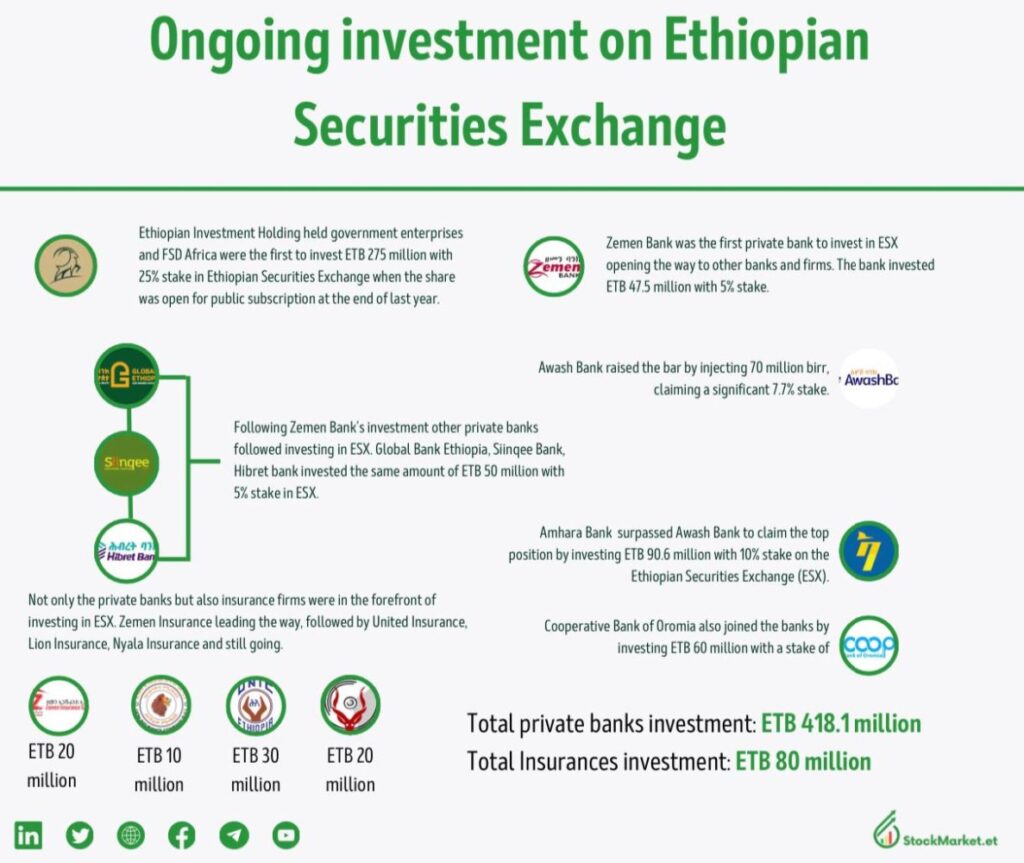
Above are some of the investments made by private banks and insurance companies.
National Bank of Ethiopia
Another significant event of the week was the Ethiopia Digital Payment Conference, organized by the National Bank of Ethiopia, bringing together stakeholders from the digital payment realm. Notably, the conference aligns with the nation’s recent strides in digital payment, encompassing the digitization of fuel payments and governmental service fees like taxes and utilities, the expansion of access points, and the proliferation of digital service providers, accounts, and transactions.
Below are the key highlights points from the digital payment landscape in Ethiopia:
- Annual value of digital transactions: 5 trillion birr
- Interoperable value of transactions per year: 205.6 billion birr
- Number of digital transactions per year: 1.2 billion
- Mobile money agents: 233,000
- Digital micro-credit per year: 5 billion birr
- Non-bank digital financial service providers: 11
- Debit cards in circulation: 38.4 million
- POS terminals: 8,000
- ATMs: 12,000
The Conference also marked the launch of a new QR code standard for making interoperable digital payments. This standard QR code, launched by the National bank, applies to all banks, microfinance institutions, and payment service providers.