


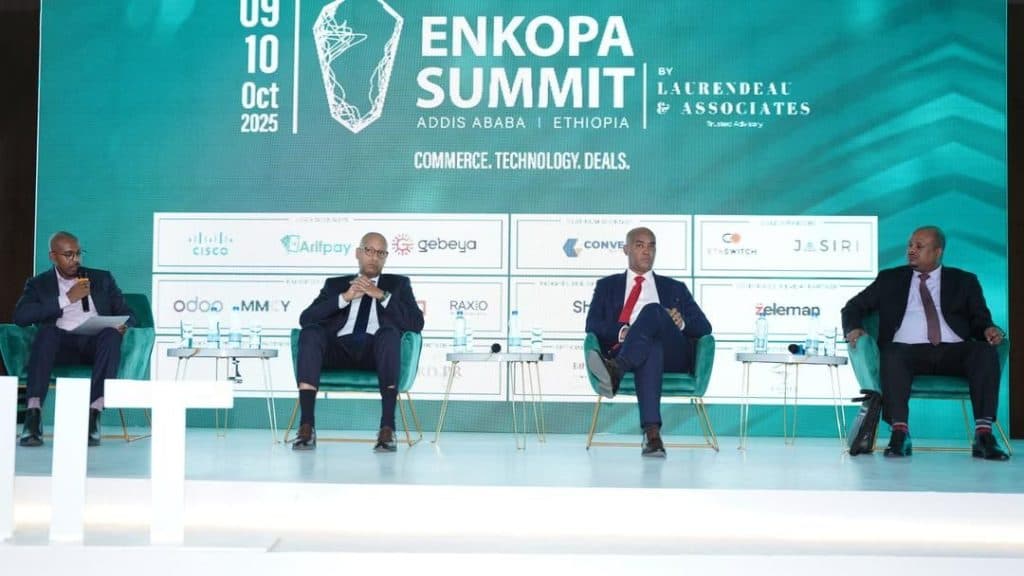
When Ethiopia’s financial sector began its long-awaited reform journey, few areas held as much transformative promise as investment banking. The Enkopa Summit this year was more than a platform for financial dialogue — it was a window into a new era, one in which Ethiopia begins to move beyond traditional commercial banking and steps into a capital-market-driven economy.
The conversation around investment banking, once abstract in Ethiopia’s context, now has real faces, institutions, and policies shaping it. From regulators to practitioners, the insights shared at Enkopa revealed both how far Ethiopia has come and how far it still needs to go.
The Rise of Investment Banking: From Scarcity to Structure
Andualem Hailu, Founding CEO of Awash Capital, captured the spirit of change vividly.
“In our previous experience, people used to struggle to find funding to start their business,” he said. “But now, with a proper and well-designed prospectus, we see a decent and credible path emerging.”
Awash Capital, one of the emerging investment banks in the country, represents this shift, moving entrepreneurs away from relying solely on informal financing or bank loans toward more structured capital-raising mechanisms. The emergence of prospectus-based financing, underpinned by regulatory oversight, marks a historic turning point.
Investment banking in Ethiopia is gradually positioning itself as the bridge between capital and innovation, connecting businesses hungry for expansion with investors searching for returns.
Regulatory Momentum: ECMA’s Foundational Role
The Ethiopian Capital Market Authority (ECMA), established in 2022, stands at the center of this evolution.
Senior Advisor Assefa Asmero outlined the milestones shaping the sector’s foundation:
- 2021: Endorsement of the Capital Market Proclamation.
- 2022: Formal establishment of ECMA.
- Since then: A wave of directives — from licensing service providers and exchanges to developing the framework for collective investment schemes (CIS), which are expected to be enacted by the end of the year.
These steps are laying the groundwork for a modern and diversified financial ecosystem. The Ethiopian Securities Exchange (ESX), now actively trading in the money market segment, is also joined by other structures such as the Central Securities Depository (CSD), ensuring secure clearing and settlement.
“We also have a market surveillance system,” Assefa noted, “along with a public disclosure platform where issuers share their financial information — key to building market efficiency and investor trust.”
ECMA’s initiatives, such as the IPO Clinic, Regulatory Sandbox, and Green Finance Framework, are designed to foster innovation while ensuring that new financial products are tested and supervised responsibly.
Learning from Regional Markets
Assefa also emphasized that Ethiopia’s capital market journey did not start from scratch.
“Even when we started, we reviewed markets like Malaysia, Kenya, and South Africa,” he said.
Kenya, for instance, hasn’t seen any listing for the last eight years in equity listings, offering valuable lessons on liquidity, governance, and retail participation.
Many stock markets on the continent remain illiquid, with limited trading and low investor engagement. Ethiopia’s approach, therefore, must focus not just on building a market, but also on activating it. That’s where public awareness and participation come in.
Financial Literacy and Inclusion: The Retail Investor Push
ECMA and its partners are doubling down on financial literacy campaigns — targeting not just Addis Ababa but regional cities across the country. The message is clear: the capital market belongs to everyone.
The authority uses television, radio, and social media to educate citizens about saving, investing, and buying securities.
“More than 25 million people have already opened digital IDs which is a prerequisite to open an account to invest in the Ethiopian capital market,” Assefa highlighted. “We encourage everyone to open investment accounts from the investment banks and start investing in different instruments.”
This digital readiness, paired with a young, tech-savvy population, gives Ethiopia a strong foundation to build a vibrant retail investor base.
CBE Capital: Simulating the Market’s Future
At the heart of practical implementation is CBE Capital, a subsidiary of the Commercial Bank of Ethiopia, licensed at the end of 2024.
Vice President Abel Beyene shared how the institution is helping simulate real market activity ahead of full-scale operations.
“Since our licensing, many people have visited our office,” Abel noted. “Everything is in place — we only need the public to know about it.”
CBE Capital is now engaging in valuation exercises, DCF (discounted cash flow) modeling, and price discovery mechanisms — all essential tools in investment banking. These efforts aim to ensure that when Ethiopia’s capital market becomes fully active, price formation and investor behavior align with international standards.
Abel also drew attention to the evolving landscape of returns:
“Today, a 28-day Treasury bill yields around 13%, compared to the 7% you’d get in a savings account — and that’s before tax. Investors will soon start to see the power of informed investment.”
Still, challenges persist. Few licensed entities currently play active roles in brokerage and investment banking, and public awareness remains limited. Institutions like CBE Capital and Awash Capital are therefore not only market participants — they are educators and catalysts for change.
Invest in Skills, Not Just Capital
A recurring theme throughout the summit was that the financial market’s success depends not only on infrastructure and regulation but also on human capital.
Andualem’s closing message captured this perfectly:
“Invest in your professional skill,” he urged. “This industry will demand competence, ethics, and creativity.”
Indeed, as Ethiopia’s capital market opens, opportunities will multiply — but so will responsibilities. Investment banking, at its core, requires technical knowledge, trust, and long-term thinking.
A Market in the Making
From regulatory foundations to institutional readiness and public engagement, Ethiopia’s investment banking story is one of momentum and promise. The frameworks are in place, the players are emerging, and the conversations — once confined to theory — are now turning into action.
The journey ahead will test patience, coordination, and policy consistency. But if the energy at Enkopa Summit is any indicator, Ethiopia’s investment banking awakening has already begun — and it’s shaping a future where access to capital is no longer a privilege, but a possibility.
Comments