



Ethiopia and the United Kingdom have reaffirmed their long-standing partnership by signing three major cooperation agreements aimed at supporting economic reforms, strengthening public investment systems, and expanding green energy infrastructure.
Prime Minister Abiy Ahmed (PhD) received Rt. Hon. Yvette Cooper, the UK Secretary of State for Foreign, Commonwealth and Development Affairs, where the two sides reviewed ongoing collaborations and explored new areas of cooperation to advance shared development goals.
£17.5 Million UK Support for Public Investment Reforms
One of the key agreements signed was a Memorandum of Understanding (MoU) for Phase II of the Ethiopia Investment Advisory Facility (EIAF). The new phase will establish a Public Investment and Asset Management (PIAM) Facility running from 2025/26 to 2028/29.
Under this agreement, the UK government will provide up to £17.5 million in technical assistance to help Ethiopia strengthen its public investment and asset management systems. The facility will support the implementation of Ethiopia’s Homegrown Economic Reform Agenda and aims to improve conditions for export-oriented, private sector–led, and inclusive economic growth.
USD 400 Million Power Transmission Deal with Gridworks
The two governments also advanced cooperation in the energy sector through the signing of a Joint Development Agreement (JDA) with Gridworks, a UK government-owned investor in Africa’s electricity networks and a subsidiary of British International Investment (BII).
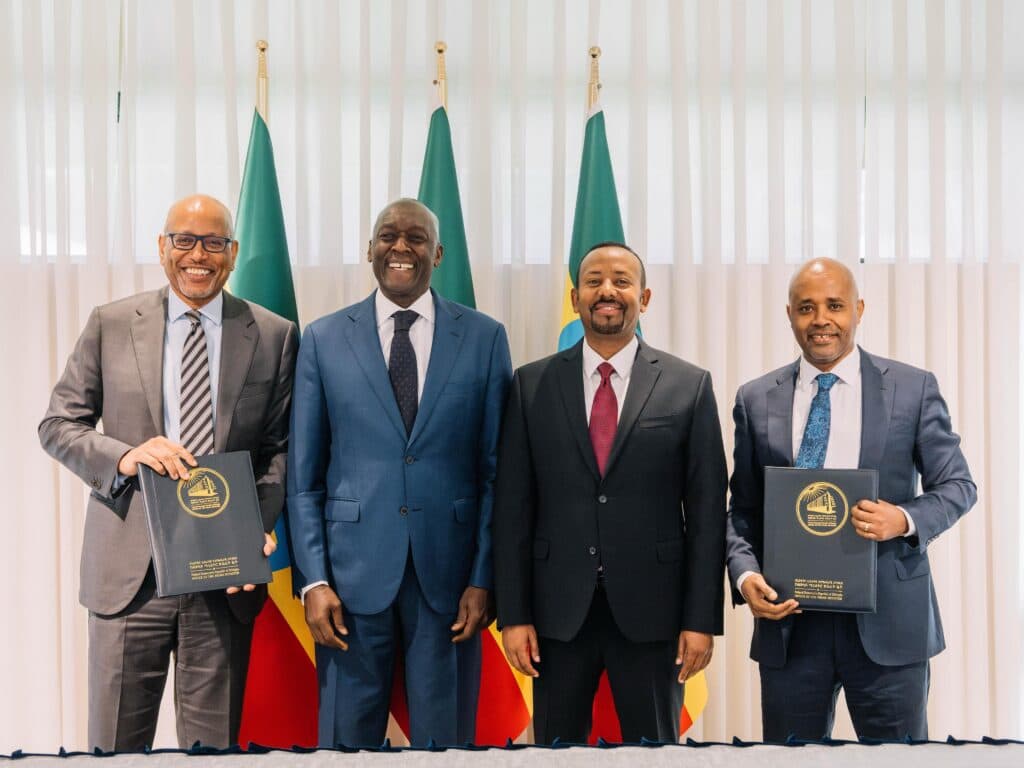
The agreement covers two privately financed transmission projects with a combined value of around USD 400 million, marking Ethiopia’s first public-private partnerships (PPPs) in power transmission. The JDA was signed by Finance Minister Ahmed Shide and Gridworks CEO Chris Flavin, in the presence of Prime Minister Abiy Ahmed and UK Foreign Secretary Yvette Cooper.
The two projects include:
- A 206 km, 132 kV Degehabur–Kebridehar transmission line, connecting Ethiopia’s Somali region with the central and northeast grids.
- A 198 km, 400 kV Hurso–Ayisha transmission line, designed to unlock wind and solar potential in the northeast and strengthen power interconnection with Djibouti.
These projects are expected to improve grid reliability, meet rising industrial power demand, enable greater use of renewable energy, and support long-term rural electrification.
Supporting Ethiopia’s 2030 Power Targets
Ethiopia faces urgent electricity needs, with nearly half of the population still without access to power and growing demand from industry. Finance Minister Ahmed Shide noted that the government aims to connect 96% of citizens to the grid and raise power availability to nearly 20 GW by 2030, under the country’s Ten-Year Development Plan.
“The two projects will bolster industrial growth by improving power reliability and accelerate electrification for millions of households,” he said.
Unlocking Renewable Energy and Regional Connectivity
Gridworks CEO Chris Flavin described the projects as central to Ethiopia’s national development goals, while UK Ambassador to Ethiopia Darren Welch said the agreement demonstrates the UK’s ambition to remain a strong investment partner in Ethiopia, particularly in transmission infrastructure that supports growth, jobs, and renewable energy development.
Ethiopia Electric Power CEO Ashebir Balacha emphasized that partnering with international investors will help strengthen the grid and unlock the country’s vast renewable energy potential. Meanwhile, Abebe Gebrehiwot Yihdego, Head of the PPP Unit at the Ministry of Finance, highlighted that the projects mark an important milestone in attracting private investment into Ethiopia’s transmission network.
The initiatives also align with broader regional goals, including Mission 300, which seeks to expand electricity access across Africa, where an estimated 650 million people still live without power.
Together, the three agreements underscore deepening economic and development cooperation between Ethiopia and the United Kingdom, with a strong focus on sustainable growth, energy access, and private sector participation.


Comments