


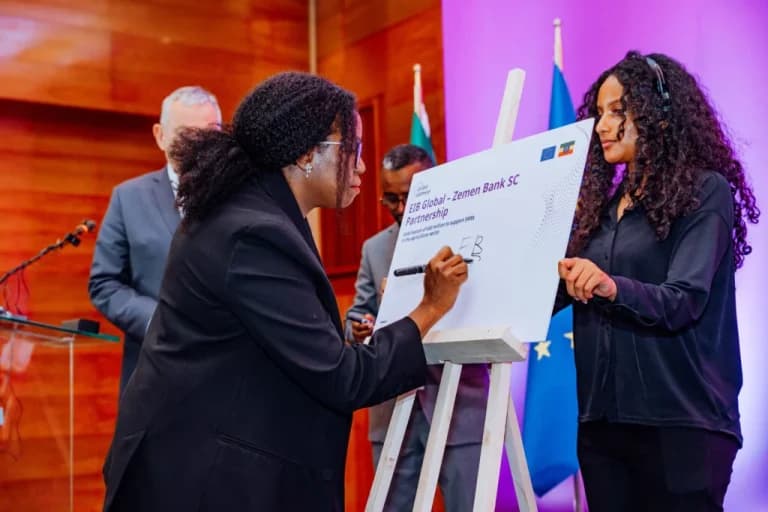
Ethiopia has secured more than $170 million in new agricultural financing through two major agreements involving the European Investment Bank Global, Development Bank of Ethiopia, and Zemen Bank, signaling a coordinated push to strengthen export capacity, expand financial inclusion, and support climate-resilient agriculture.
The largest share comes from a $129.5 million (€110 million) financing facility extended to the Development Bank of Ethiopia (DBE), which will serve as the central conduit for the third phase of the Rural Financial Intermediation Programme (RUFIP III). The program will channel funds through microfinance institutions and Rural Savings and Credit Cooperatives (RUSACCOS), targeting smallholder farmers and agricultural micro, small, and medium enterprises (MSMEs) across all regions.
Under the DBE-led program, 50% of the financing is earmarked for women-led enterprises, while 20% will support climate adaptation initiatives. The package also includes a $10 million technical assistance component aimed at strengthening lending systems, enhancing environmental and social safeguards, and improving financial literacy. In addition, part of the funding will subsidize climate-risk insurance products to help farmers manage shocks such as droughts, floods, and pests.
DBE President Esayas Kassa said the initiative aligns with the bank’s focus on sustainable development and inclusive finance, emphasizing its potential to transform rural livelihoods.
Complementing this effort, a separate €40 million financing agreement between EIB Global and Zemen Bank targets export-oriented agricultural SMEs, particularly in coffee and horticulture. The facility includes a €20 million credit line from EIB Global, matched by €20 million from Zemen Bank, and will support businesses engaged in producing and exporting fruits, vegetables, herbs, and coffee.
At least 30% of this funding will be directed toward climate-focused investments, while another 30% will support women-led or women-serving enterprises. The initiative is part of the European Union’s “Green Agri Value Chain” program, which aims to boost Ethiopia’s export competitiveness and foreign exchange generation.
Speaking at the EU–Ethiopia Business Forum, Ambroise Fayolle highlighted agriculture’s central role in Ethiopia’s economy, noting that such financing mechanisms help mobilize private capital across the value chain.
Zemen Bank CEO Dereje Zebene said the partnership would enhance productivity and drive inclusive growth, while Jozef Sikela emphasized its role in boosting exports, creating jobs, and expanding opportunities for young people.
Ethiopia’s Minister of Finance Ahmed Shide also welcomed the broader initiative, noting that it supports sustainable agricultural practices and expands access to finance for rural enterprises.
Together, the two financing packages reflect a growing alignment between Ethiopia and European partners under initiatives such as the EU’s “Global Gateway” strategy, the “2X Challenge” for women’s economic empowerment, and national priorities under Ethiopia’s Financial Inclusion Strategy II.
Agriculture remains a cornerstone of Ethiopia’s economy, contributing over one-third of GDP and serving as a primary source of employment and foreign exchange. The new funding is expected to increase productivity, strengthen export performance, and build resilience across rural communities.


Comments