


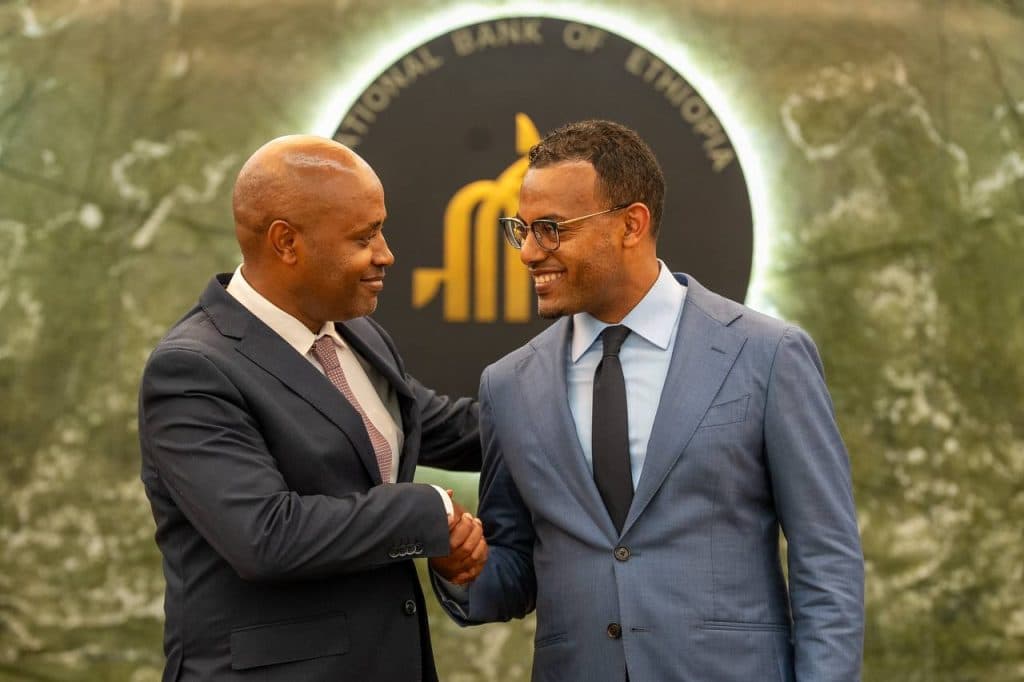
On a muted September afternoon in Addis Ababa, the announcement arrived without ceremony but carried the unmistakable weight of a turning point: Dr. Eyob Tekalign would assume the governorship of the National Bank of Ethiopia. There were no dismissals wrapped in drama, no emergency pressers or currency shocks—just a quiet passing of the baton from Mamo Mihretu to one of the very architects of the economic order now under strain. In a country where policy decisions ripple far beyond spreadsheets and forecasts, the silence around the shift said as much as the appointment itself.
Eyob arrives not as an outsider, not as a reformer descending from nowhere, but as one of the original engineers of the Homegrown Economic Reform agenda. This is the same man who, as State Minister of Finance, pitched market liberalization to Bretton Woods institutions, framed debt talks in Washington, and argued that Ethiopia had outgrown its old command-and-control reflex. Those who have followed the last five years of Ethiopia’s economic transformation know his name well, not as a supporting character, but as one of its central authors.
His appointment comes at a moment when the central bank’s role is under intense pressure and scrutiny. Inflation is lower than last year but still high enough to sting. The birr’s journey toward a market-based exchange rate is both a policy goal and a political gamble. Foreign exchange shortages continue to choke business activity, while debt restructuring hangs in mid-air between creditors’ caution and government optimism. And across the table, the IMF and World Bank quietly hold the scorecard, making sure the reforms they funded stay on script.
Yet if anyone expected an abrupt shift in tone or direction with Eyob’s arrival, the Monetary Policy Committee offered an early clue of what the next phase would, and would not, look like. Meeting on September 25, just days before Eyob settled into office, the committee held the policy rate at 15 percent. Deposit, lending facility, and reserve requirement rates remained untouched. But there was one notable move: the annual credit growth ceiling for banks was nudged from 18 percent to 24 percent, not abolished, not liberalized fully, but eased by just enough to suggest caution wrapped in pragmatism.
Inflation, officially at 13.6 percent in August, has fallen from the punishing highs of the previous year. Food prices have decelerated, though non-food inflation is still climbing, driven in part by what economists politely call “exchange-rate pass-through.” Broad money expanded by more than 23 percent, base money by more than 70, in large part due to gold purchases that have quietly become one of the NBE’s most unconventional monetary tools. Liquidity has improved, Treasury bill yields are falling, and the interbank money market has surged past the trillion-birr mark, a milestone that would have been unthinkable even three years ago. Banks remain largely stable, but loan-to-deposit ratios at some institutions reveal just how tight the margins are.
The MPC didn’t sound triumphant, nor did it sound confused. It sounded watchful. Inflation remains above target, and “policy should stay disinflationary,” the committee said. Market-based tools, the policy rate, reserve ratios, open market operations, and strategic forex interventions, would remain the instruments of choice. Fiscal policy has so far resisted the temptation to lean on the central bank, and the external sector is benefitting from the float-like reforms introduced in 2024. It felt less like a reboot and more like an intermission: the script isn’t changing, but the director has.
Still, not everyone sees this as merely continuity. Economist Getachew Tekle, writing on LinkedIn, captured the paradox with unusual clarity. In his view, this is not a shift in policy substance but a shift in tone. Eyob is an economist, not a showman. He is more forceful, more certain, less inclined toward open consultation than Mamo. Where his predecessor projected reform through constant motion and high visibility, Eyob may operate with tighter messaging, sharper elbows, and a narrower circle of influence. But the parameters, the IMF program, the macro targets, the timelines, have already been drawn. The governor is not a composer; he is a conductor asked to stay in tempo.
And yet, Getachew argues, there is a corner of the economy where Eyob’s fingerprints may show more boldly: the financial sector itself. If he chooses to confront the entrenched networks and inefficiencies within Ethiopia’s banks, from overextended loan books to quietly protected privileges, his legacy may be regulatory rather than monetary. But that assumes he resists the currents of interest and inertia that have swallowed many of his predecessors.
The larger truth is that Eyob steps into a role whose freedom of maneuver is narrower than the job title implies. The IMF’s oversight is both a parachute and a leash. Debt restructuring talks limit the space for improvisation. The move toward a more flexible exchange rate is both overdue and risky. Inflation may be cooling, but the cost of living has not retreated for most households. The parallel currency market still signals unmet demand and unresolved structural issues. To govern the NBE at this moment is to operate with both hands slightly tied, one by international expectations, the other by domestic political economy.
And yet, there is something quietly consequential about what happens now. Mamo Mihretu’s term was defined by visibility, acceleration, and reform by momentum. Eyob’s tenure may be one of calibration, one where the question is no longer “what must we change?” but “what must we hold steady long enough to work?” If this is a bridge moment, then it is one that tests endurance more than imagination.
There is also the matter of trust, not the kind negotiated in Washington or measured in SDR allocations, but the kind that lives in markets, boardrooms, and shops that still price goods in whispers of dollars and euros. Ethiopia’s economic story is no longer just about reform, but about whether reform fatigue turns into reform reversal, or if careful stewardship can turn exhaustion into resilience.
There are no guarantees. The IMF projects global growth ticking back up in 2025 and 2026, but warns about tariff shocks that could ripple back through commodity and currency markets. Domestic credit is expanding, foreign exchange earnings from gold and coffee have improved, and remittances are rising. But growth without stability is noise, and stability without confidence is still fragility with better PR.
What happens next is not just about personality, though personality will shape how the institution speaks and regulates. It is not just about numbers, though numbers will determine how far policy can stretch before something snaps. It is about whether Ethiopia is entering the consolidation chapter of its economic experiment, the part where the reforms stop being promises and start being tests.
Eyob Tekalign begins his governorship not with the luxury of reimagining the system, but with the burden of proving that the system he helped design can hold. His success will not be measured by the novelty of his decisions, but by the steadiness of his execution, and by how little or how much ordinary Ethiopians feel the difference between policy and pain.
If this is a transition of style, not substance, then perhaps style is exactly what the moment demands: less show, more signal; less noise, more intent. The story from here will not be written in announcements, but in the slow, difficult work of disciplining a financial sector, taming inflation without killing credit, and navigating an IMF deal while pretending not to be constrained by one.
The question is not whether Eyob will change the direction of Ethiopia’s economy. The question is whether he can keep it from veering off course, and whether, in the process, the institution he leads becomes quieter, sharper, and more certain of its lane.
That kind of leadership doesn’t trend. But it leaves traces.


Comments