


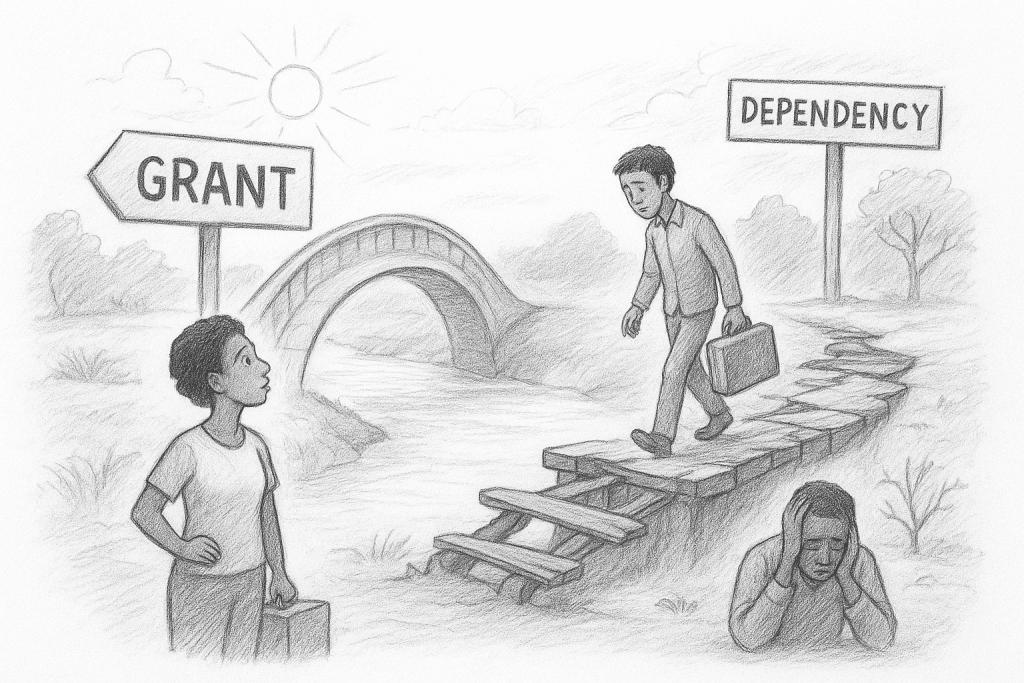
Grant funding has long been heralded as a vital lifeline for Africa’s entrepreneurial ecosystem, a source of non-dilutive capital that allows early-stage ventures to take risks, test innovations, and pursue social impact missions in environments where access to finance remains constrained. But beneath its promise lies a complex duality.
While grants can catalyze progress, open markets, and validate ideas, they can also quietly entrench dependency, distort incentives, and deter the very commercial investment needed for scale. The paradox of “free money” in African business is that it often comes at a hidden cost: one that tests the balance between sustainability and survival.
The core finding of this analysis is clear, grant capital should be treated not as a permanent financial model, but as a strategic bridge to self-sustaining commercial viability. Success depends on deliberate transition planning, disciplined execution, and a relentless focus on market-driven revenue.
The Dual Nature of Non-Dilutive Capital
For most African entrepreneurs, raising early-stage capital remains one of the greatest barriers to growth. Development agencies, philanthropic foundations, and corporate CSR initiatives have stepped in to fill the gap, offering grants that don’t demand equity or repayment.
This type of funding can unlock innovation in sectors often deemed too risky or unproven for private investors, from agritech to climate resilience to social inclusion. Yet the long-term impact of these grants extends far beyond liquidity.
What often goes unexamined is how dependency on external, donor-driven funds reshapes internal business structures, influences strategic priorities, and determines whether a venture ever transitions into a sustainable enterprise.
The Hidden Costs: When “Free Money” Becomes a Trap
The “Grant-preneur” Mindset
One of the most pervasive risks in Africa’s impact-driven economy is the rise of the “grant-preneur.” These are entrepreneurs whose survival hinges on continuous cycles of donor funding.
Instead of building sustainable, revenue-generating models, such businesses become adept at navigating donor ecosystems, tuning operations, language, and metrics to fit funding priorities rather than market demand.
“If your business cannot survive without the next round of grant funding, it is not a business, it’s a project.
This dependency can stifle innovation, dilute entrepreneurial focus, and ultimately create ventures that exist to secure the next grant rather than to serve the next customer.
Mission Drift and Skewed Priorities
Grants often come tied to specific social or developmental objectives defined by the donor. While these mandates can align with good intentions, they can also push companies off their commercial trajectory.
This “mission drift” can lead to a focus on optics, quantifiable short-term impact metrics that appeal to donors, rather than sustainable growth or true market penetration. Entrepreneurs may begin optimizing for reports and renewal cycles instead of customer satisfaction or competitiveness.
The result is a system that “rewards the appearance of impact, not actual scale.”
Investor Hesitancy and Signaling Risk
Private investors—venture capitalists, angel networks, and even local banks—often view grant-dependent firms with caution. Heavy reliance on donor funding can signal weak market validation or a fragile business model.
From an investor’s standpoint, a grant-heavy portfolio raises concerns about whether a company can survive without external subsidies. This skepticism has created a “credibility paradox,” where grants that once boosted legitimacy can later deter commercial capital.
The unintended consequence of over-relying on grants is that it may make commercial investors hesitant to engage.”
Operational Instability and Policy Risk
Tying core operations to external donors also exposes African businesses to significant volatility. Donor priorities shift with political cycles, policy changes, or geopolitical tensions.
The experience of startups reliant on USAID or other government-funded initiatives highlights this vulnerability. A sudden freeze or reallocation of funds can trigger operational crises—halt payrolls, disrupt supply chains, and erode partner confidence.
For businesses built around such uncertain funding flows, financial stability becomes hostage to global policy decisions rather than local performance.
The Hidden Benefits: Grants as Catalysts for Growth
Despite the risks, grant capital offers clear strategic advantages that, when used wisely, can be transformative.
The Credibility Bridge
A grant from a respected international foundation can serve as a powerful stamp of approval. This external validation acts as informal due diligence, de-risking the venture for future investors.
Such grants not only provide liquidity but also enhance reputational capital. They can help entrepreneurs “unlock capital from other investors,” bridging the gap between early experimentation and investor readiness.
Catalytic Seed Funding
Grant money is uniquely suited for funding proof-of-concept work, R&D, and early pilots—areas where private investors rarely tread.
In frontier markets or underserved regions, these funds can enable entrepreneurs to gather real-world data, refine their models, and demonstrate traction before approaching commercial backers.
In this way, grants play a catalytic role: they absorb early-stage risk so that private capital can later step in.
From Grant Reliance to Market Resilience: A Strategic Transition
Turning grant dependence into commercial independence requires a structured, phased approach. Each stage should redefine how the business uses external capital and measures success.
| Phase | Strategic Goal | Key Actions |
|---|---|---|
| 1. Grant Utilization | Achieve Commercial Milestones | Use grant funds for tangible, revenue-linked goals such as product development, pilot success, or market entry. |
| 2. Sustainability Planning | Develop a Revenue-First Model | Create a long-term plan centered on market-driven income rather than grant renewals. |
| 3. Investor Readiness | Attract Private Capital | Leverage grant credibility to secure partnerships with venture firms, banks, and strategic investors. Adopt ESG and governance practices aligned with investor expectations. |
| 4. Commercial Scaling | Exit the Grant Cycle | Transition to private investment or self-funding through profit, prioritizing efficiency, innovation, and competitive advantage. |
This framework requires a mental shift—from optimizing for donor compliance to optimizing for customer value and operational performance.
The best African businesses use grants as launchpads, not life support systems. They treat donor funds as temporary scaffolding, building the internal structures needed to stand on their own.
Walking the Fine Line
The hidden impact of grant money in Africa’s entrepreneurial landscape is deeply paradoxical. It empowers innovation but risks dependency; it validates impact but can distort purpose.
Grants remain indispensable, especially in markets where early-stage risk is high and access to finance is limited. But their effectiveness ultimately depends on how they are managed.
African entrepreneurs must view grants as time-bound tools—to be leveraged for experimentation, credibility, and market entry, not as perpetual lifelines.
When managed strategically, grant funding can indeed serve as a bridge—to sustainable growth, investor confidence, and continental competitiveness. But without discipline and foresight, that same bridge can quickly become a trap.
The difference lies not in the money itself, but in how it’s used.



Comments