


Good morning!
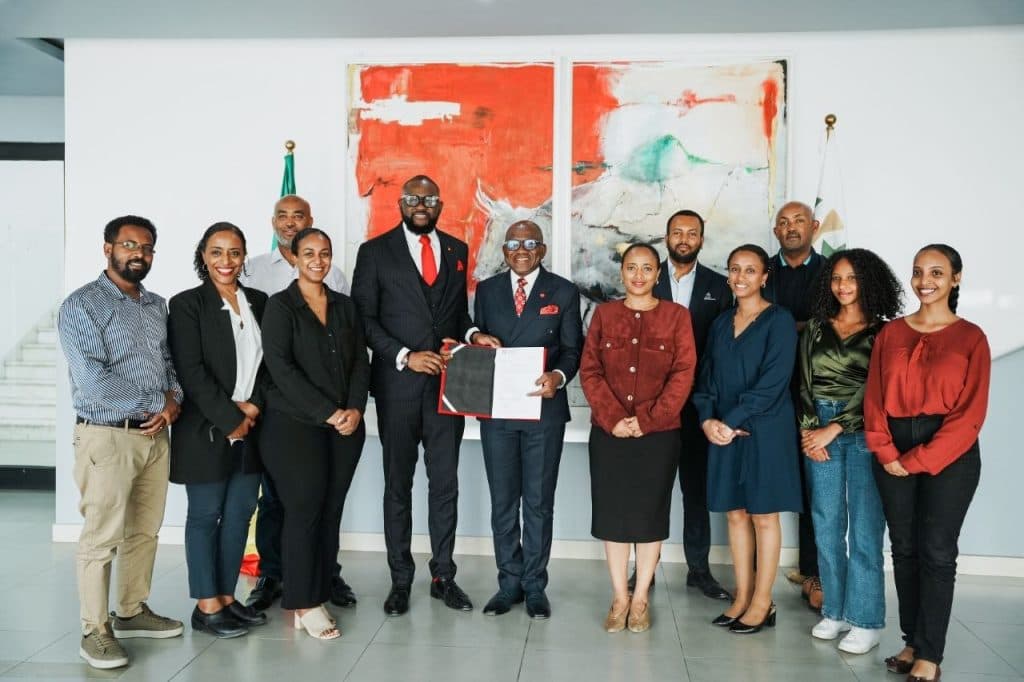
For a year, the story of Ethiopia’s capital market has been a domestic one. Local banks listed, local brokers got licensed, tens of thousands of local shareholders learned what a share even is. This week the door swung outward. Nigeria’s United Capital became the first foreign institution ever licensed to run an investment bank in Ethiopia, planting a flag in Addis that the rest of the continent’s financial industry will be watching.
It did not arrive alone. The IMF cleared the way for another USD 468 million, the Africa Finance Corporation closed the largest syndicated loan in its history, and Safaricom Ethiopia went looking for birr from the IFC because local banks could not lend it enough. At home, the interbank money market crossed 3 trillion birr, the country approved its first-ever national trade policy after more than a century of patchwork rules, and EthioPay processed over a million transactions in a single day on its way to an African financial-inclusion award. CBE, Ethiopian Airlines and Visa put a global payment card in travelers’ pockets, and Ethiopian Airlines pointed a plane back toward Kuwait.
The counter-note, as ever, came from London: the bondholders are done negotiating and are sharpening a court case.
Grab your buna. The doors are open, and a lot is walking through them.
Capital Market Spotlight
United Capital becomes Ethiopia’s first foreign investment bank
This is the one that changes the picture. The Ethiopian Capital Market Authority has granted Nigeria’s United Capital Group the country’s first foreign investment-banking licence, issued on 5 June after months of legal and regulatory vetting that pulled in the Authority, the Ethiopian Investment Commission, and other government bodies. The firm will operate through a wholly owned local subsidiary, United Capital Financial Services PLC, and has brought in more than USD 1.5 million in capital to fund the operation.
The detail that matters for the future: the Authority says United Capital could eventually run under as many as four licence categories, including investment banking and collective investment scheme management. Until now, every licensed capital-market service provider in Ethiopia has been homegrown; a Deloitte subsidiary held a securities-advisory licence, but no foreign institution had been let into investment banking itself.
Here is why it matters. A young exchange needs two things foreigners bring better than anyone: capital and expertise. The first foreign bank through the door is never just one bank. It is a signal to every other institution that has been watching from Lagos, Nairobi, and the Gulf that the paperwork is real, the licence is gettable, and the market is open for business. ECMA Director General Hana Tehelku framed it as exactly that, a sign of Ethiopia’s push to build a globally competitive market while inviting in outside capital and know-how. The question now is who follows, and how fast.
Ethio Telecom tells its 45,000 new owners: now go open a trading account
A week after listing, the country’s biggest company is discovering that getting shares into people’s hands is only half the job. Ethio Telecom has urged the roughly 45,000 verified shareholders from its IPO to open trading accounts with licensed brokers or investment banks, because shares cannot be bought or sold through Ethio Telecom itself, only through ECMA-licensed intermediaries on the exchange.
The IPO numbers are a reminder of the scale here: 47,377 people registered, about 10.7 million shares sold, and 3.2 billion birr raised, before the company spent weeks on data cleaning and know-your-customer verification. CEO Frehiwot Tamiru put her finger on the real bottleneck, which is not regulation but understanding. Many shareholders simply have not traded yet because they do not fully grasp the process, and participation now depends on the whole ecosystem, the brokers and banks, not just the telecom.
This is the unglamorous middle of building a market. The listing is the headline; the financial literacy is the work. A household name with tens of thousands of first-time investors is the perfect test of whether the pipes between an IPO and an active secondary market actually carry water. Source: Capital
ECMA wants to wire investing into the phone in your hand
Speaking on the sidelines of the Africa CEO Forum in Kigali, Hana Tehelku laid out where the regulator wants the market to go next, and it runs straight through the mobile money boom. Her argument: Ethiopia has seen explosive mobile-money adoption in just two to three years, with transactions running into the tens of trillions of birr, and integrating those payment rails with investment products is now essential rather than optional.
The rest of the agenda was about trust, strengthening investor protection, lifting financial literacy, and attracting foreign portfolio investment through clearer rules and better infrastructure. It is a coherent picture: the country that just licensed its first foreign bank and listed its biggest company is now trying to make buying a share as frictionless as sending money on a phone. If that integration lands, the financial-literacy gap Ethio Telecom is wrestling with this week gets a lot smaller. Source: Capital
Reform Desk
Ethiopia approves its first national trade policy, 118 years in the making
On 26 May, the Council of Ministers approved Ethiopia’s first-ever national trade policy, a document that arrives more than a century after the Trade Ministry itself was established. For all that time, trade has been run through a patchwork of separate laws, directives, and shifting procedures, a setup officials and the private sector alike blame for inefficiency, illegality, and a market that was hard for new entrants to plan around.
Trade and Regional Integration Minister Kasahun Gofe pitched the framework as a move toward transparency, accountability, and predictability, with rules that stop changing every other year. The stated priorities are easing the cost of doing business, protecting consumers, and promoting fair competition, while pushing Ethiopia’s exports beyond raw agricultural commodities toward manufacturing, value-added goods, services, and tourism.
The timing is not accidental. With WTO accession back on the table and AfCFTA implementation looming, a coherent trade policy is the rulebook the rest of the reform program has been missing. It is the kind of plumbing that does not trend, but everything from export earnings to FX supply eventually runs through it.
Money Markets
The interbank market crosses 3 trillion birr
The quiet engine of the reform keeps accelerating. Ethiopia’s Interbank Money Market has now passed 3 trillion birr in cumulative transactions, less than two years after launching on the ESX trading platform in October 2024. The growth curve is the story: 500 billion birr in the first six months, 1 trillion by September 2025, 2 trillion by March 2026, and 3 trillion just months after that.
The market lets commercial banks lend and borrow short-term funds from each other rather than leaning on the central bank, with the National Bank’s 15 percent policy rate and interest-rate corridor giving the trades a reference point. Twenty-six banks are now onboarded.
Why care about a number most people never see? Because a deep, liquid interbank market is the foundation everything else this week is being built on. Foreign banks like United Capital, government and corporate debt, a functioning equity market, none of it works well without banks able to manage liquidity smoothly among themselves. The 3 trillion figure is less a milestone than a readiness check, and the system keeps passing it faster each time.
Financing & Debt
IMF clears the fifth review, opening the door to USD 468 million
The IMF reached a staff-level agreement on the fifth review of Ethiopia’s USD 3.4 billion reform program, paving the way for a roughly USD 468 million disbursement and describing the economy as resilient despite a more uncertain global backdrop. Subject to board approval, it is the next tranche of the financing that has underwritten the FX float, the auctions, and the broader liberalization since July 2024. Steady review-by-review progress is exactly the signal that keeps the reform program credible to the outside capital now circling the market.
AFC closes its largest-ever loan: USD 2 billion
The Africa Finance Corporation raised a record USD 2 billion syndicated loan, upsized from an initial USD 1.6 billion target on strong demand, in a striking vote of confidence in African infrastructure at a moment of global volatility. The geography of the lenders tells the story of who is betting on the continent: banks from Asia-Pacific and Europe each took 35 percent, the Middle East 25 percent, and Africa 5 percent, with Barclays, Commerzbank, First Abu Dhabi Bank, and Rand Merchant Bank leading the deal. AFC’s assets have crossed USD 19 billion, its membership spans 48 countries, and it is opening its first office outside Lagos in Nairobi. For Ethiopia, a continent-scale infrastructure financier with this much firepower is precisely the kind of capital pool the country’s energy, transport, and industrial ambitions will be courting.
Safaricom Ethiopia goes hunting for birr, and finds the IFC
Here is the same coin’s other side. Safaricom Ethiopia is negotiating a USD 100 to 150 million local-currency facility with the IFC, structured as a birr-denominated syndicated loan, so it can fund expansion in the currency it actually earns. CEO Wim Vanhelleputte, speaking at an investor forum in Mombasa, framed it as a fix for the currency mismatch that has dogged foreign investors in Ethiopia. The reason it has to come from the IFC rather than local banks is the constraint worth underlining: Ethiopia’s credit market is capped by regulatory limits on annual loan growth and single-borrower exposure, which makes large, long-term financing genuinely hard to raise at home. The operator recently had to take USD 134 million in external debt for exactly that reason, even as it passed 10 million customers and edged toward breakeven. The lesson sits right next to the United Capital story: the market is opening, but domestic lending capacity is still the bottleneck.
Bondholders stop talking, start preparing for court
And the door that will not close cleanly. The committee representing holders of Ethiopia’s USD 1 billion Eurobond rejected the government’s latest restructuring proposal and warned that some members are now preparing legal claims in the English courts to enforce their rights under the 2024 notes. The bond has been in default since December 2023. The sticking point remains comparability of treatment, the G20 Common Framework principle, pushed by the Official Creditor Committee co-chaired by France and China, that private creditors must accept relief on terms comparable to official lenders. Notably, the bond itself stayed calm, with bids around 105 cents on the dollar, suggesting the market still expects a deal eventually. But the threat of litigation moves this from a negotiation to a standoff. The second engine of the economy is revving on the trading floor; the first is still dragging this debt behind it. Source: Reuters
Fintech & Payments
EthioPay clears a million transactions in a day, and wins an African award for it
The rails are scaling faster than almost anything else in this newsletter. EthSwitch, Ethiopia’s national payment switch, processed more than 1 million EthioPay-IPS transactions in a single day, worth over 5 billion birr, and was recognized alongside technology partner BPC with The Asian Banker’s “Best Financial Inclusion Technology Initiative in Africa for 2026” award. Built on BPC’s SmartVista platform, EthioPay handles account-to-account and wallet-to-wallet transfers, QR payments, request-to-pay, and recurring payments across institutions, the kind of interoperable backbone that lets a customer at one bank pay a customer at another without friction. CEO Yilebes Addis called it tangible proof of what interoperable instant payments deliver. This is the infrastructure ECMA wants to plug investing into, and it is already running at national scale.
CBE, Ethiopian Airlines and Visa put a global card in your wallet
Unveiled on 4 June at the Skylight Hotel, the co-branded Visa prepaid card from the Commercial Bank of Ethiopia, Ethiopian Airlines, and Visa is built for the Ethiopian who travels, studies, or shops abroad, and ties spending straight into the ShebaMiles loyalty program, earning one mile per USD 4 spent at point-of-sale or online overseas. To get one, you need accounts with both CBE and Ethiopian. The scale behind it is the headline CBE quietly dropped alongside the launch: 15 trillion birr in digital transactions, around 11 million digital users, and Ethiopian’s 1.5 million-plus ShebaMiles members worldwide. It is a neat encapsulation of the week’s theme, a domestic bank, the flag carrier, and a global network stitching Ethiopian spending into the world’s payment grid.
Aviation
Ethiopian Airlines points a plane back toward Kuwait
A sign the regional skies are reopening: Ethiopian Airlines will resume flights to Kuwait City on 16 June, nearly four months after it suspended a swath of Middle East routes on 28 February over security concerns, a stretch that also took out Amman, Tel Aviv, Dammam, and Beirut. The crisis was expensive, the airline lost an estimated USD 137 million in a single peak week and pulled more than 100 weekly flights, so each route that comes back is revenue and connectivity restored. Kuwait reopens first as the airport phases back to life; the rest of the network is watching the same security signals.
Deep Dive
The Future of Ethiopia Will Be Decided in Classrooms, Not Comment Sections
This week’s long read takes on the myth you have heard a hundred times in Addis: the Grade 10 dropout editing reels from Bole out-earning the economics graduate selling airtime near Mexico Square. The conclusion feels obvious, that education is losing relevance in the age of TikTok and AI. The data says the opposite, and louder.
Each additional year of schooling still lifts earnings about 9 percent globally, a figure that has barely moved across the shift from industrial to software economies, and in Sub-Saharan Africa the return climbs to roughly 13.5 percent. Returns to university have actually risen over time, not fallen. What AI is doing is not replacing skilled labour but concentrating value around it, workers with AI skills now command wage premiums near 56 percent, up from half that a year earlier. And the creator economy, the supposed proof that degrees are dead, is a winner-take-most attention market where half of creators earn under USD 15,000 and only about 4 percent clear USD 100,000. The platform hands you distribution. It does not hand you judgment. In an economy plugging itself into the world this fast, the bar is rising faster than the floor is falling, and the people who clear it will be the ones who kept learning. Read the full piece on Stockmarket.et.
That is your Monday Breakfast Stories for this week. Ethiopia licensed its first foreign investment bank in United Capital, the IMF cleared the way for another USD 468 million, AFC closed a record USD 2 billion, and Safaricom went looking for birr the local banks could not supply. The interbank market crossed 3 trillion, the country finally has a national trade policy, EthioPay topped a million daily transactions and took home an African award, and a CBE–Ethiopian–Visa card wired local spending into the global grid. Ethiopian Airlines is flying back to Kuwait. And in London, the bondholders are reaching for their lawyers.
The doors are open in almost every direction at once, foreign banks, foreign capital, global rails. The bondholder standoff is the reminder that opening new doors does not settle the bills behind the old ones. Both are true this morning.
Keep your coffee strong and See you next Monday. ☕