


Good morning. Pour the buna.
If last week was about a number, a billion birr cleared in a single week, this week was about a question that sits underneath every number: where is the money going to come from? And the answer Ethiopia gave, over and over, in announcement after announcement, was the same. From everywhere it can find it.
The country reached east toward a BRICS development bank and west toward the World Bank in the same seven days. It opened a new lane for Sharia-compliant finance through one bank’s launch and another’s bond plans. It put a fifth company on its own exchange and lined up the sixth. And it stood up an institution of lawyers built specifically to handle the deals all of this will generate. Different doors, one motive: a reform program that is hungry for capital and increasingly unwilling to depend on any single source of it.
A government widening every pipe it has, because it is going to need all of them.
Capital Market
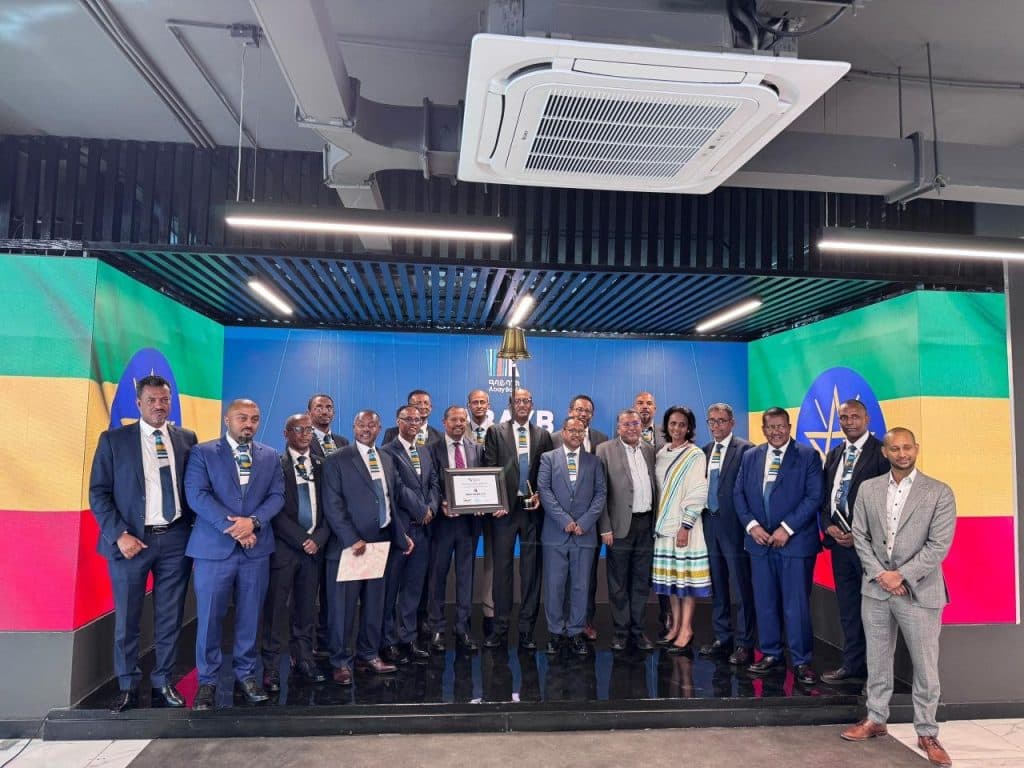
Abay Bank became the fifth name on the exchange.
Abay Bank listed on the Ethiopian Securities Exchange this week, marked with the now-familiar bell-ringing ceremony, with shares trading at around ETB 1,800 on the Neway app on day one. Deloitte advised on the transaction. Two details are worth pausing on. First, the bank says roughly 70% of its transactions already run through digital channels, a listing on a digital exchange is just the next logical surface for a bank that has already moved most of its business onto a screen. Second, ESX CEO Dr. Tilahun Kassahun was candid that the exchange’s real constraint isn’t supply but participation: getting more Ethiopians through the front door is what turns a list of names into a liquid market. He still expects 10 to 12 companies to list over the next year, and reminded everyone the exchange can throttle wild price swings through volatility controls when it needs to.
And the sixth is already in the pipeline.
The Ethiopian Capital Market Authority registered Bunna Bank’s securities, 61.9 million existing shares plus 2.59 million new ones approved for offer to current shareholders, under the 2024 securities directive. ECMA was careful to stress that registration is not an endorsement, just a formal step. But that’s exactly the point. The equity market is no longer a one-off event; it’s becoming a process with a queue. Wegagen, Gadaa, Ethio Telecom, Awash, now Abay, with Bunna lining up behind them. Each registration is one more company choosing to raise money from the public instead of borrowing it from a bank, which is the whole reason a capital market exists.
Islamic & Development Finance
Zemen Bank opened a new lane: interest-free banking, at scale.
Zemen launched Z-Qamar, its full Sharia-compliant banking service, rolling it out across all 142 branches through dedicated windows and standalone outlets. CEO Dereje Zebene framed it not as a product but as “the next chapter of a 17-year journey,” built over two years of governance and compliance groundwork and modeled on interest-free banking in Pakistan, the UAE, and Nigeria. The bank is targeting 10,000 customers in year one and billions of birr in deposits over the next two to three. Read it alongside everything else this week and the logic is clear: interest-free finance is a pool of savings that conventional banking has historically left on the table. In a country scrambling for deposits to lend, that’s not a niche. It’s a frontier.
The Development Bank wants to raise money the new way, too.
Appearing before Parliament for its nine-month review, DBE President Esayas Kassa (PhD) said the state lender plans to issue green bonds and Sharia-compliant sukuk in the coming fiscal year. The why matters more than the what: since December 2025, the old mechanism that forced commercial banks, insurers, and pension funds to buy DBE bonds has been phased out. That was a captive, guaranteed source of funding, and it’s gone. So the policy bank is rebuilding its model from scratch, recapitalization, harder loan recovery, external financing, a push for Green Climate Fund accreditation, and a pivot to the capital market it once sidestepped. A development bank that used to be handed its funding now has to go out and earn it. Sukuk and green bonds are how it plans to.
Money & Markets
The FX auction cooled, and that’s the good news.
The National Bank ran its 24th special foreign exchange auction, selling USD 100 million that cleared at 157 birr to the dollar, a touch below the 158 of the previous round. The more telling figure is demand: banks bid USD 160.5 million, down sharply from USD 236.3 million two weeks earlier, with the bid-to-cover ratio falling from 2.36 to 1.6 and fewer banks showing up. Easing demand and a slightly stronger birr suggest the FX squeeze is loosening, at least for now. The auction itself, routine, repeatable, predictable, remains the quiet workhorse of the post-2024 reform: a market mechanism doing the job the black market used to.
Binance is back. The birr is not.
After reports that Binance had “returned” to Ethiopia via Ethio Telecom following regulatory talks, the exchange clarified the part that actually matters to users: birr-denominated trading remains unavailable. Platform access has been restored, but the early-2026 National Bank directive declaring ETB-paired peer-to-peer crypto transactions illegal is still in force, and the birr is still the country’s only legal tender for these purposes. Treat it as technical re-engagement, not a policy U-turn. The throughline connects to the FX story above: P2P crypto had become an unofficial parallel exchange rate, a leak in the currency-control system the reform is built to seal. Reopening the app while keeping the birr off it is the regulator trying to have innovation without the leak.
Macro & Funding
Parliament signed for USD 600 million from the World Bank.
In a special Friday session, lawmakers approved a USD 600 million concessional IDA loan — part of a larger USD 1.45 billion World Bank package that also includes USD 850 million in grants, USD 200 million of it through the Crisis Response Window. The terms are about as soft as sovereign borrowing gets: interest-free, a 0.75% annual service charge, a 31-year repayment runway, and a six-year grace period. The proceeds go straight into the federal treasury to finance the budget, supporting reforms across public finance, social protection, energy, and agricultural input markets. With roughly 17% of the 2.34-trillion-birr budget pencilled in from foreign grants and loans, this isn’t a bonus. It’s a line item the budget is built to depend on.
And the Council reached for a different lender entirely.
The same week it leaned on Washington, the Council of Ministers approved a draft proclamation for Ethiopia to join the New Development Bank, the BRICS-founded, Shanghai-headquartered lender and forwarded it to Parliament. Ethiopia, a BRICS member since January 2024, would become the fourth African shareholder after South Africa, Egypt, and Algeria, opening another channel for infrastructure and development finance. The framing in the Council’s own language was telling: diversifying external financing and reducing dependence on limited funding channels. Put the two stories side by side and you have the whole strategy in miniature. A World Bank loan and a BRICS bank application, approved within days of each other, by a government that has decided it would rather not have to choose.
Energy & Infrastructure
Three cities are getting their grids rebuilt.
The Ethiopian Electric Utility signed a 3-billion-birr agreement to rehabilitate and modernize power distribution networks in Ambo, Nekemte, and Assosa, with World Bank backing through a blended structure of about 1.2 billion birr in local currency and USD 12 million in foreign exchange, targeting completion in two years. CEO Getu Geremew framed it around the unglamorous goal that actually matters to a business or a household: fewer outages, fewer technical faults, more dependable supply. Ethiopia has spent a decade building generation capacity, the GERD chief among it, but generation is wasted if the distribution network leaks it. This is money spent on the last mile, where the power either reaches the customer or doesn’t.
Business
The lawyers consolidated for the deals to come.
Four of Ethiopia’s established firms, Tameru Wondim Agegnehu & Partners, Mesfin Tafesse & Associates, Mekdes & Associates, and Hanna Mulugeta Law Office, merged to form Taza Legal LLP, launched at the Commercial Bank of Ethiopia’s headquarters. The combined firm opens with seven partners, more than 20 professionals, over a century of pooled experience, and a seat as Ethiopia’s member of the African Legal Network across 15 markets. Managing partner Mesfin Tafesse and senior partner Tameru Wondim Agegnehu pitched it as a bet on institutions over individuals, the future of Ethiopian law belonging to firms that outlast their founders. It’s also a bet on deal flow. M&A, project finance, banking, energy, cross-border investment: these are exactly the practice areas that light up when an economy opens its financial sector and stands up a stock exchange. The market this newsletter covers is, quietly, creating its own supporting industries. The law firm is one of them.
🎙️ One more thing.
🎙 Episode 3 is live.
From the biggest business and finance stories of the week to a deeper conversation on Ethiopia’s investment culture, we explore how people save, invest, take risks, and think about wealth creation. As Ethiopia’s financial landscape evolves, building an investment culture may be just as important as building the market itself.
Watch here
That’s your Monday Breakfast Stories for this week. A fifth listing and a sixth in the queue, a new lane for interest-free finance, a development bank reinventing how it raises money, a World Bank loan and a BRICS bank application signed within days of each other, three city grids getting rebuilt, and a law firm built for the deals all of it will generate. The connecting thread isn’t any single milestone. It’s a country teaching itself to raise money from every direction at once, east and west, faith-based and market-based, public and private, because the reform it has committed to is expensive, and the bills don’t wait.
Keep your coffee strong. See you next Monday. ☕