


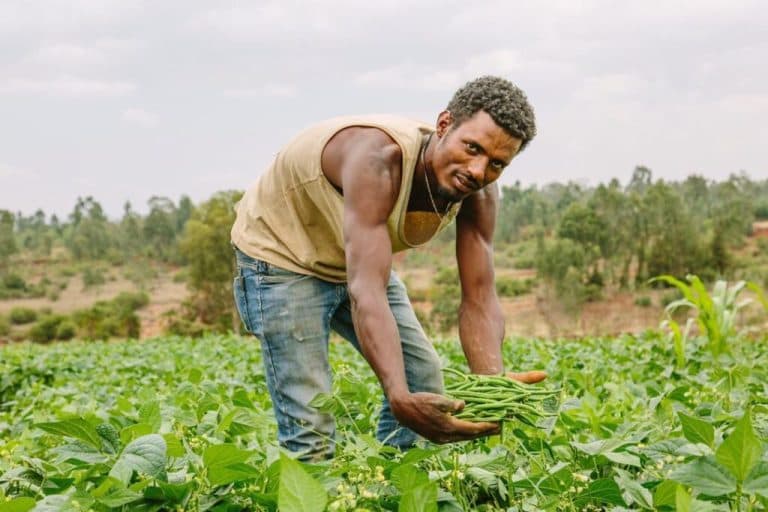
At sunrise in rural Ethiopia, millions of farmers step onto their land, the same land that feeds the country, fuels its exports, and anchors its economy. Agriculture is not just a sector here; it is the system.
And yet, behind this familiar image lies a less visible reality: the very sector that sustains Ethiopia is itself starved of one critical resource, finance.
A new report by the Ministry of Finance Ethiopia tells a story that is hard to ignore. In the 2023/24 fiscal year, Ethiopia’s agricultural sector, responsible for nearly a third of GDP, employing almost two-thirds of the population, and generating close to 80 percent of export earnings, received just 2 percent of the credit it actually needs.
The number is not just small. It is staggering.
At first glance, the data seems less alarming. Banks, after all, have been lending to agriculture. Between 2020 and 2025, about 8 percent of total loans went to the sector and even more, if you include a major government-backed fertilizer financing program.
But that’s where the illusion begins.
Nearly 70 percent of all agricultural lending in 2023/24 came from a single channel: a fertilizer financing scheme run by the Commercial Bank of Ethiopia. Strip that away, and what remains is a thin, stagnant stream of credit, barely reaching farmers, agribusinesses, or the broader value chain.
In other words, much of what looks like “agricultural finance” is not financing production, innovation, or growth. It is simply financing inputs.
And that distinction matters.
What makes this story more striking is the timing.
Ethiopia is in the middle of one of its most ambitious economic reform programs in recent history. Credit is expanding. Private sector lending is rising. Small and medium enterprises are seeing unprecedented growth in access to finance.
By many measures, the financial system is becoming more dynamic, more inclusive, and more responsive.
Just not for agriculture.
While total domestic credit grew by over 23 percent in 2024/25, and SME lending nearly doubled, the sector that employs the majority of Ethiopians has remained largely on the sidelines of this transformation.
It is a quiet divergence, one that risks turning into a structural fault line.
This is not just a banking issue. It is an economic one.
Without access to finance, farmers cannot invest in better inputs, irrigation, or technology. Agribusinesses cannot expand. Supply chains remain fragmented. Value addition, the very thing Ethiopia needs to boost exports and stabilize foreign exchange, remains limited.
The result is a cycle that reinforces itself: low productivity leads to low income, which leads to low bankability, which leads to even less access to credit.
Breaking that cycle requires more than growth. It requires direction.
Part of the problem lies in how the financial system is structured.
Traditional bank lending in Ethiopia, like in many developing economies, depends heavily on fixed collateral, land titles, buildings, and other immovable assets. But most smallholder farmers and rural businesses simply do not have these.
So even when liquidity exists in the banking system, it does not flow to where it is most needed.
The Ministry’s report points to emerging solutions: digital lending platforms, movable collateral frameworks, and financial innovations that could allow crops, equipment, or warehouse receipts to serve as collateral.
These are not just technical fixes. They represent a shift in how the system understands risk.
Ethiopia’s reform agenda has already reshaped parts of the economy, from exchange rate policy to private sector participation. But agriculture remains one of its biggest unresolved challenges.
And perhaps its biggest opportunity.
Because closing the agricultural credit gap is not just about fairness. It is about unlocking growth where it matters most, in rural incomes, food security, and export diversification.
The Ministry of Finance does not frame this as a minor imbalance. It calls it what it is: a structural problem.
One that sits at the heart of Ethiopia’s economic future.
The numbers tell a clear story. A sector that generates 32 percent of GDP and employs 64 percent of the population cannot sustainably operate on 2 percent of its credit needs.
The deeper question is whether the financial system can evolve fast enough to match the realities of the economy it serves.
Because in Ethiopia today, the backbone of the economy is still waiting for the system to catch up.



Comments