


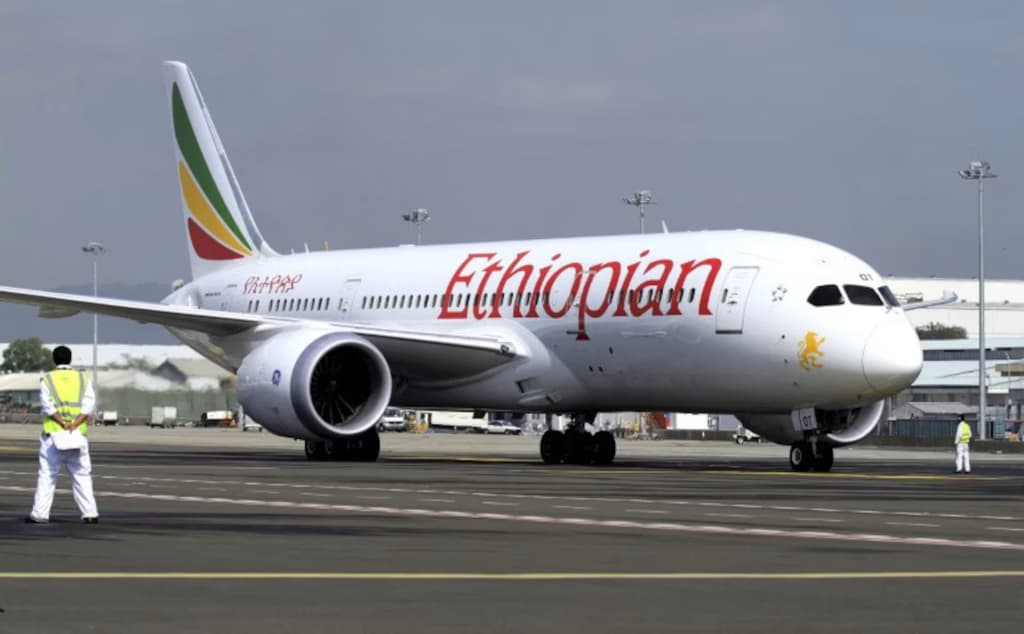
Ethiopian Airlines says it is losing up to $13.5 million in revenue per week after suspending flights to multiple destinations in the Middle East following the recent conflict involving the United States, Israel, and Iran.
The disruption has forced Africa’s largest airline to cancel flights to ten destinations across the region, significantly affecting both passenger and cargo operations. According to the airline’s Chief Commercial Officer, Lemma Yadecha, the conflict has already caused noticeable financial strain as airspace restrictions and safety concerns continue to affect aviation activity.
Before the outbreak of the conflict, Ethiopian Airlines operated three daily flights to Dubai and one to Sharjah, alongside three daily flights to Israel and one to Abu Dhabi. Currently, operations have been reduced significantly, with the airline maintaining only two daily flights to Amman.
As a result of the disruptions, the airline is canceling an average of 15 flights per day, which translates to more than 101 passenger flights per week. When cargo services are included, the total number of canceled flights rises to around 160 weekly flights.
The airline typically transports between 45,000 and 50,000 passengers per week on Middle East routes, making the suspension particularly costly. Lemma noted that passenger traffic alone accounts for most of the weekly revenue loss, estimated at around $13.5 million, while cargo services could add up to $2 million in additional losses.
However, the airline emphasized that the headline figures do not necessarily represent the final financial impact. Ethiopian Airlines has begun redeploying aircraft originally assigned to Middle East routes to other destinations in an effort to recover some of the lost revenue.
“We used to earn revenue by transporting passengers and cargo on these routes,” Lemma explained. “When those operations stop, the immediate effect is a loss of income. But we are working to shift aircraft to other markets to mitigate the impact.”
Beyond lost ticket sales, the airline also warned that the conflict could increase operational costs across the aviation industry. The Middle East remains a major global oil-producing region, and any escalation in the conflict could lead to higher fuel prices, which would further pressure airline profitability.
The disruption comes as air travel across the Middle East faces significant uncertainty. Airspace closures and security concerns have already stranded thousands of passengers and forced airlines worldwide to reroute or cancel flights.
Industry experts say that if the conflict persists or spreads to Gulf countries, global aviation routes connecting Europe, Africa, and Asia could face prolonged disruption.
For now, Ethiopian Airlines says it hopes the situation stabilizes soon so normal operations to the Middle East can resume. Until then, the airline plans to continue adjusting its network and reallocating aircraft to other routes to cushion the financial impact.
Source: BBC Amharic



Comments